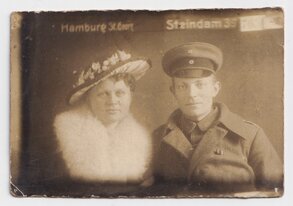
This portrait photograph shows the couple Else (née Megies, 1892–1961) and Carsten Friedrichsen (1895–1937) in the spring of 1919. The couple is seated in half-length portraits facing the camera; in the background, at the top of the image, the inscription “Hamburg St. Georg, Steindam 39” and a number are visible. Carsten Friedrichsen is wearing a uniform with a World War I wounded badge; Else Friedrichsen is wearing a dark coat with a strikingly light-colored fur collar and a wide-brimmed hat decorated with flowers. The 6×4 cm miniature photograph was taken in the studio of the Dutch photographer Jonas Sanders (1874–1957). He had founded the studio named after him at Steindamm 39 in 1912. He was one of the first to introduce the innovative, so-called “stickyback” photography to the Hanseatic city. By using more modern camera technology, which made it possible to capture several small photos of different people on a single large glass plate, the time-consuming and costly production process of photography could be significantly reduced. The numbering placed in the background of the photographed individuals served to identify them for the respective customer. Also notable is the Dutch spelling of the address “Steindam.” The images were typically developed in sets of nine to twelve on a large sheet of bromide silver paper, which could later be cut into individual photos.
The portrait photograph presented here is one of many examples of the fragmentary and unsystematic preservation of family photographs. A closer examination of the context in which it was taken allows for an analysis of the structural changes in portrait photography during the 1910s and 1920s, a topic that has received little research attention to date. The subsequent history of the studio where the photo was taken, in turn, serves as an example of the persecution of a Jewish business in Hamburg during the Nazi era.
At the beginning of the twentieth century, professional photography already looked back on a history of nearly 70 years. At the same time, photographic methods had hardly evolved during this period, and photography was accessible only to a wealthy circle. It was not until the introduction of novel photographic techniques that this would change and photography would become a mass medium.
One of these techniques was stickyback photography In German: “Leimrücken”, which first emerged under this name in 1907 on the British Isle of Man. There, the Liverpool-born photographer Spiridione Grossi practiced a new photographic technique that allowed multiple images of different people to be captured on a single large glass plate. A label was affixed to the background behind the customers being photographed, which typically listed the studio’s address and the serial number of the photograph. This served to identify the individuals in the photograph on the plate and simultaneously fulfilled an advertising purpose.
Customers were allowed to press the shutter button themselves, which introduced a degree of automation and, in a sense, served as a precursor to today’s “selfie.” Using the slide process, nine to twelve prints of the photos were developed on coated bromide-silver paper. Thanks to the adhesive backing, the photos could first be cut out and then pasted into an album. Starting in the early 1910s, many photographers discovered this affordable photographic technique for themselves, and it quickly spread throughout Europe.
A studio utilizing the new technology opened in 1912 at Steindamm 39 in Hamburg-St. Georg. Dutch goldsmith Jonas Sanders, born in 1874 in Dirksland, was one of the first to bring the new technology to the Hanseatic city. Together with his wife Vogelina (1868–1946) and their children David (1897–1973) and Antje (1905–2008), he moved into an apartment at Steindamm 58. The studio grew rapidly in its early days, allowing Jonas Sanders to hire several employees soon after. These included two full-time photographers, a lab technician, and an errand boy. In the mid-1910s, other studios of this kind emerged in Hamburg alongside Sanders’, and similar photographs exist from them. They were located on Hamburger Strasse and Mönckebergstrasse, among other places. However, the available sources regarding these studios are extremely scarce. In particular, there are hardly any contemporary sources regarding the studios run by Sanders and Eugen Ungar (1879–1957) – the latter operated the studio on Mönckebergstrasse and was also of Jewish descent. The available information stems largely from restitution files, which, due to their specific context of origin, shed light on only certain historical aspects from a particular perspective.
One of Jonas Sanders’s permanent employees was the Dutchman Willem van Kalker (1893–1964), who had worked as a photographer since the studio’s establishment. In 1917, Sanders and van Kalker founded a general partnership under the name “Sanders & van Kalker offene Handelsgesellschaft[General Partnership].” The business premises and an additional studio were located at Grosser Burstah 51. A year earlier, Sanders had already founded “Schnellphoto Germania Gesellschaft mit beschränkter Haftung [Ltd.]” together with his guild colleague Christian Georg Westerich. Sanders also operated a “Photographie-Atelier” Hamburger Adressbuch 1925, p. 481, online at: https://resolver.sub.uni-hamburg.de/kitodo/PPN773134158_1925/page/1827 with Westerich, which was located at Schulterblatt 106. No records of the two companies have survived to this day. Nevertheless, Sanders’ various activities suggest that his business flourished greatly in the beginning.
The portrait photograph described above was also taken at this time. It exemplifies how the simplification of photography increasingly led to it evolving into a mass medium. The photograph of the Friedrichsen couple also demonstrates that the photo studio must have been known beyond Hamburg’s city gates. The Friedrichsens lived in Bredstedt, over 100 km away, and they were likely in the city only to visit relatives.
The general partnership lasted only a few years. It was dissolved as early as 1925, as van Kalker left “on friendly terms.” StAHH, 351-11 Amt für Wiedergutmachung, 19859, fol. 22. After separating from his wife, Sanders himself had decided to return to the Netherlands to resume his former profession as a goldsmith. Five years earlier, he had already transferred full management of the studio on Steindamm to his son David, who had also learned the craft of photography.
David Sanders continued to expand the studio’s business operations. Various newspaper advertisements indicate that the business was no longer limited to taking photographs but also sold photographic and technical supplies. The advent of the “Photomaton,” a photo booth invented by Anatol Josepho, increasingly replaced stickyback photography. For this reason, David Sanders focused primarily on simple portrait photos required for ID cards and passports. Willem van Kalker, who remained in contact with the Sanders family, later reported on the immense influx of customers at the photo studio: “Mr. Sanders did not produce artistic photographic portraits; instead, he relied on producing photographic images en masse. His clientele included not only the residents of Steindamm; it was a well-known business throughout the city […].“ StAHH, 351-11 Amt für Wiedergutmachung, 19859, fol. 48f. At that time, the shop was open daily, even on Sundays. A newspaper advertisement from 1926 Hamburger Echo vom 30.01.1926, S. 2, online at: https://resolver.sub.uni-hamburg.de/kitodo/PPN1754726119_19260130/page/2 reveals that Sanders charged 40 pfennigs for a dozen ID photos. This allowed him to build a large customer base and keep prices low.
Despite all this, the studio remained relatively small and did not generate the high profits recorded, for example, by Eugen Ungar’s studio. With its prominent location on Mönckebergstrasse, Ungar earned at least four times as much as Sanders. Nevertheless, the Sanders photo studio managed to survive for many years coexisting alongside eight other studios on Steindamm, while other businesses constantly changed owners and locations.
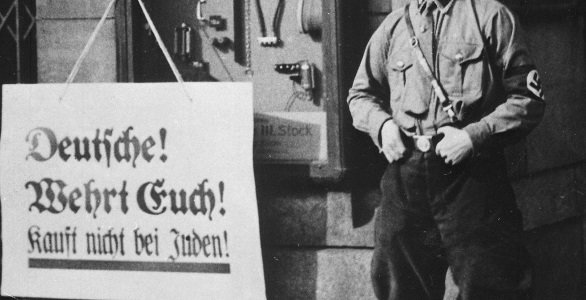
Immediately after Hitler came to power, violent attacks by the Sturmabteilung (SA) against Jewish businesses took place throughout Hamburg. David Sanders also fell victim to such an attack in May 1934. One Sunday morning, several SA men marched into his shop, smashed the display windows, and assaulted him with kicks and punches to the back and face. Sanders reportedly “managed to alert passersby, who then called the police” StAHH, 351-11 Amt für Wiedergutmachung, 19859, fol. 2.. The next day, Willem van Kalker visited him at his apartment together with the Dutch consul. The consul advised Sanders to “leave immediately under any circumstances, as he could expect to be arrested at any moment and also deported as an undesirable alien” StAHH, 351-11 Amt für Wiedergutmachung, 19859, fol. 29.. Sanders followed this advice and fled to Amsterdam. His companion, Alwin Ollenburg, later reported that conversation with Sanders during the journey had been nearly impossible, as he was suffering so greatly from the persecution.
David Sanders’ fiancée, Emma Luise (née Wilken) (1901–?), who worked as an employee at the telephone exchange, initially remained in Hamburg. However, during a visit to Amsterdam in May 1937, she was denounced to the personnel department of the post office. Since she had been warned, Wilken remained in the Netherlands. In September 1937, she married David Sanders. He opened a photography studio in Amsterdam, but the invasion of German troops forced the couple to flee once again in 1940. Via London, they made their way to Batavia (now Jakarta). There, too, Sanders opened a photography studio, but the couple was taken prisoner of war in 1942 following the Japanese invasion. During this time, Emma Sanders in particular suffered from diphtheria, malaria, and bubonic plague. After their release from captivity in April 1946, they emigrated to Wellington, New Zealand. There, David Sanders opened his final photography studio, where he worked alongside his wife. Both suffered until their deaths from the long-term effects of their persecution and the conditions in the prisoner-of-war camps. David Sanders died in Lugano, Switzerland, in 1973.
After Sanders fled, the photo studio on Steindamm in Hamburg was run for a short time by Willem van Kalker and his colleague Hans Heine. In 1937, however, van Kalker also emigrated and established a new life for himself in Cape Town. The studio’s subsequent history is unknown. The building at Steindamm 39 was likely completely destroyed during the large-scale air raids on Hamburg in July and August 1943.
The analysis of the portrait photograph from the Sanders Photo Studio exemplifies the transformation of photographic practice in the early twentieth century. Through contextualization, it becomes evident that technical innovations such as stickyback photography enabled a significant simplification and reduction in cost of photographic processes, allowing various techniques – tailored to the specific needs and financial means of the clients – to coexist. The photograph of the Friedrichsen couple represents the social normalization of photographic portraits in everyday life during the post-World War I era.
On the other hand, the history of the Sanders Photo Studio illustrates the arbitrariness of Nazi persecution of Jewish individuals and businesses, as well as the lifelong consequences suffered by those persecuted. While David Sanders was forced to flee as early as 1934, Eugen Ungar was able to continue operating his studio before he, too, was persecuted by the Nazi state in late 1940 and fled to Buenos Aires. The two studios had not been founded as specifically “Jewish” studios. It was only under the Nazis that they and their operators were persecuted as Jews or “Aryanized.”
The flight and migration of the studio owners, as well as the forced sale of their property and the destruction caused by the air war, have resulted in nothing remaining today to remind us of the studios’ existence. Although photographs from these studios are likely still preserved as a vast source in numerous private photo albums and estates, without a more detailed context they provide little insight into the companies behind them, their work, and their subsequent history.
This work is licensed under a Creative Commons Attribution - Non commercial - No Derivatives 4.0 International License. As long as the material is unedited and you give appropriate credit according to the Recommended Citation, you may reuse and redistribute it in any medium or format for non-commercial purposes.
Hauke Heymann studies history and geography at the University of Hamburg. He works as student assistant at the IGdJ. His research interests are: German-Jewish history, the deportations of Sinti and Roma from Hamburg under National Socialism and working with personal testimonies or ego documents.
Hauke Heymann, Sanders Photo Studio. A Jewish “speed photographer” in Hamburg (translated by Erwin Fink), in: Key Documents of German-Jewish History. <https://keydocuments.net/article/jgo:article-304> [October 17, 2026].
 This work is licensed under a Creative Commons Attribution - Non commercial - No Derivatives 4.0 International License. As long as the material is unedited and you give appropriate credit according to the Recommended Citation, you may reuse and redistribute it in any medium or format for non-commercial purposes.