Given the sheer volume of material just in the underlying digitization project, the selection made here – like any other conceivable selection – is inherently subject to a certain degree of randomness. On the one hand, this has to do with the curators and their research interests; on the other hand, coincidence is a fundamental, albeit often overlooked, factor in working with archival material. The ideal image of an archive is associated with structure, preservation, and permanence. However, despite all efforts to ensure order and completeness, what we find in archives depends on numerous parameters: What has been preserved, by whom and according to what principles was it recorded and organized, in what language is it available, how accessible is it, and, last but not least, what is being searched by whom and how so? The challenge is to accept coincidences not only as a necessary evil, but to integrate them into the knowledge process as opportunities for unexpected discoveries, surprising insights, and previously invisible connections.
Click on the folder-icon for a random entry to the exhibition or scroll down to chapter 1 ...
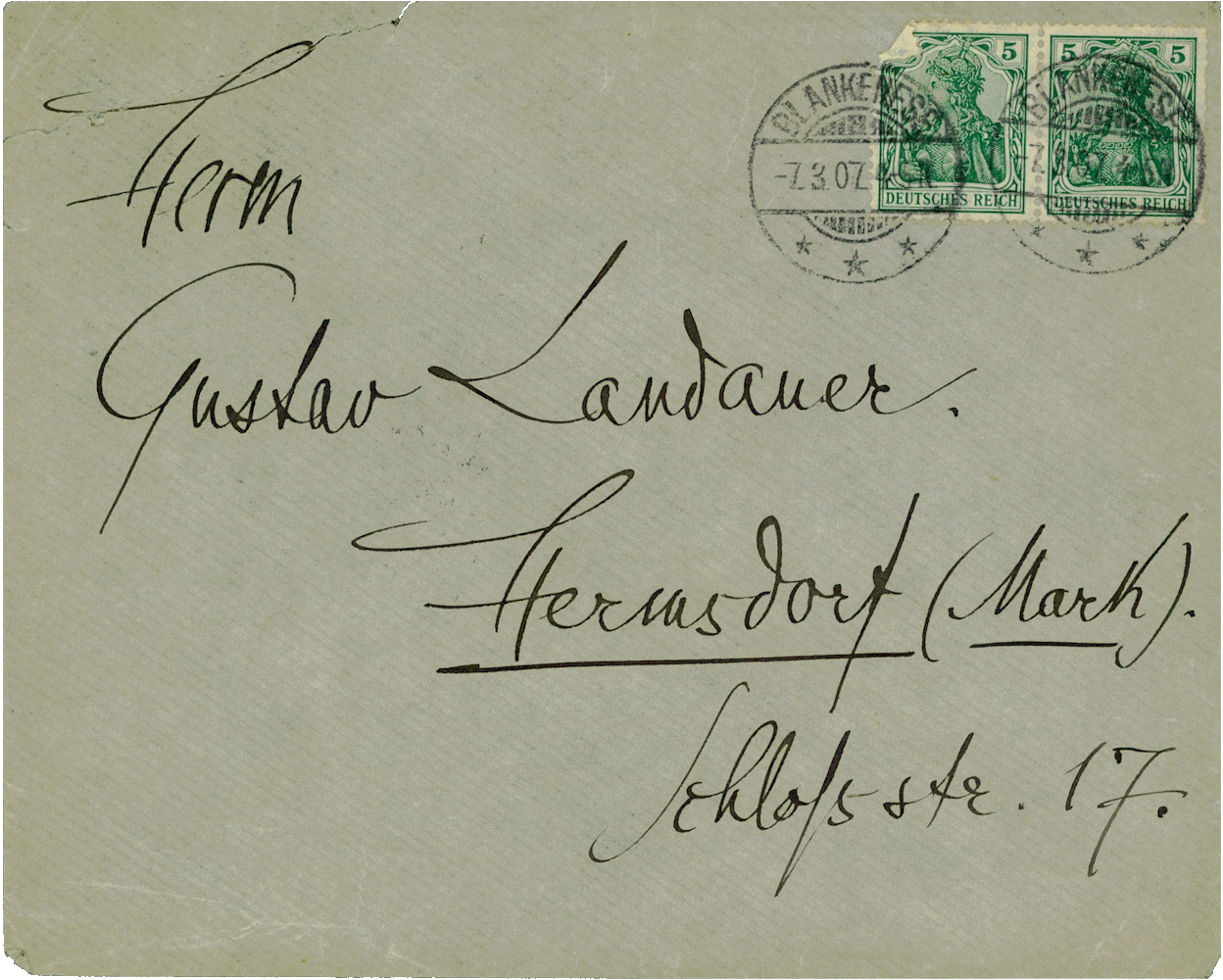
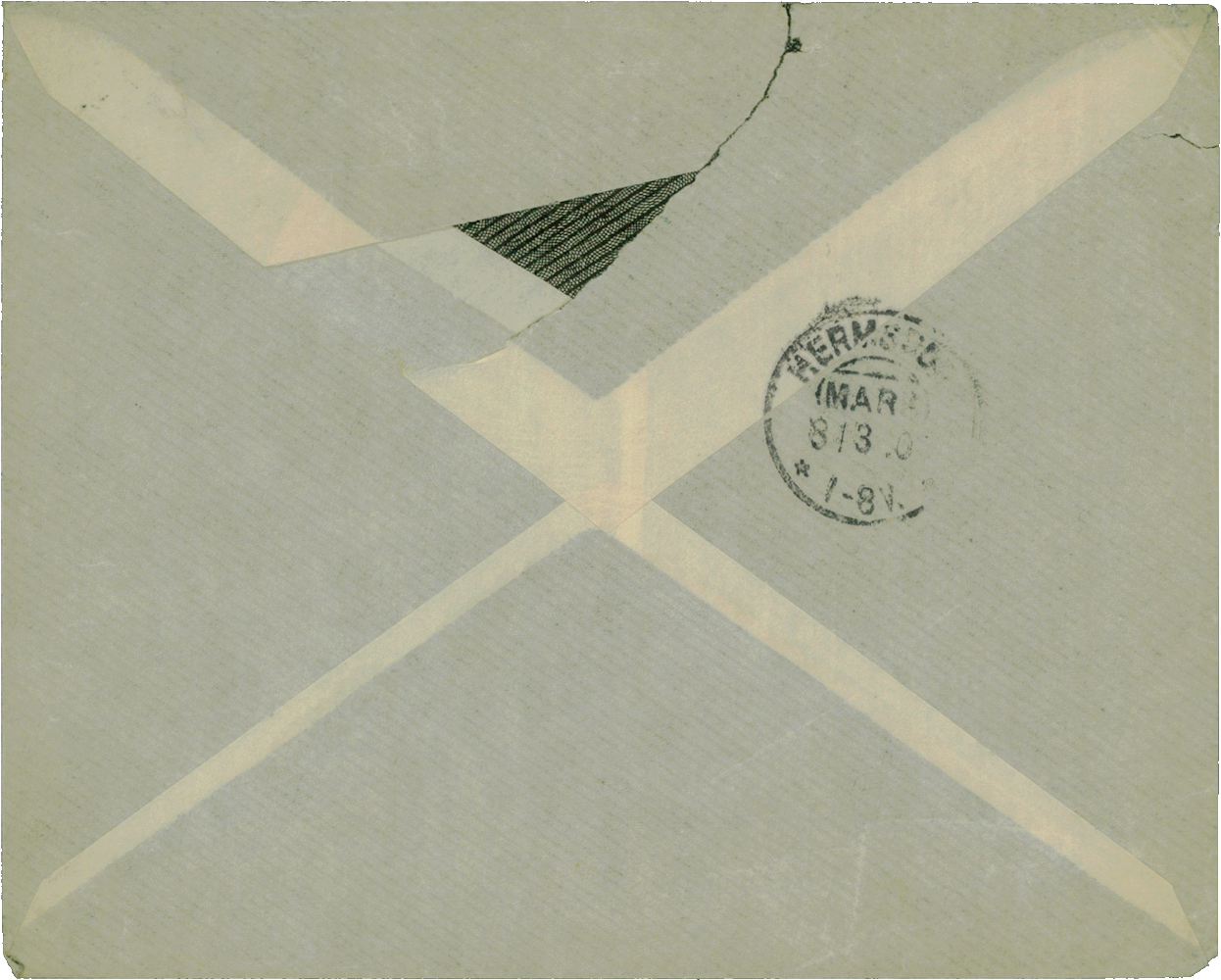
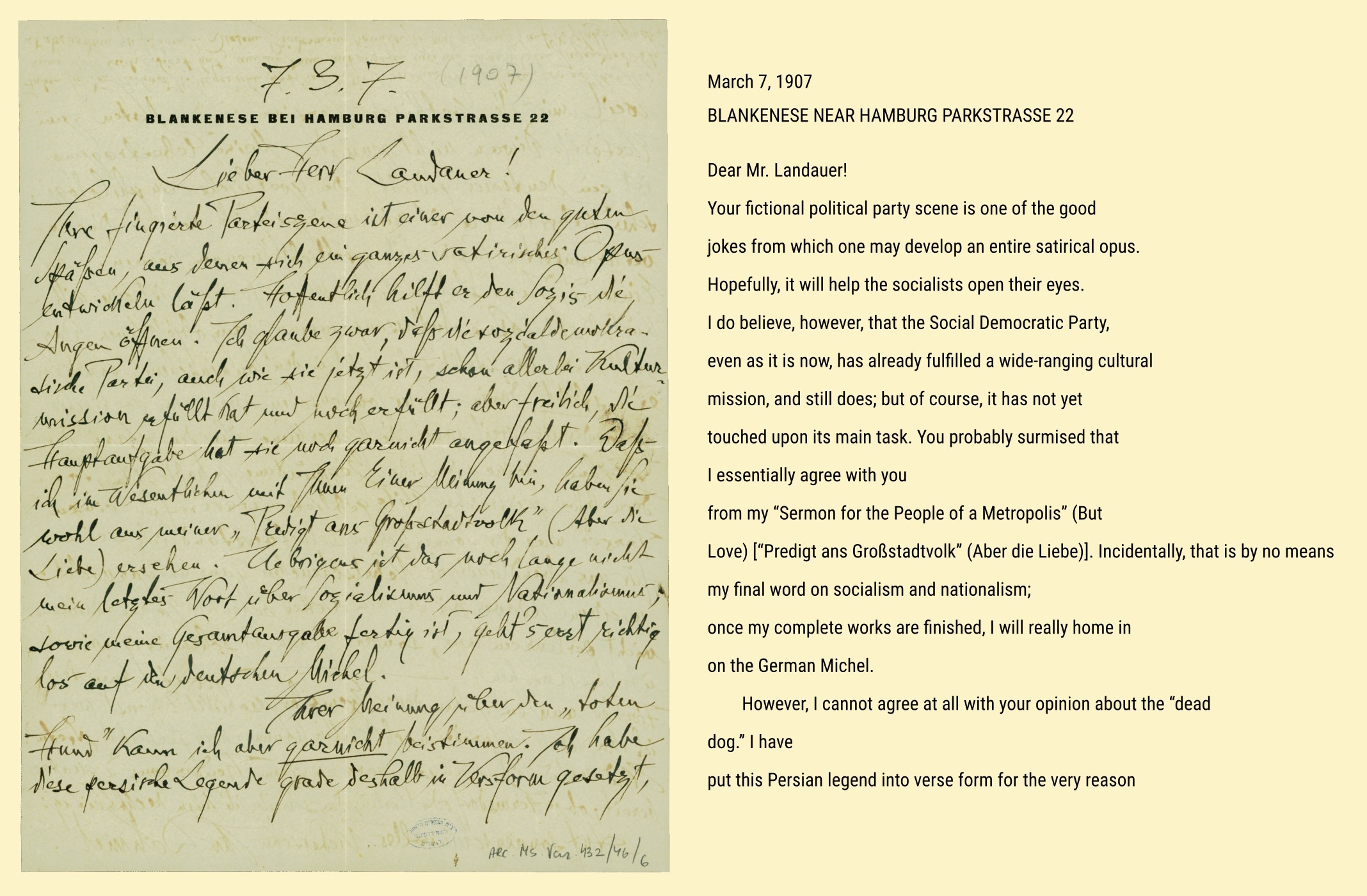
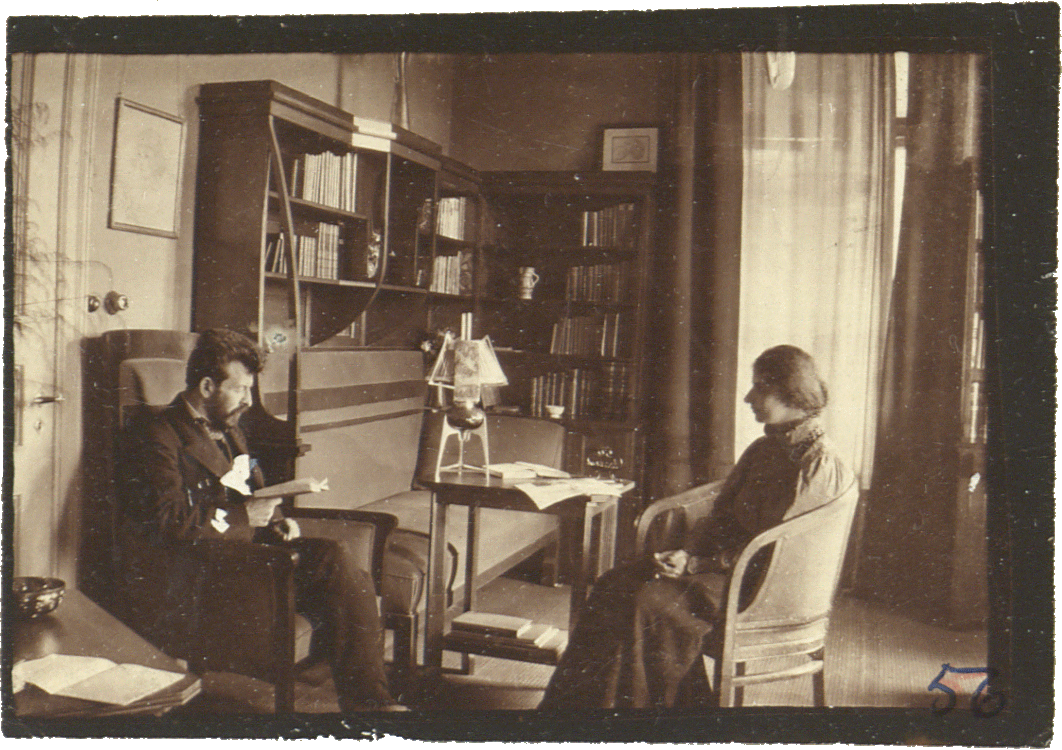
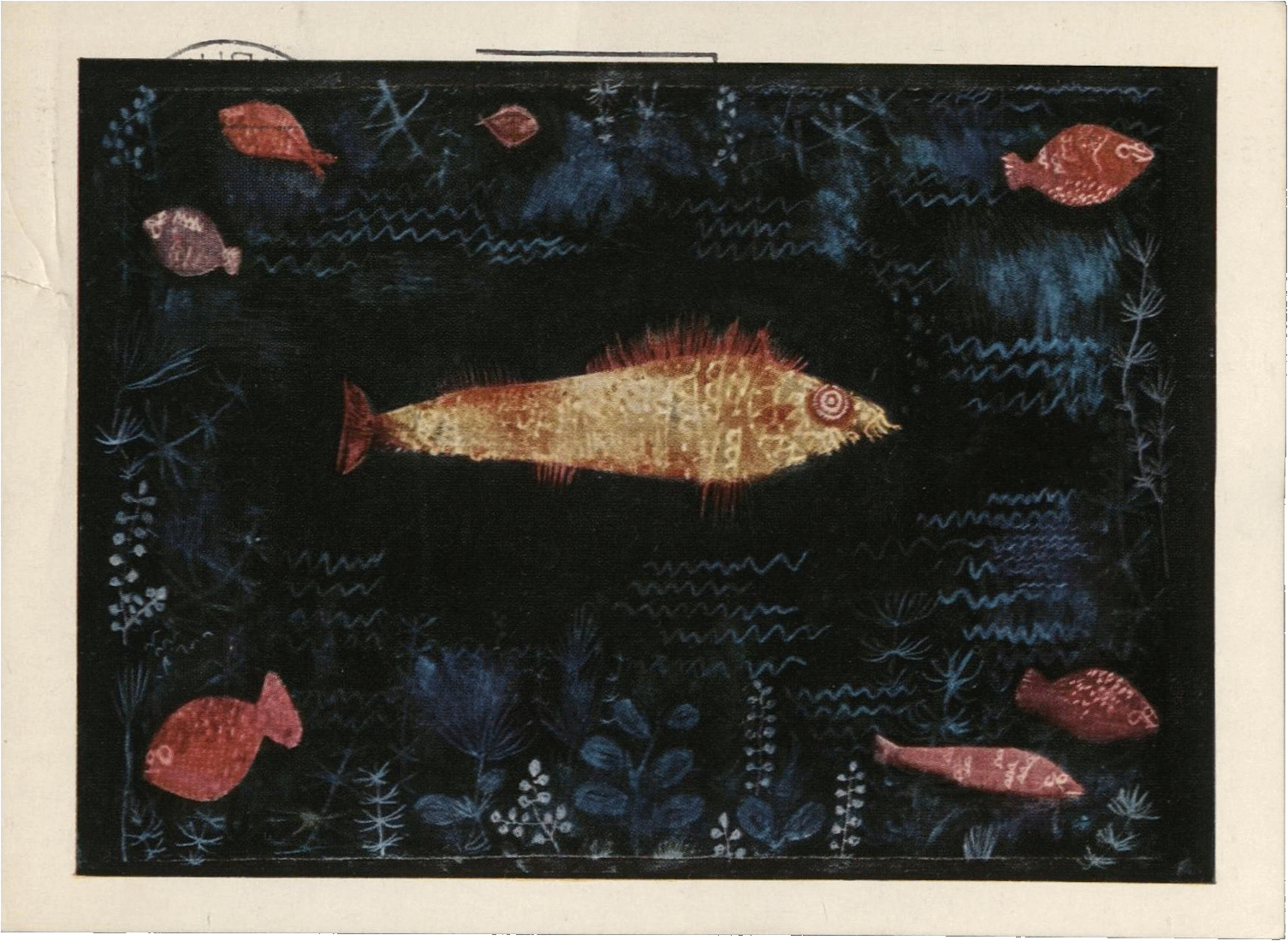
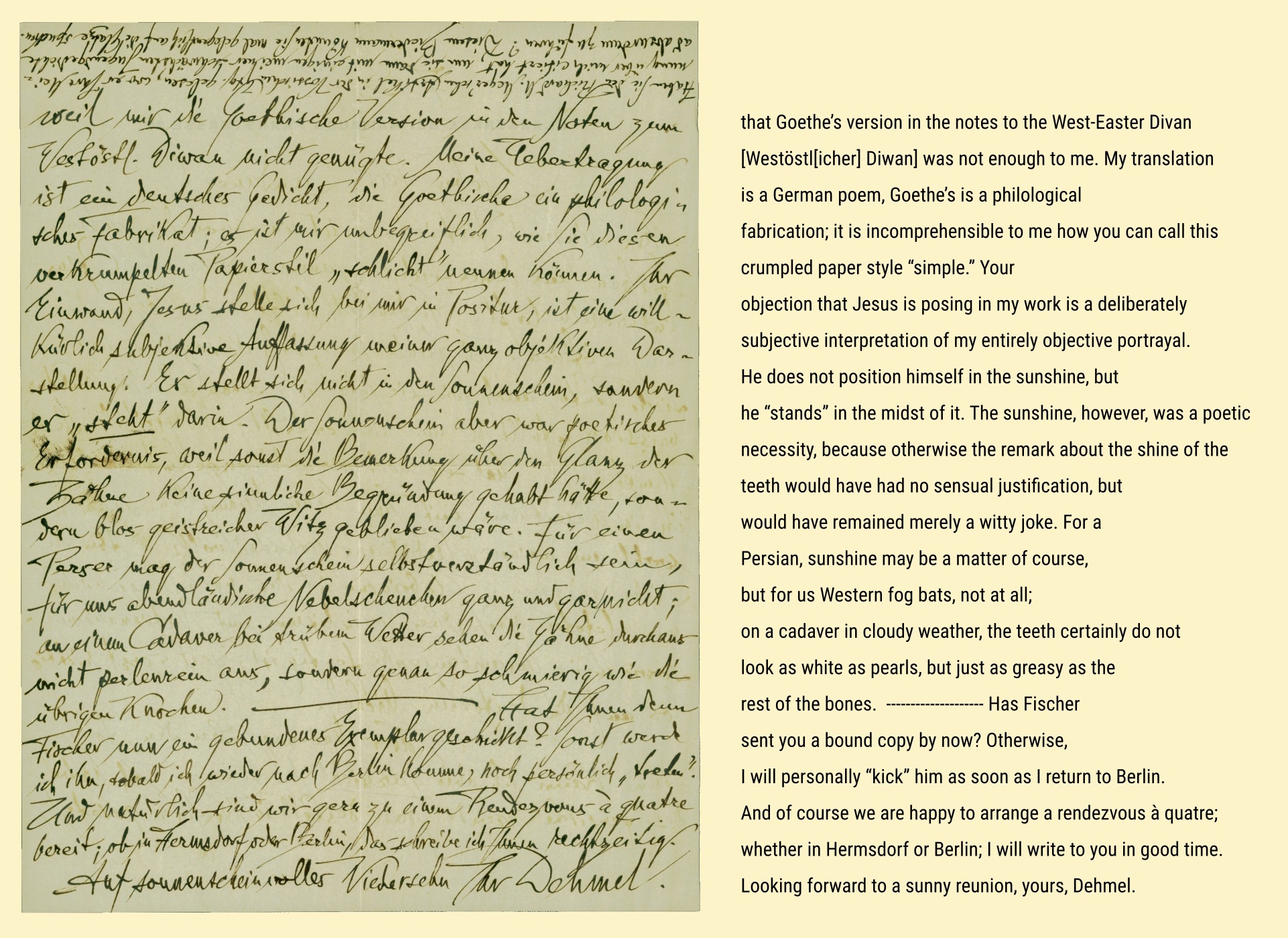
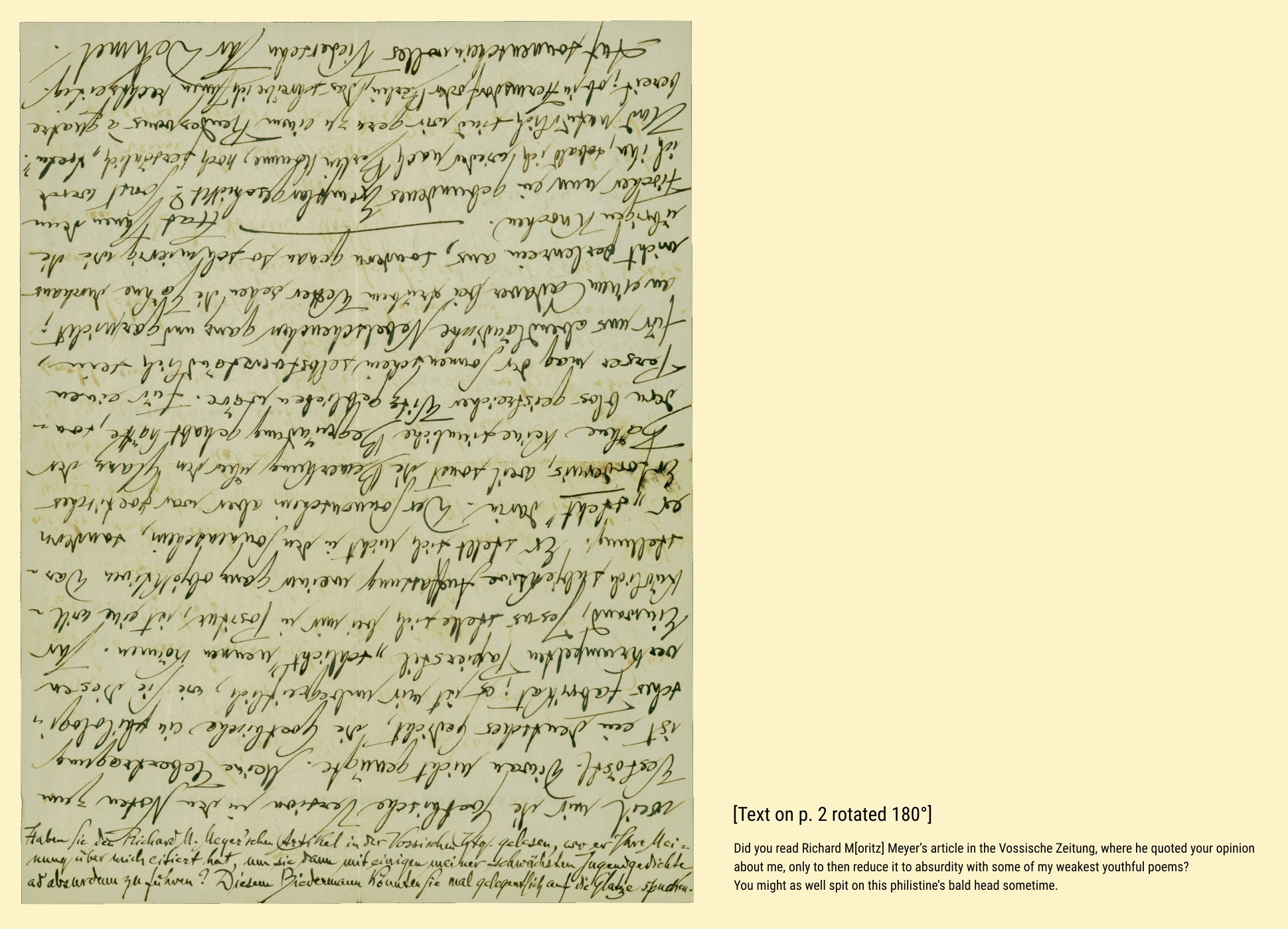
This letter, sent by Richard Dehmel in the spring of 1907 from Blankenese, then an independent municipality near Hamburg, to Gustav Landauer in Hermsdorf near Berlin, provides insights into an intense and intellectually stimulating correspondence between fellow writers. The tone is familiar and sharp-tongued, the topics are diverse and touch on literary as well as political issues. The letter is part of a wide-ranging correspondence network surrounding Richard and Ida Dehmel, whose local center was first their joint apartment at Parkstrasse 22 and later the so-called Dehmel House. Most of the letters are located in the Dehmel Archive at the State and University Library of Hamburg. The fact that the letter shown here is in the Gustav Landauer Archive in Jerusalem constitutes the result of decades of migration history: After Gustav Landauer was murdered in Munich in 1919, the philosopher Martin Buber, who lived in Heppenheim, became the administrator of his estate. Before Buber left Germany in 1938 due to Nazi persecution, he divided the estate into three parts. He took one part with him to Palestine, left another part with his publisher Lambert Schneider in Heidelberg for safekeeping, and had a third part, which included the letter from Richard Dehmel shown here, taken to the US via Switzerland with the help of Landauer’s son-in-law Max Kronstein. From New York, Kronstein’s daughter (and Landauer’s granddaughter) Marianne Lütke handed over the Landauer papers to the Israeli National Library in 1970, where they were reunited with the other two parts and today form the Gustav Landauer Archive. The letter is thus representative not only of the dispersion and incompleteness of archived correspondence, but also of the forced migration movements to which archival material can be subjected, quite independently of the fate of its creators.
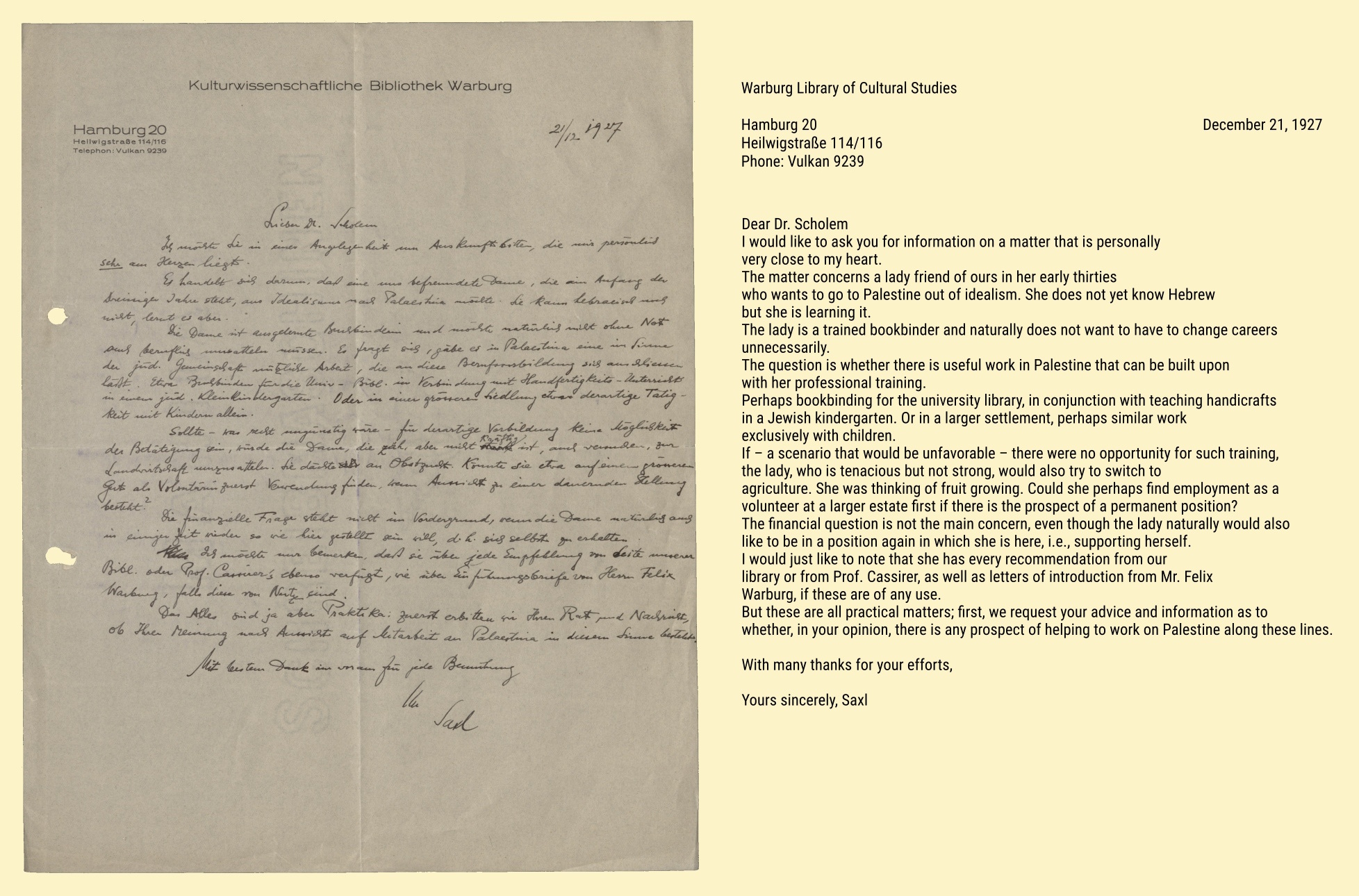
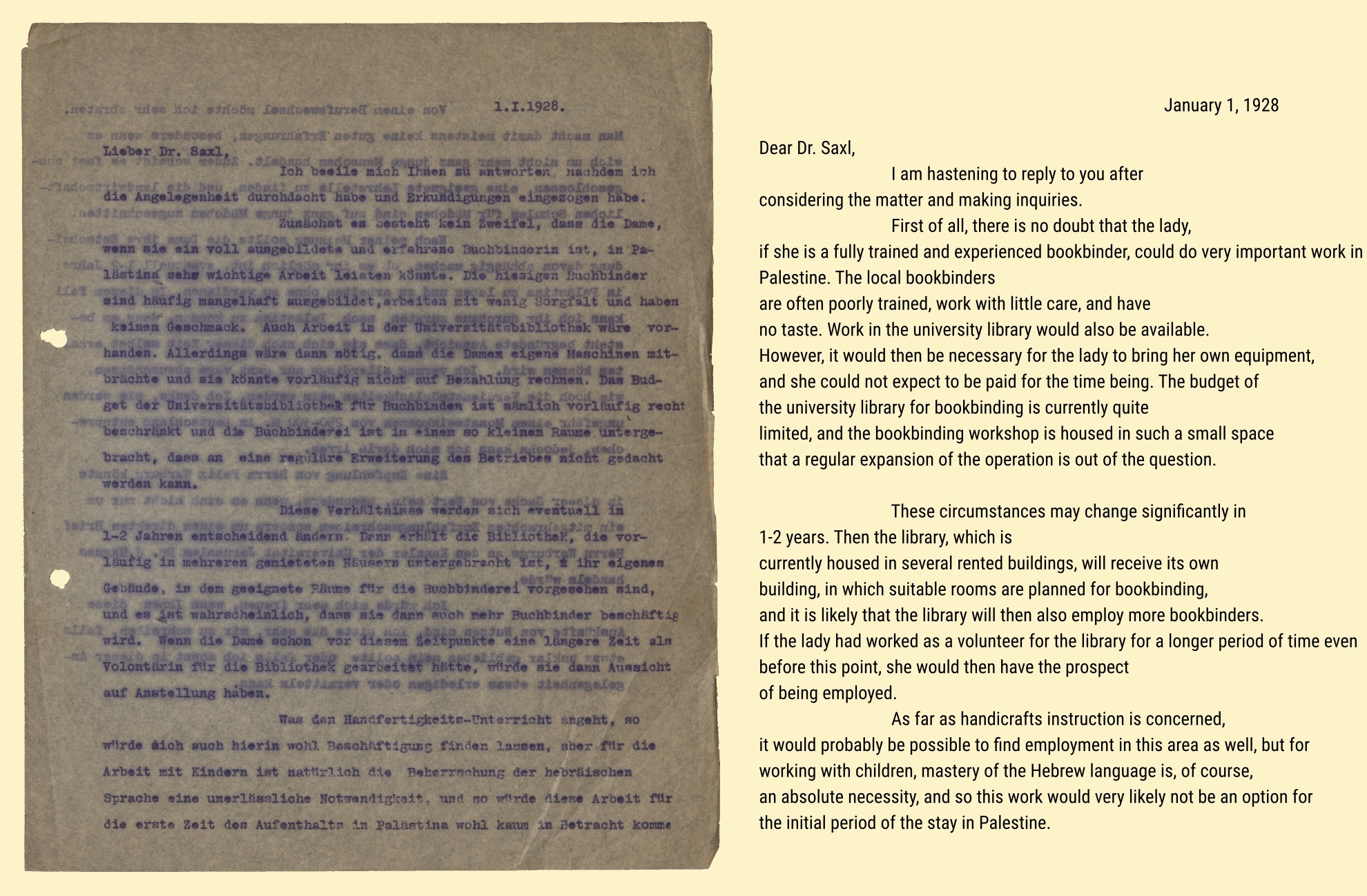
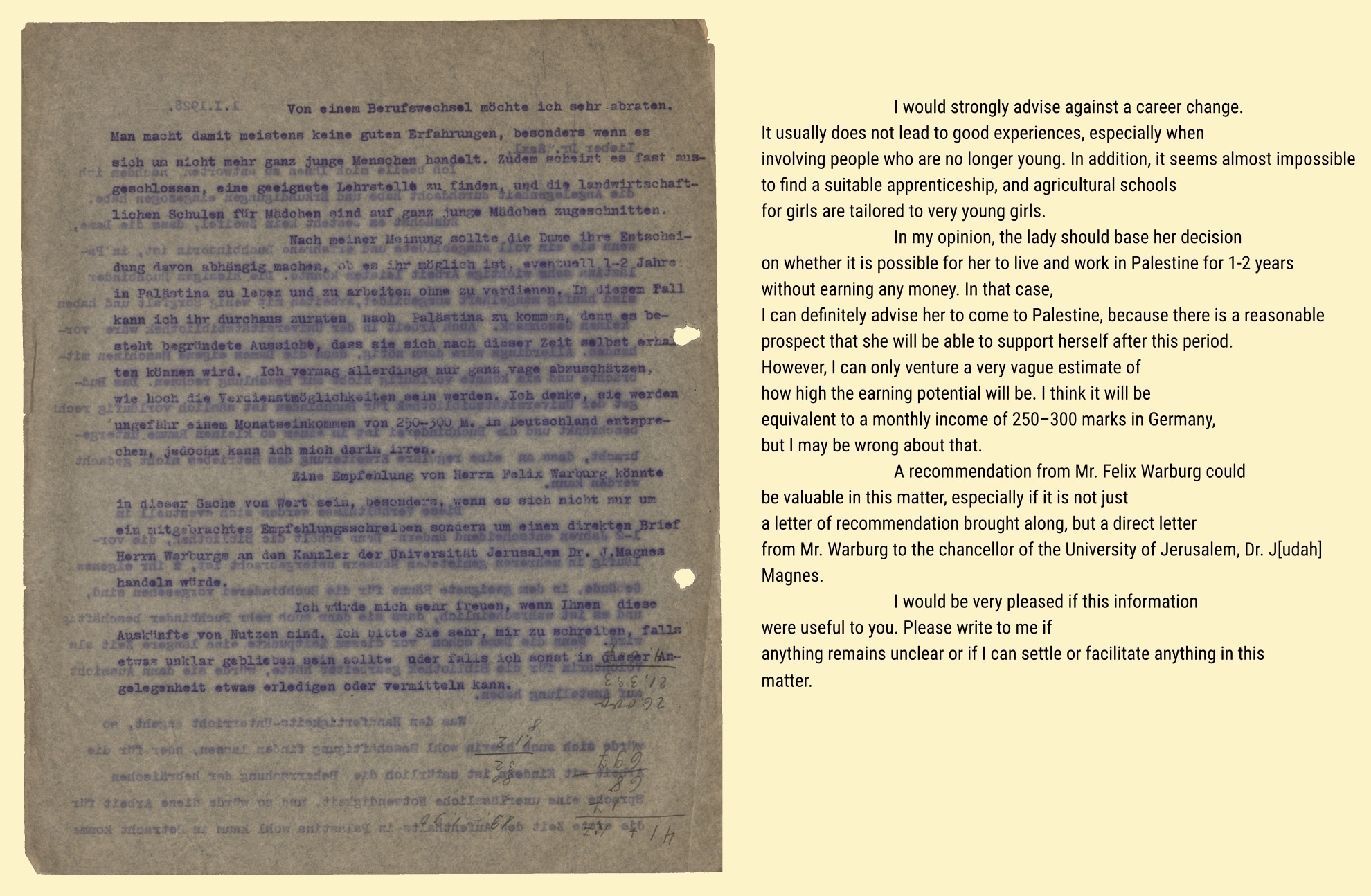
Those who wanted to go to Palestine “out of idealism” at the end of the 1920s, as this letter states, were in many cases dependent on networks and support on both sides of the Mediterranean. With this in mind, art historian and director of the Warburg Library of Cultural Studies (Kulturwissenschaftliche Bibliothek Warburg – KWB) Fritz Saxl asks Gershom Scholem, who worked at the Jerusalem University Library at the time, for advice and support for an unnamed “female friend.” Saxl emphasizes her desire to work in her trained profession as a bookbinder, as well as her fundamental willingness to reorient herself professionally. Further letters of recommendation from the Warburg Library, as well as from Ernst Cassirer and Felix Warburg, are also cited. Scholem’s detailed reply provides insights into the financial situation of the university library and the general economic situation in Palestine in early 1928. Despite an urgent need for bookbinding skills, there was no prospect of payment at first, and Scholem also advised against a career “reorientation.” The letter suggests that Scholem considered idealism and financial reserves for one to two years to be basic requirements for immigration. The further course of the correspondence until the summer of 1933 does not reveal whether Saxl’s placement efforts were successful, though the correspondence continued intensively. In July 1933, for example, Scholem inquired about “requirements of forcible coordination [Gleichschaltungsanforderungen]” toward the library and regretted not having the means to bring the library to Jerusalem. When Escha Scholem (née Burchardt, later Bergmann) visited her hometown of Hamburg in February 1930, she wrote to her husband in Jerusalem about the extremely friendly reception she received at the Warburg Library (see quote).
“I called on Saxl, was triumphantly dragged through the library, and systematically grilled with great enthusiasm by everyone present. About Palestine (present and future), about the library (theoretical and practical), and about you, what you do and how you live.”
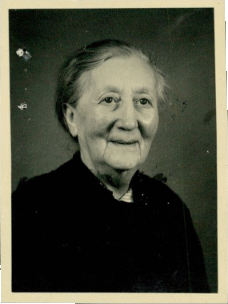
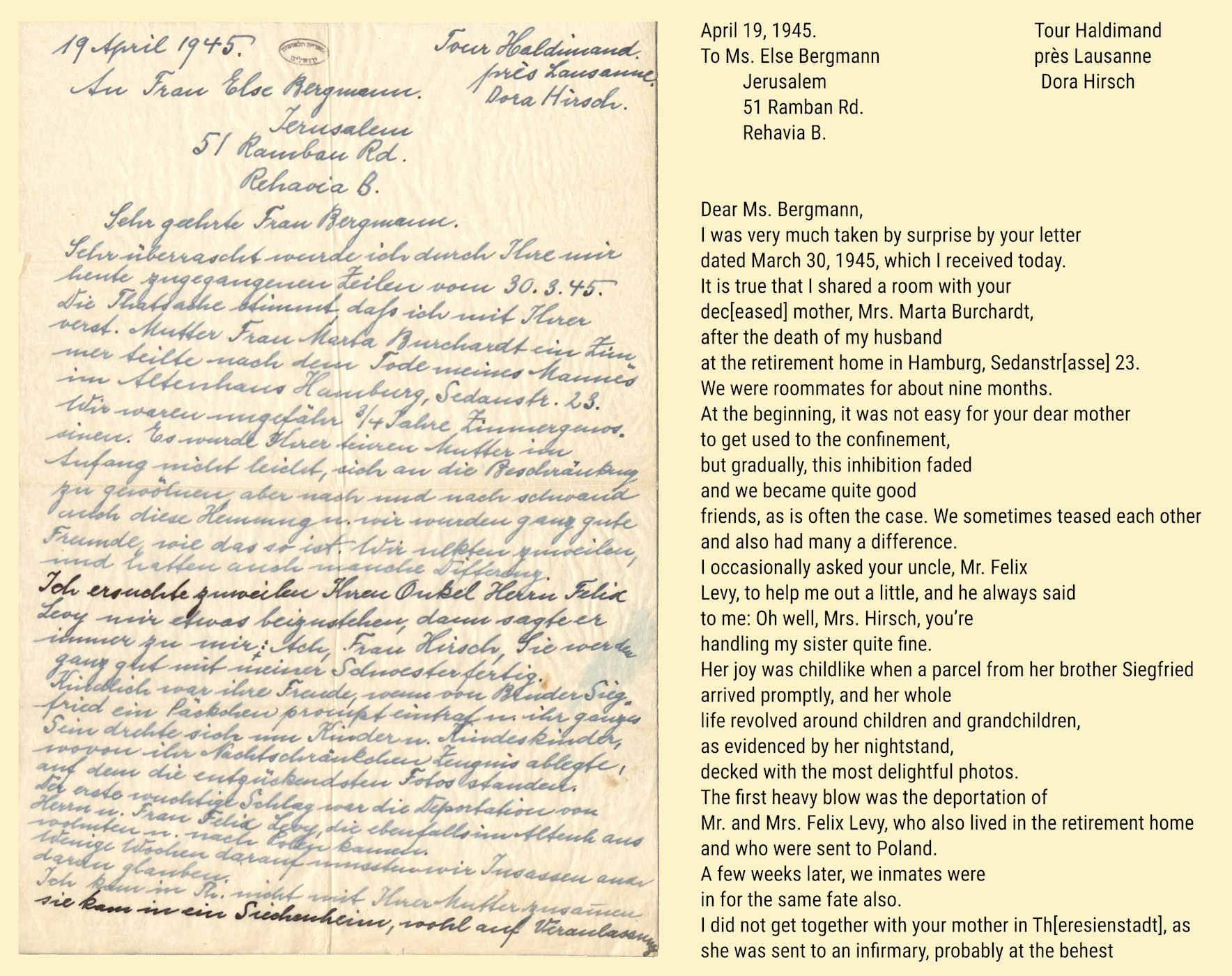
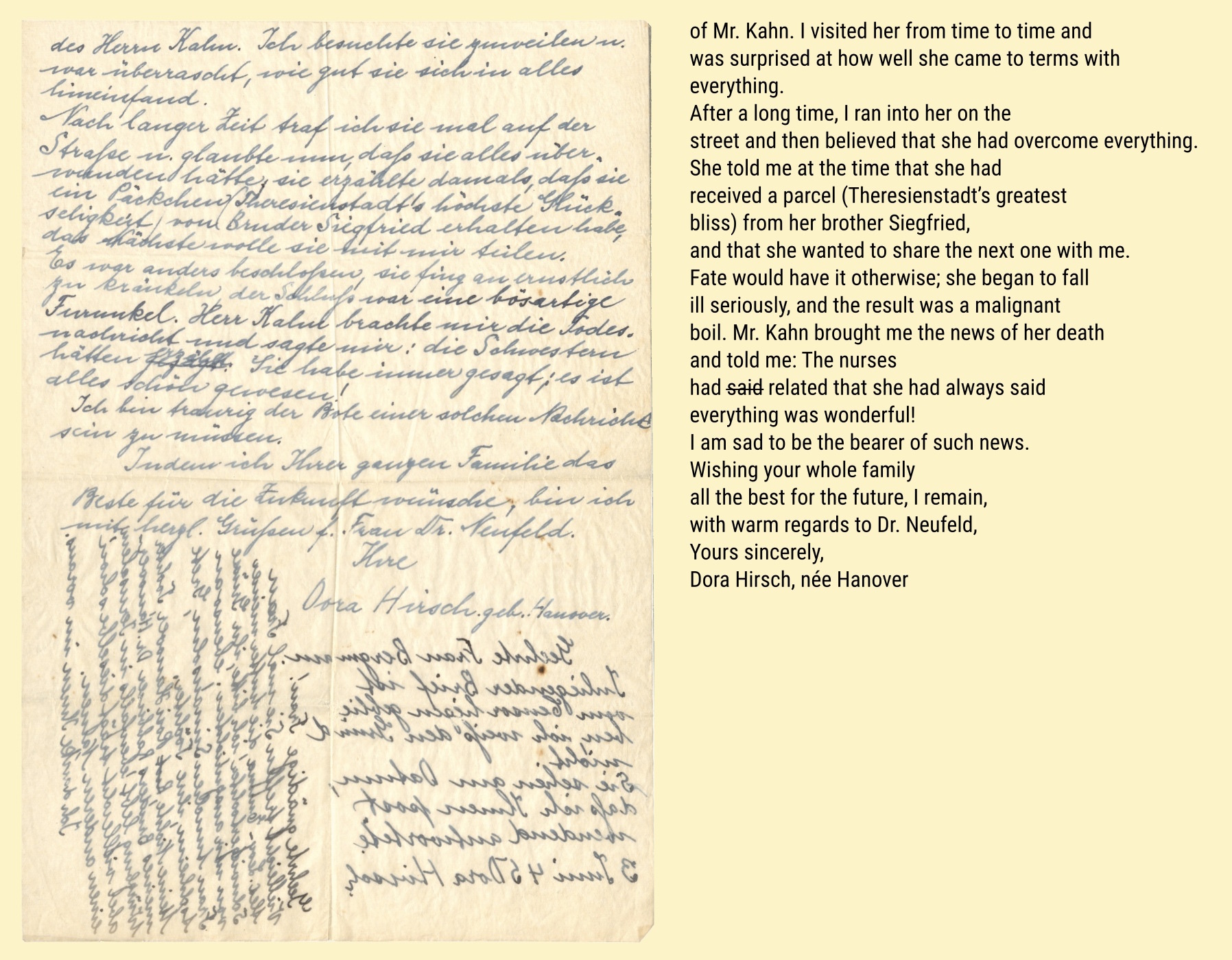
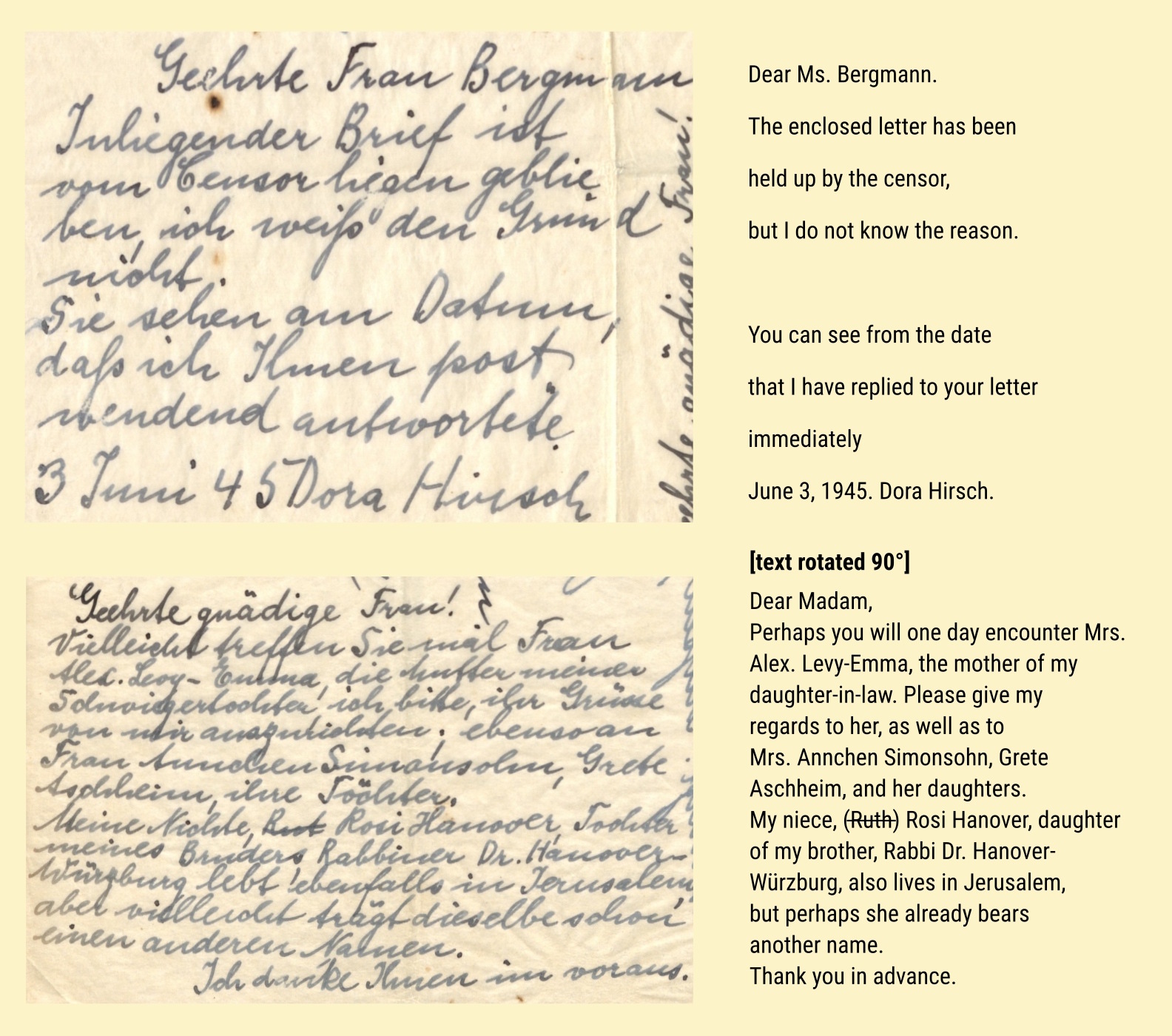
In a letter dated April 19, 1945, barely three weeks before the official end of the war, Dora Hirsch wrote to Else Escha Bergmann to give her information about the fate of her mother Martha Burchardt and her uncle Felix Levy. The letter was probably a response to a request from Bergmann. The correspondence is exemplary for first attempts at contact to inquire about relatives, friends, or the whereabouts of assets. Often, the writers had previously lived through years of uncertainty and only received certainty about the whereabouts or, respectively, death of their relatives after the end of the war. Dora Hirsch informed Bergmann that Felix Levy and his wife, Aunt Amelie, had been murdered in Auschwitz. Bergmann’s mother, Martha Burchardt, who had been deported with Hirsch from the Jewish retirement home on Sedanstrasse to Theresienstadt, died there about a year after her arrival. In many ways, this initial correspondence formed the basis for the subsequent relationship with their former home, as it was only the information about family members and other close persons that provided clarity about their own situation. In the years that followed, a relation had to be developed vis-à-vis this situation. The complexity of such correspondence is impressively demonstrated in this letter by the many additions that reveal the processual nature of the writing. At the same time, one comment refers to military censorship, which interfered with the writing of letters. In April 1945, Dora Hirsch was in a Swiss transit camp, where she had arrived on a transport from Theresienstadt to Switzerland negotiated between Jean-Marie Musy and Heinrich Himmler. From there, she wrote numerous letters to family members and friends.
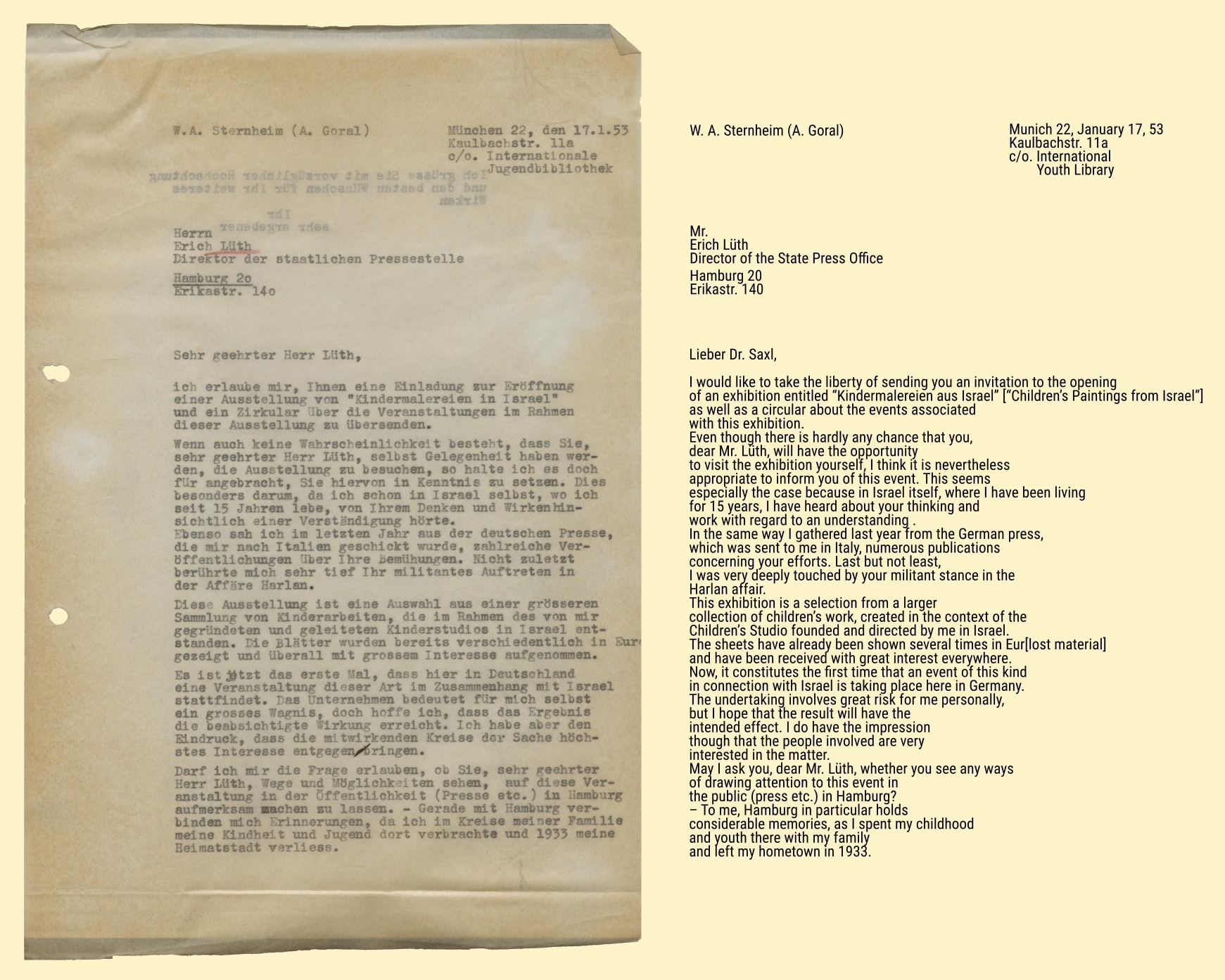
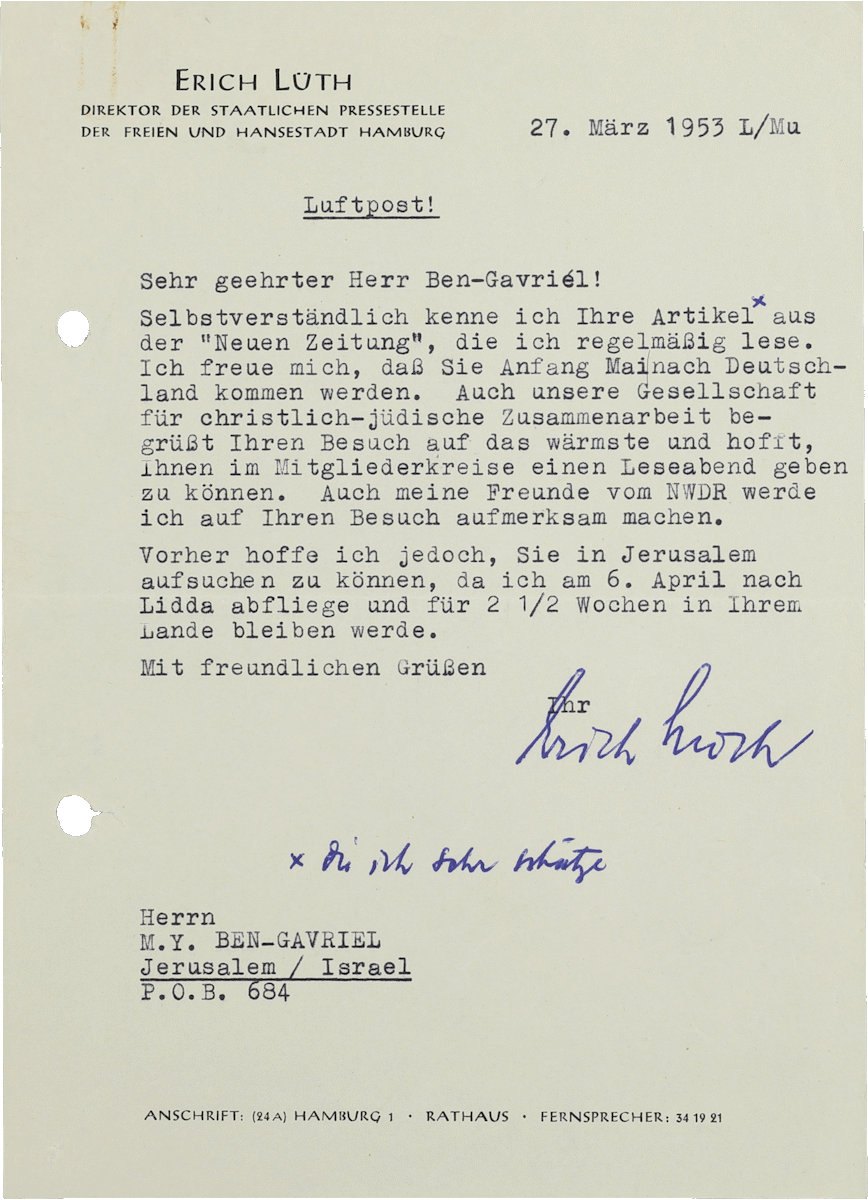
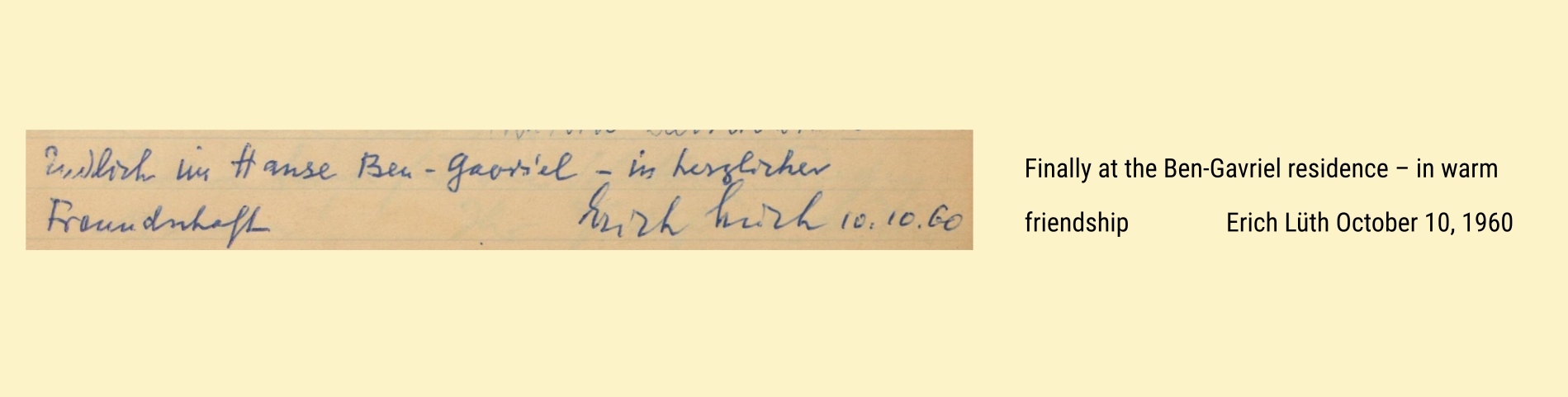
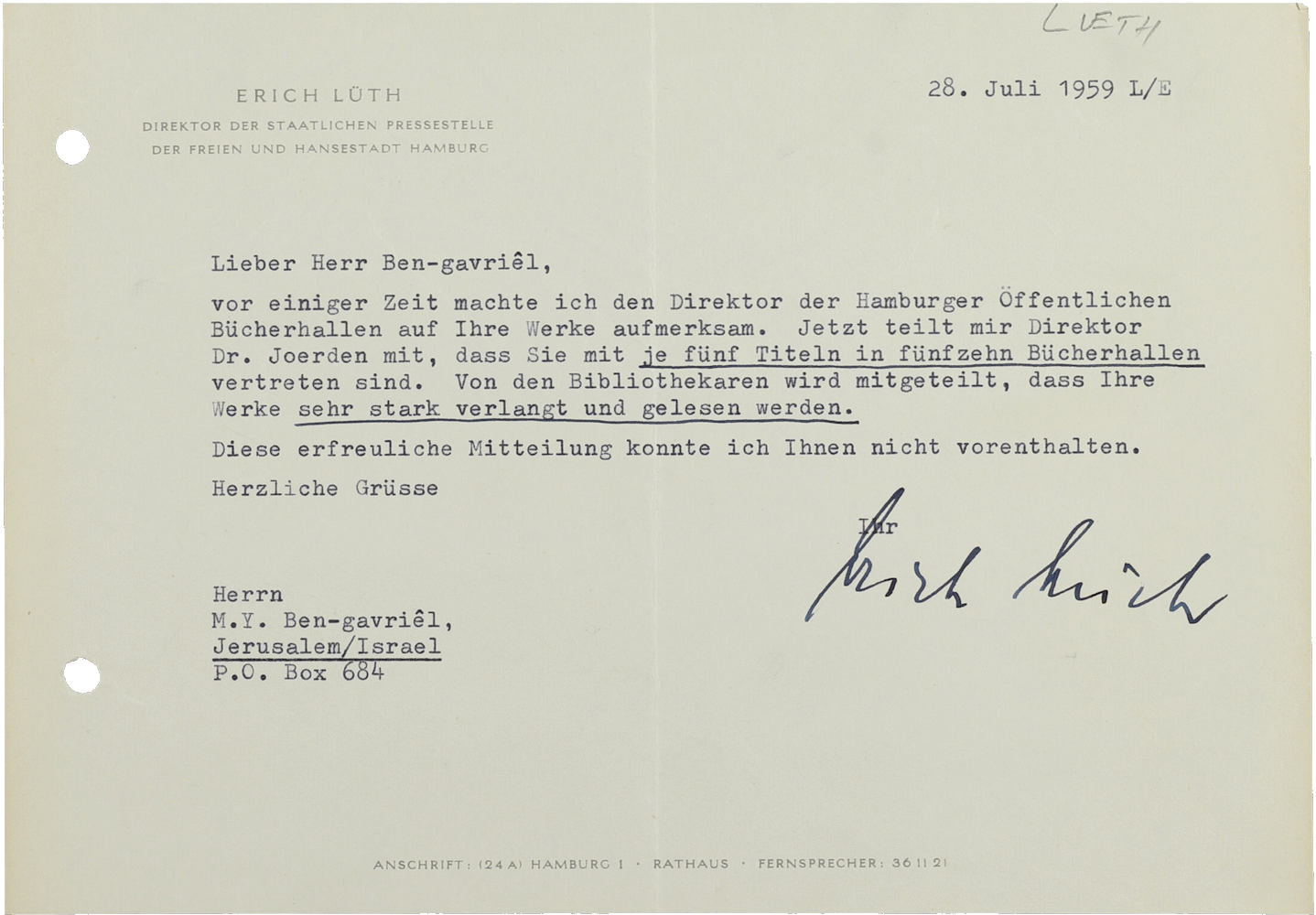
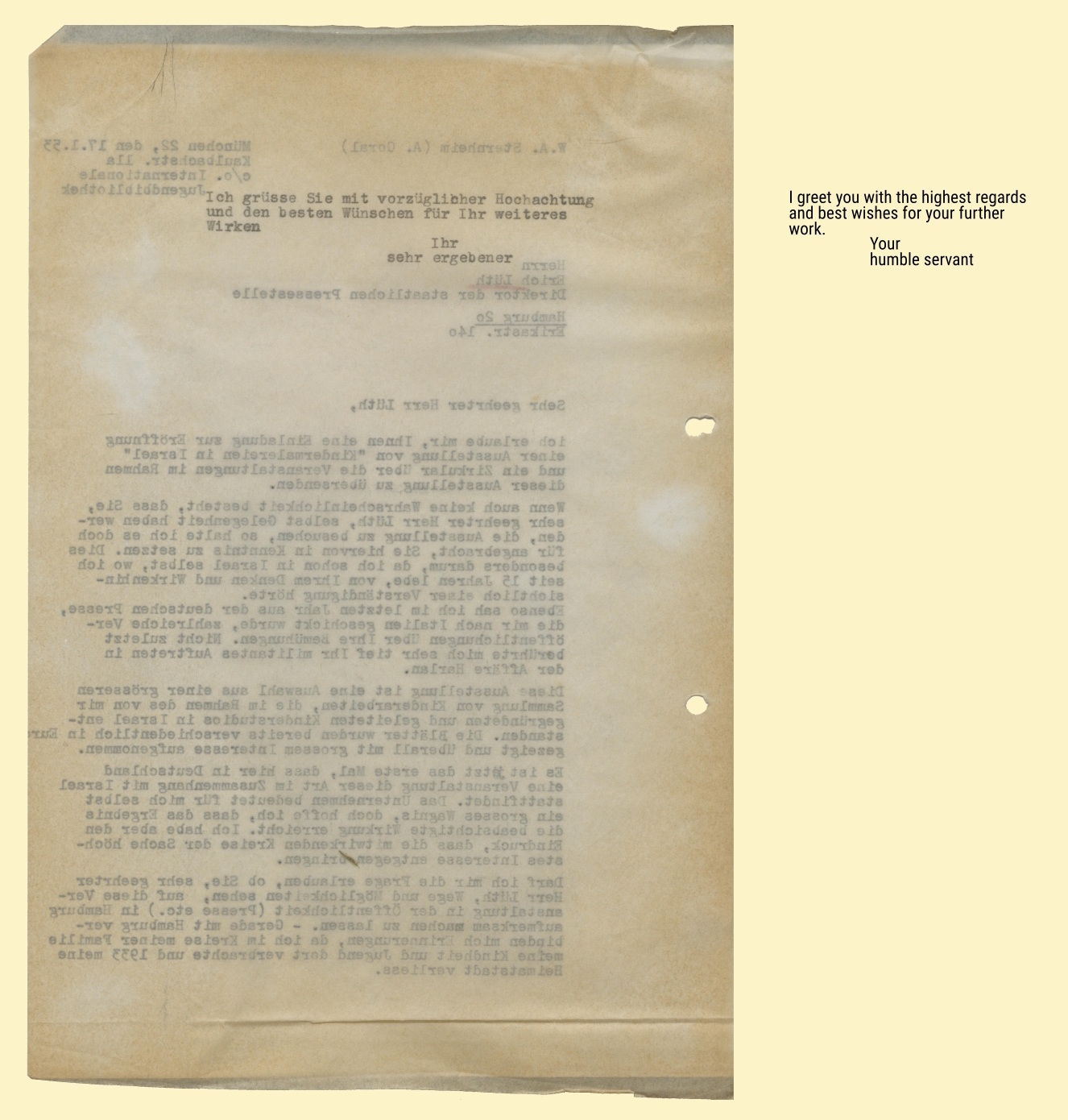
Erich Lüth was press spokesman for the City of Hamburg (1946–1953 and 1957–1964), founded the “Peace with Israel” campaign, and was co-founder of the Society for Christian-Jewish Cooperation. He traveled to Israel as early as the 1950s, where he also made contact with Jews who had fled Germany. Through his position, his publication work, and his social engagement, Lüth became a central figure in the socio-political debate about the Nazi past. As numerous correspondences show, Lüth also became a key figure for German artists living in exile, who saw him as their primary contact on the part of the German state and the Hamburg government and wrote to him with requests for support, contacts, or placement. Arie Goral, for example, asked for help in showing his exhibition on “Children’s Paintings in Israel” in his native city of Hamburg. The letter to M. Y. Ben-Gavriêl from 1953 and the entry in his Jerusalem guest book seven years later testify to long-standing contacts that ranged from the exchange of information by letter all the way to private meetings. The fact that Lüth himself enjoyed this position as an intermediary – despite all the resistance that accompanied his activities – is evident from the quote from his autobiography.
“I also found contacts to Israeli immigrants among writers of German origin: Max Brod, poet and Kafka’s heir, the negligently overlooked playwright Max Zweig, the satirist and novelist M. Y. Ben Gavriêl, whom I tried to reunite with their German audience and establish new connections to German publishers and radio stations, not to mention Martin Buber, whom I persuaded to accept the Goethe Prize from the F.V.S. Foundation [...]."Erich Lüth: Ein Hamburger schwimmt gegen den Strom [„A Hamburg resident swims against the tide“], 1983
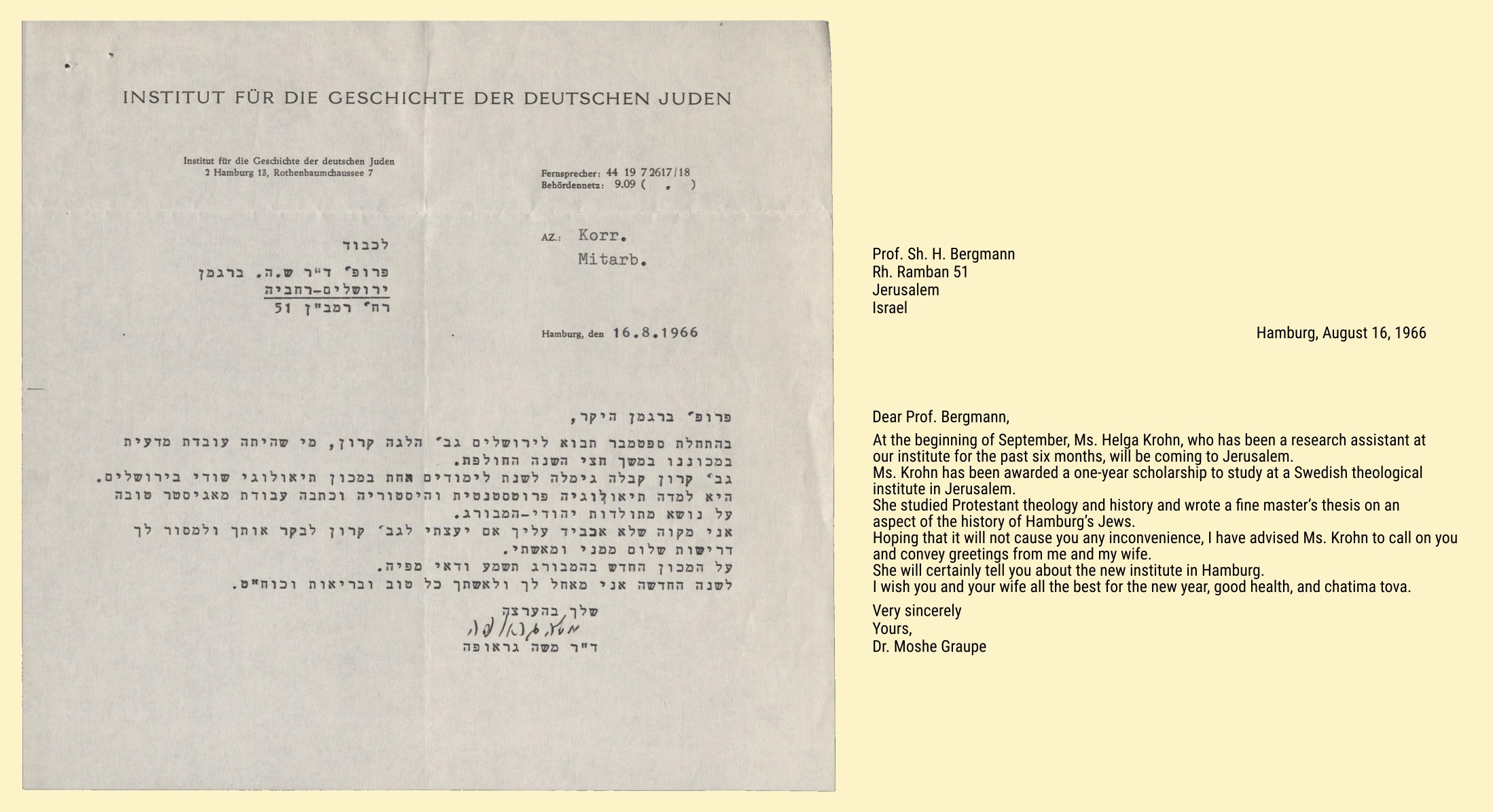
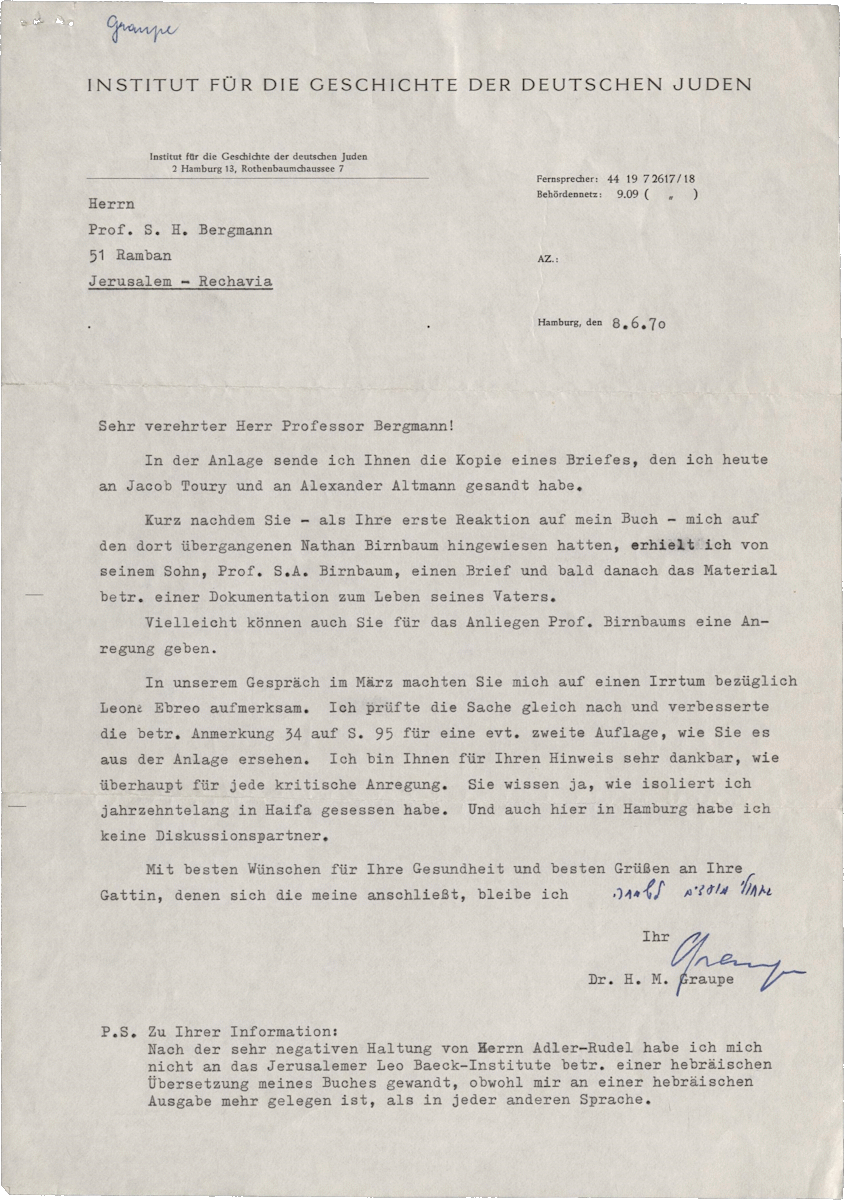
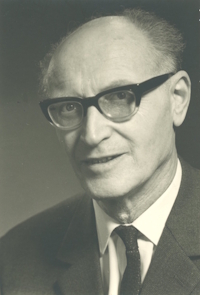
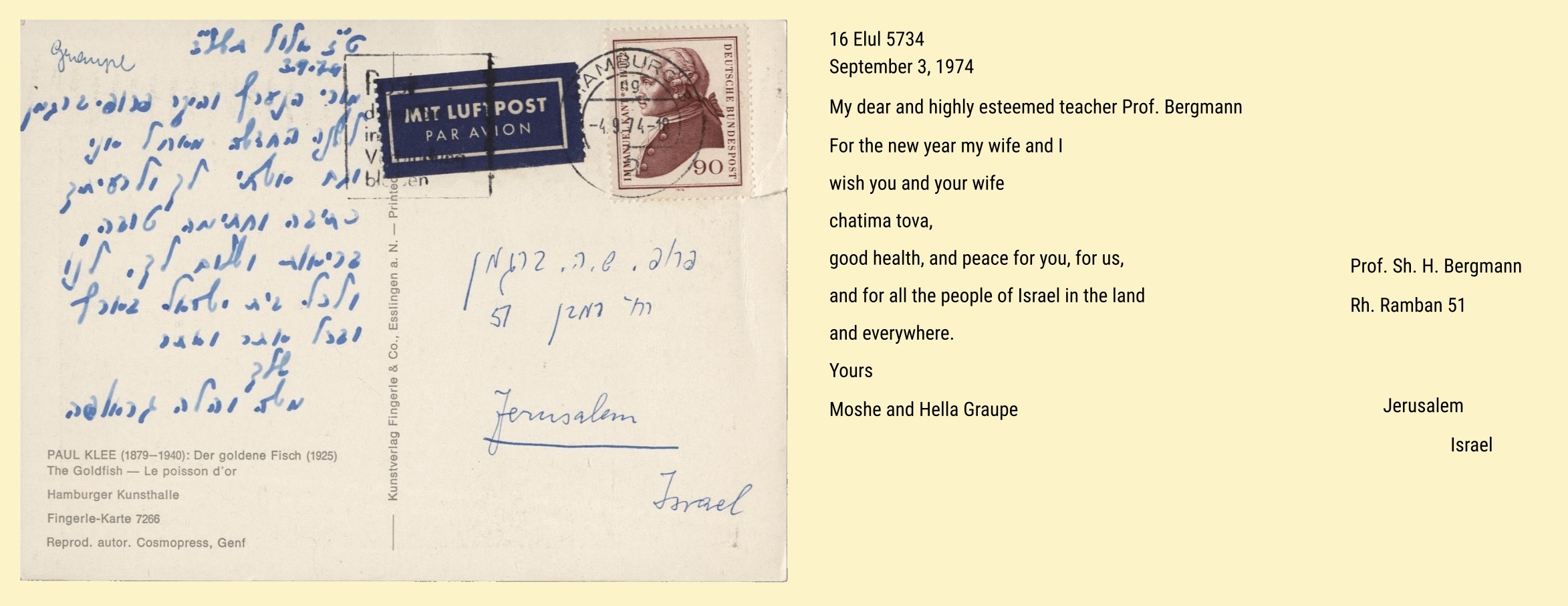
When initial start-up funding was provided in 1963 for the establishment of a scientific institute for the history of German Jews, the question of who ought to head it quickly led to discussions on who should research and represent Jewish history in Hamburg. In May 1964, historian and Jewish studies scholar Heinz Moshe Graupe, who had applied for the position from Israel, took up the post of institute director. Graupe was born in Berlin in 1906, studied in Freiburg, Hamburg, and Berlin, attended the College of Jewish Studies in Berlin, and emigrated to Palestine with his wife in 1933. When applying for the position in Hamburg, Graupe had already made it clear that he felt Israeli and was rooted in Haifa. In order to overcome the “isolated position” implied in the quote, Graupe cultivated transnational academic networks and was in contact with Hugo Bergmann in Jerusalem, to whom he announced the arrival of his colleague Helga Krohn in 1966. While Graupe usually wrote in Hebrew, as shown on the postcard, Bergmann sometimes replied in German “so as not to have to change typewriters”. The question of language and thus of audience was important for Graupe’s academic work, too, and he endeavored to publish his German research papers in Hebrew translation as well.
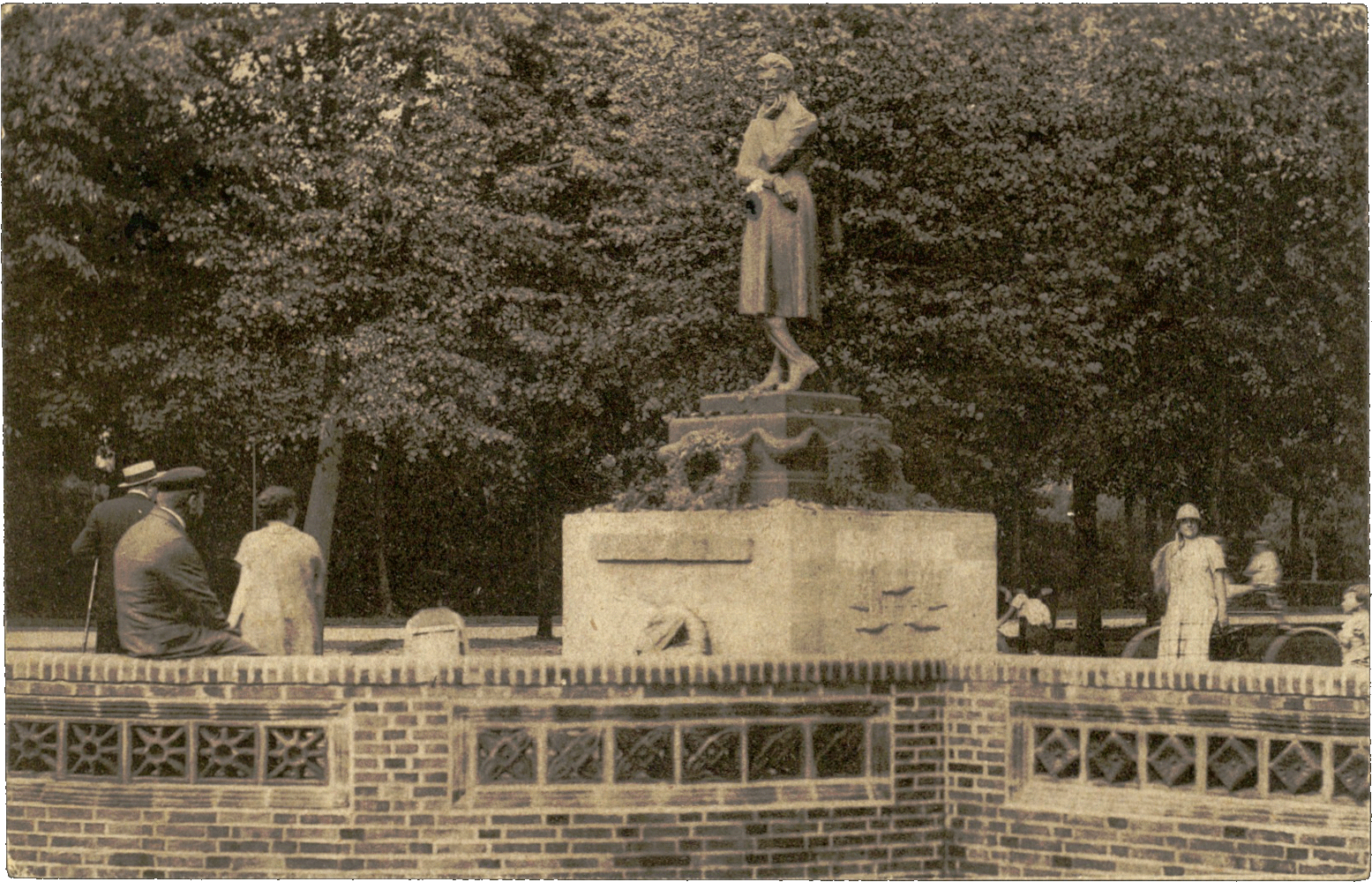
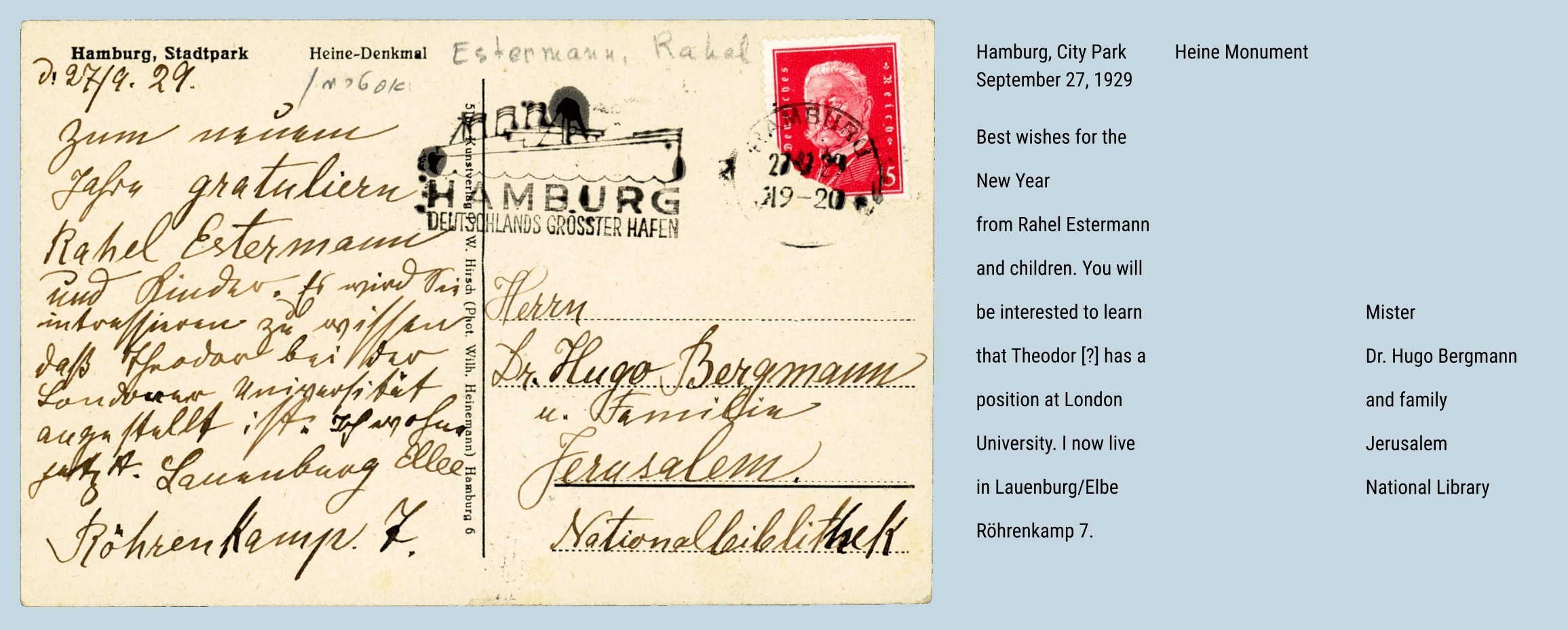
The Heinrich Heine memorial stood in Hamburg’s Stadtpark [city park] for just seven years, from 1926 to 1933. Twenty years passed between the idea and its installation, during which economic and political adversities delayed the project initiated by Alfred Kerr in 1906 on the 50th anniversary of the poet’s death. Ten years after the National Socialists had the image of the ostracized poet removed, the bronze statue designed by Hugo Lederer was melted down for weapons production during World War II. This postcard by photographer Wilhelm Heinemann immortalizes the Heine monument at its former location in the city park. Surrounded by promenaders and children, the poet gazes thoughtfully toward the surroundings. The writer Rahel Estermann sent the card as a greeting for the Jewish New Year on September 27, 1929, from Hamburg to the then director of the Jewish National and University Library, Hugo Bergmann. It is striking that although Rahel Estermann gives her own new address in Lauenburg in detail, the card itself is addressed only in German (!) to “Dr. Hugo Bergmann and family. Jerusalem. National Library.” However, this does not seem to have been an obstacle to delivery by the postal service in what was then the British Mandate of Palestine.
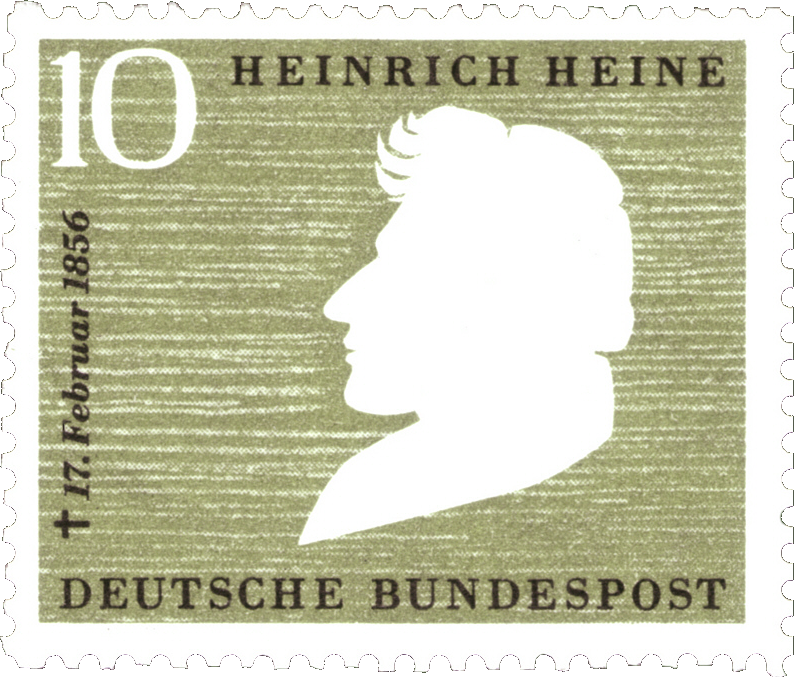
The National Socialists wanted to remove Heinrich Heine not only from the cityscape, but also from cultural memory, attributing his famous “Song of the Loreley” to an “unknown author.” After 1945, Jewish authors such as Mascha Kaléko took careful note of how successful this repression had been. Even the commemorative stamp for the Heine Year in 1956 is ironically interpreted in her poem, based on Heine’s “Germany, a Winter’s Tale,” as a symbol of repression and forgetting. The writer and journalist M. Y. Ben-Gavriêl came to similar conclusions with an unusual experiment: At the end of the 1950s, he began sending registered envelopes from Jerusalem to famous figures in (the history of) German literature. Most of the letters were returned to him as “undeliverable,” with the addressees listed as “unknown” or “not found.” As a stamp collector, Ben-Gavriêl was delighted with the stamped envelopes bearing current Israeli stamps. As an essayist, he drew a line from the bureaucratic notes to the supposed “cultural oblivion” in the land of poets and thinkers, which he harshly criticized. In all versions of Ben-Gavriêl’s essay, the first addressee, who according to the German postal authorities is “unknown hereabouts,” is always the same: Heinrich Heine, Bolkerstrasse 7, Düsseldorf.
The poet of “Loreley” is celebrated
His name is slowly becoming more familiar.
The reader even says “Heinrich Heine,”
– Not “unknown author.”
Although the complete edition is no longer available,
And it’s not enough for a monument anywhere.
The poet is immortalized in miniature
– By means of postage stamps.
What a delicious topic the postage stamp would offer
to the mockingbird Heine ...!
Yes, Germans don't know their classics,
The quote from Götz is by Goethe.
Mascha Kaléko, “Deutschland, ein Kindermärchen“ [“Germany, a Children’s Tale”], 1956
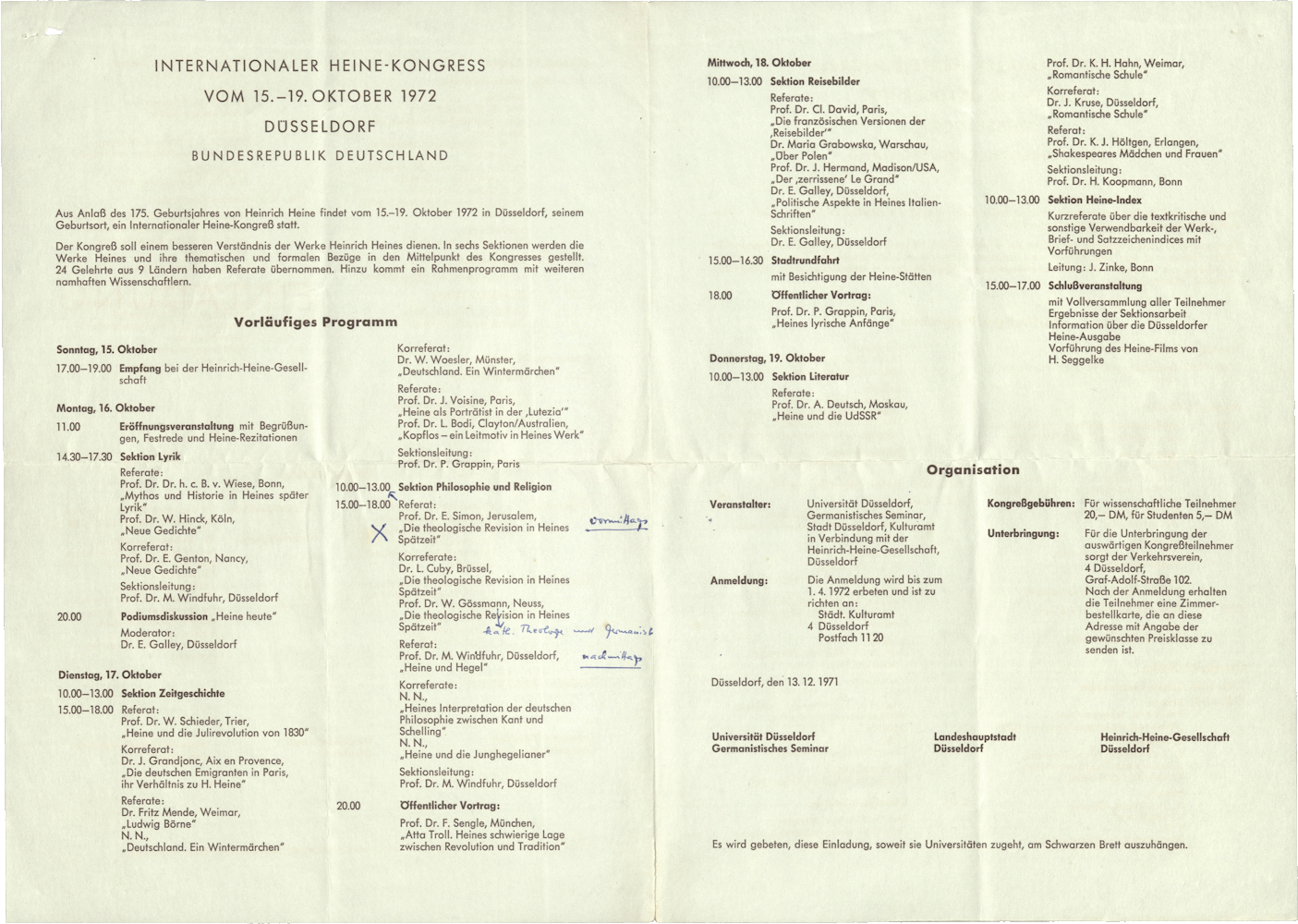
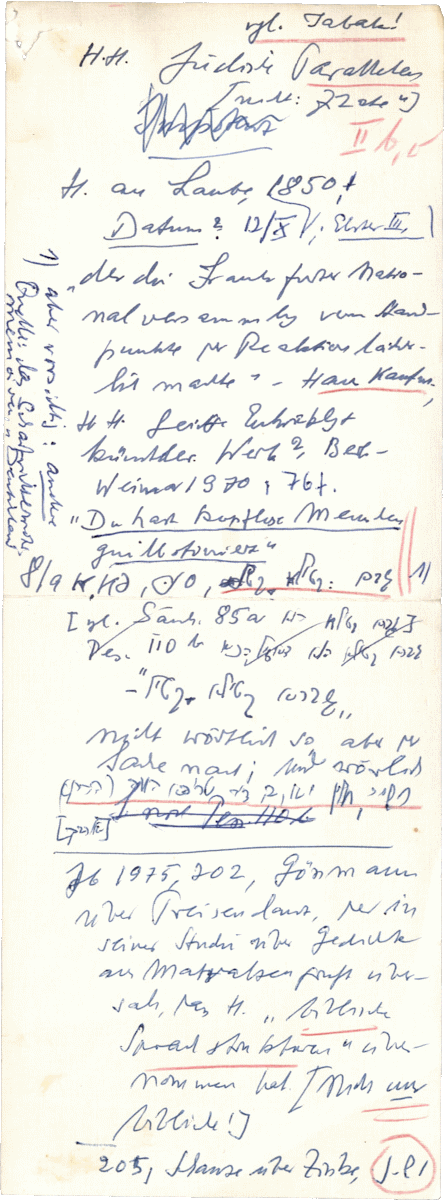
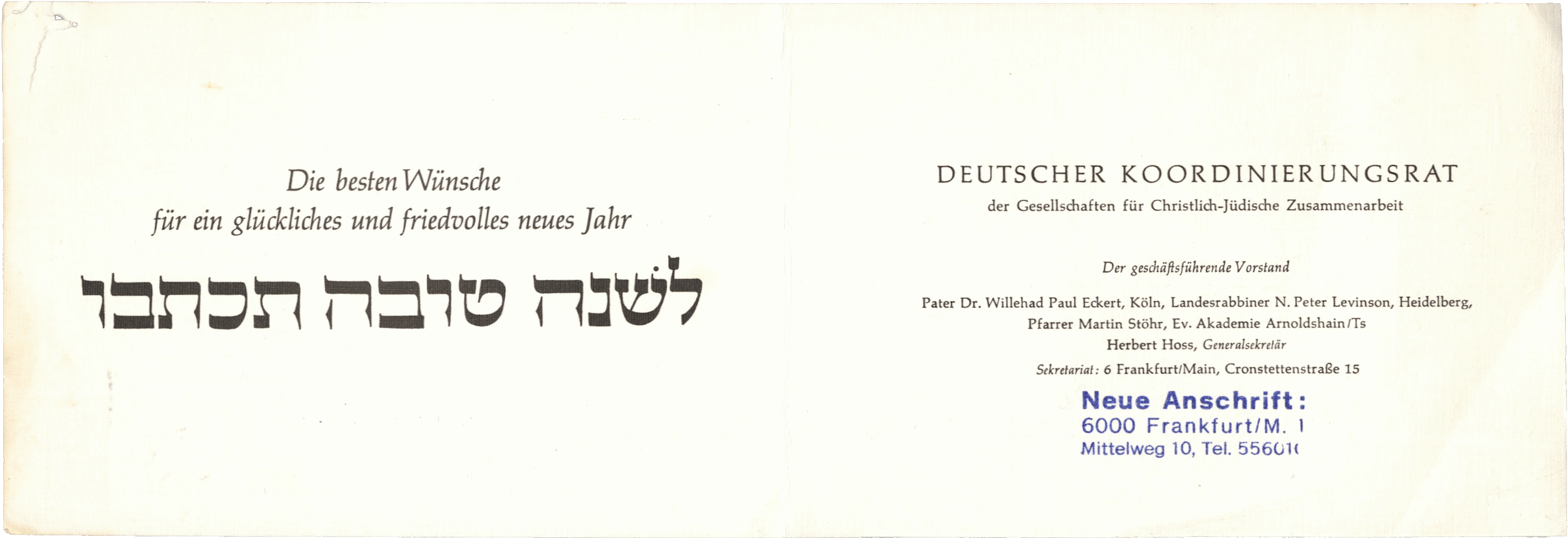
The unease surrounding Heinrich Heine did not stop at academic Heine research in post-war Germany. When an international Heine congress was held in Düsseldorf in 1972, the terms “Jew” or “Jewish” were nowhere to be found in the program. This meant that one aspect of the question raised in Golo Mann’s opening lecture, “Heine, to whom does he belong?,” was conspicuously absent. The religious philosopher and educator Ernst Simon, who was the only Jewish speaker invited, had already insisted in his letters to the convener and Heine editor Manfred Windfuhr that he would speak about “Heine as a Jew” or “Heine’s position on Judaism” – and expressly not from a theological point of view, as the draft program suggested. Newspaper reports on the congress praised Simon’s lecture as particularly personal and moving. However, despite much preparatory work and numerous drafts, his planned book on Heinrich Heine was never published. More than 30 archive folders containing well over 3,000 separate pages testify to the intensity with which Simon occupied himself with Heinrich Heine throughout his life. Most of these are handwritten notes that are difficult to read, such as the one shown here, which is located on the back of a New Year’s card from the German Coordinating Council of Societies for Christian-Jewish Cooperation [Deutscher Koordinierungsrat der Gesellschaften für Christlich-Jüdische Zusammenarbeit].
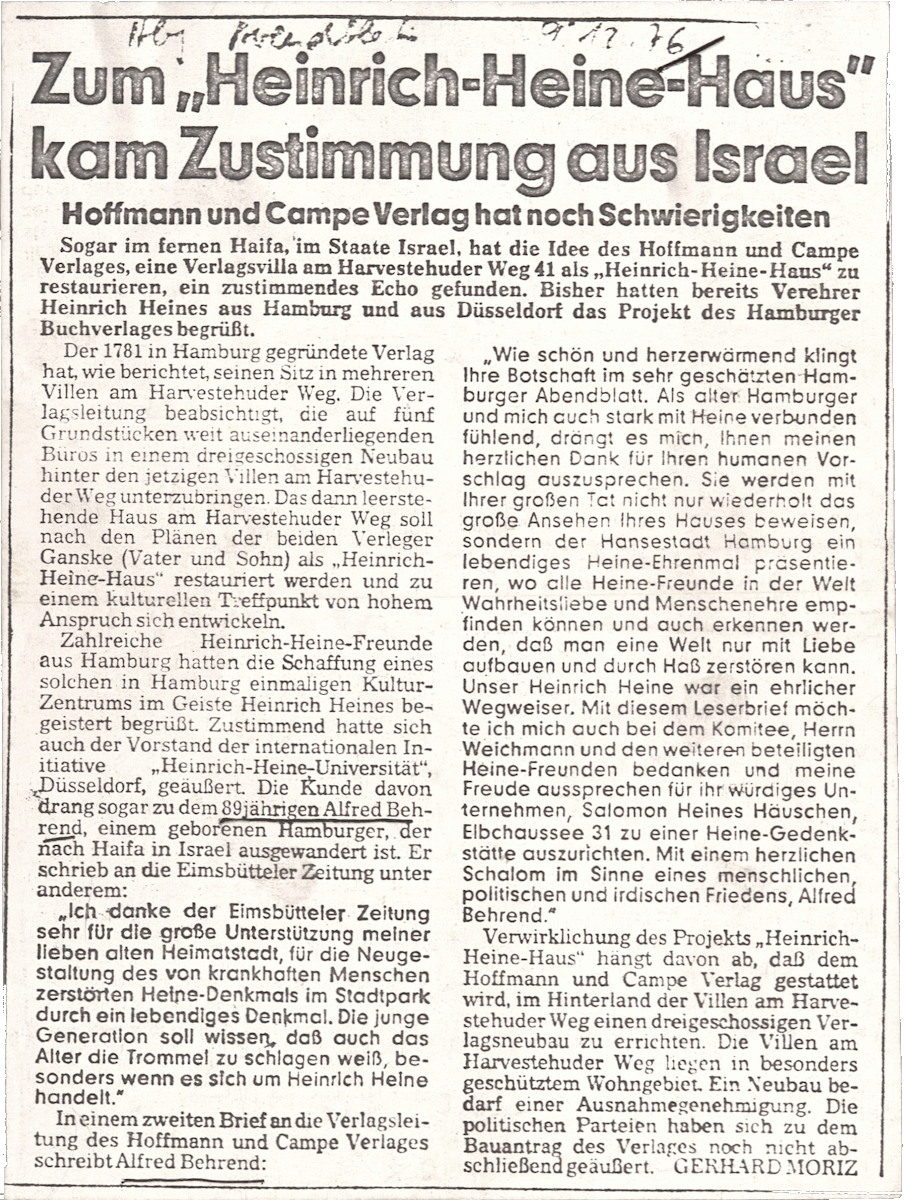
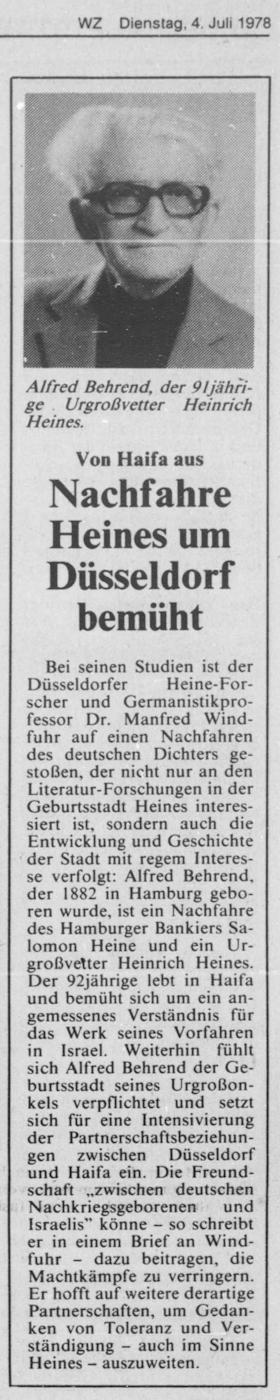
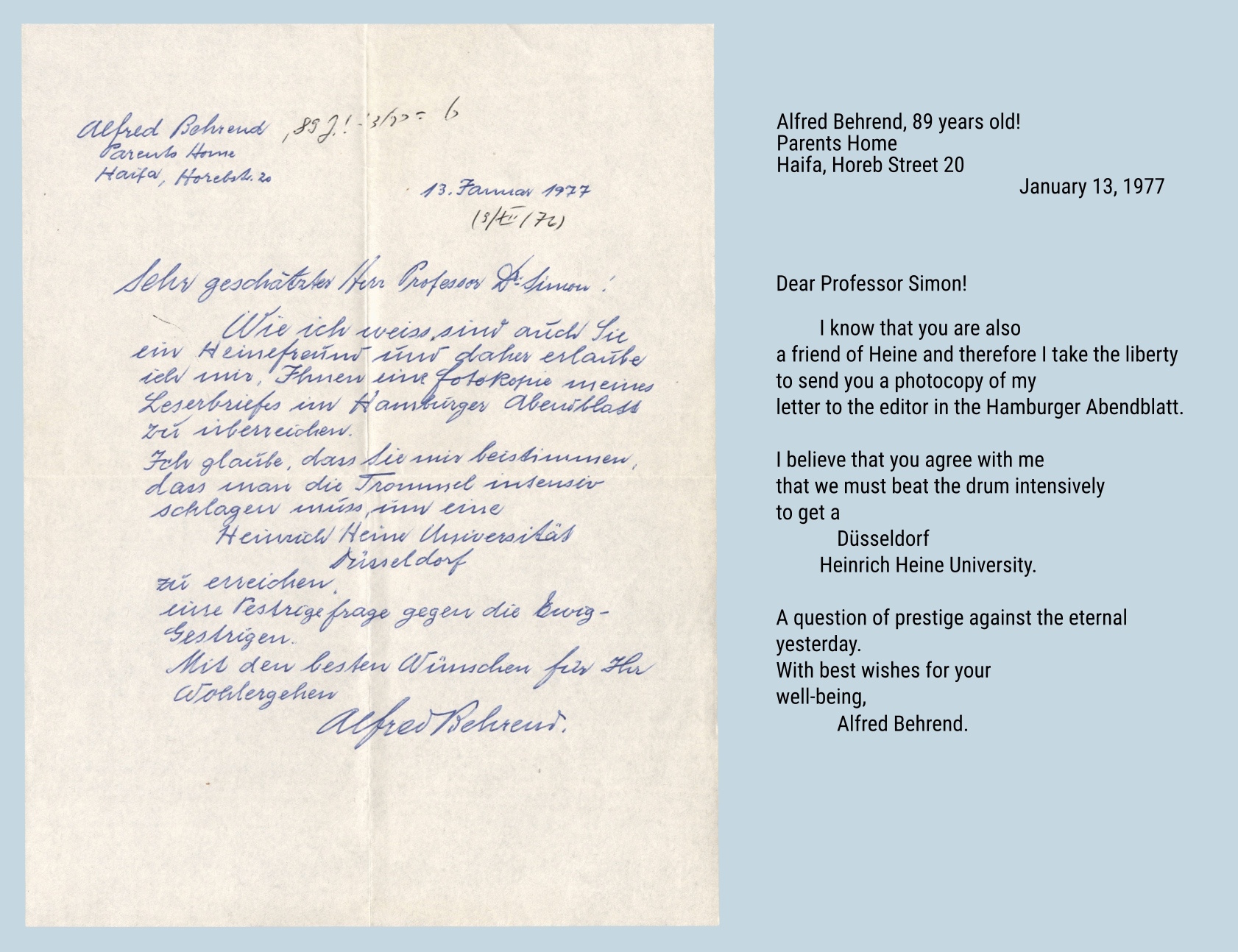
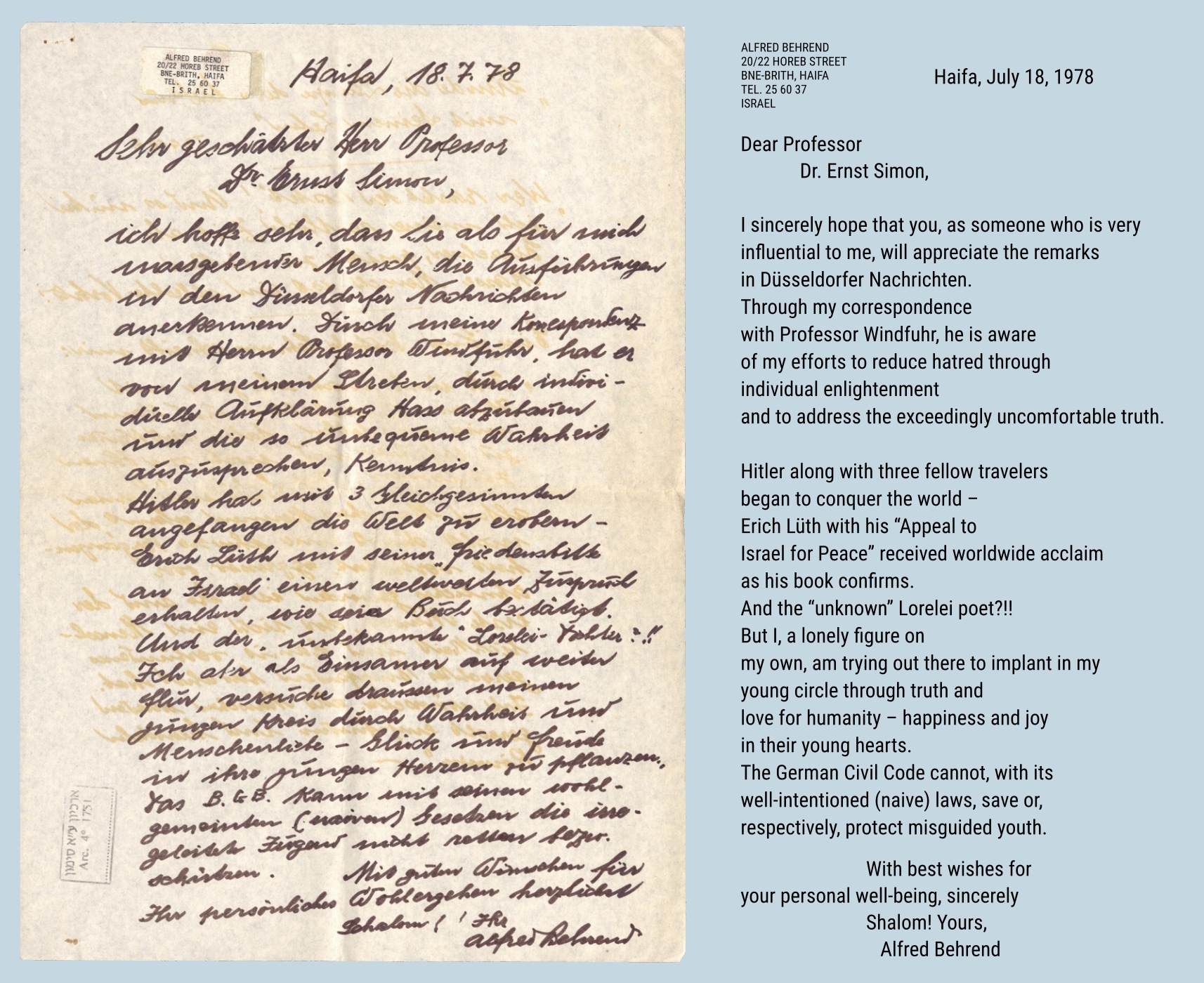
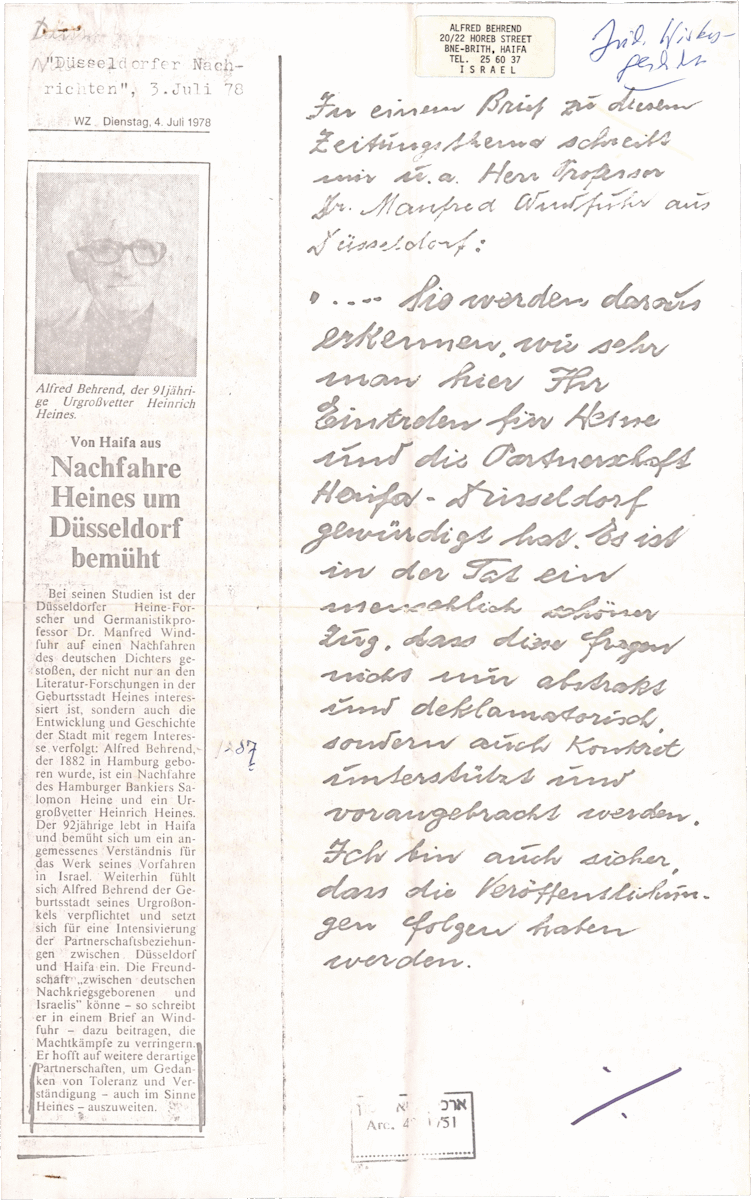
Born in Hamburg in 1887, businessman Alfred Behrend remained connected to his hometown until old age, despite Nazi persecution and his forced flight to Palestine. He visited Hamburg regularly, corresponded with the Senate Chancellery until his death in 1982, and continued to take an interest in current political issues even from his retirement home in Haifa. When, at the end of 1976, the establishment of a “Heinrich Heine House” was discussed by Hoffmann und Campe Publishers, he endorsed the idea in a letter to the editor of Eimsbütteler Zeitung, which was reported in Hamburger Abendblatt. Behrend also campaigned from Haifa for the University of Düsseldorf to be named after Heinrich Heine, which was reported in Düsseldorfer Nachrichten in 1978, as Behrend himself was a descendant of Heinrich Heine’s uncle Salomon Heine and thus a distant cousin of the poet. He maintained contact with the Düsseldorf-based Heine researcher Manfred Windfuhr as well as with Erich Lüth in Hamburg. He sent the documents of his commitment to commemorating Heinrich Heine to his revered “Heine friend” Ernst Simon in Jerusalem, where they can be found today in the latter’s literary estate.
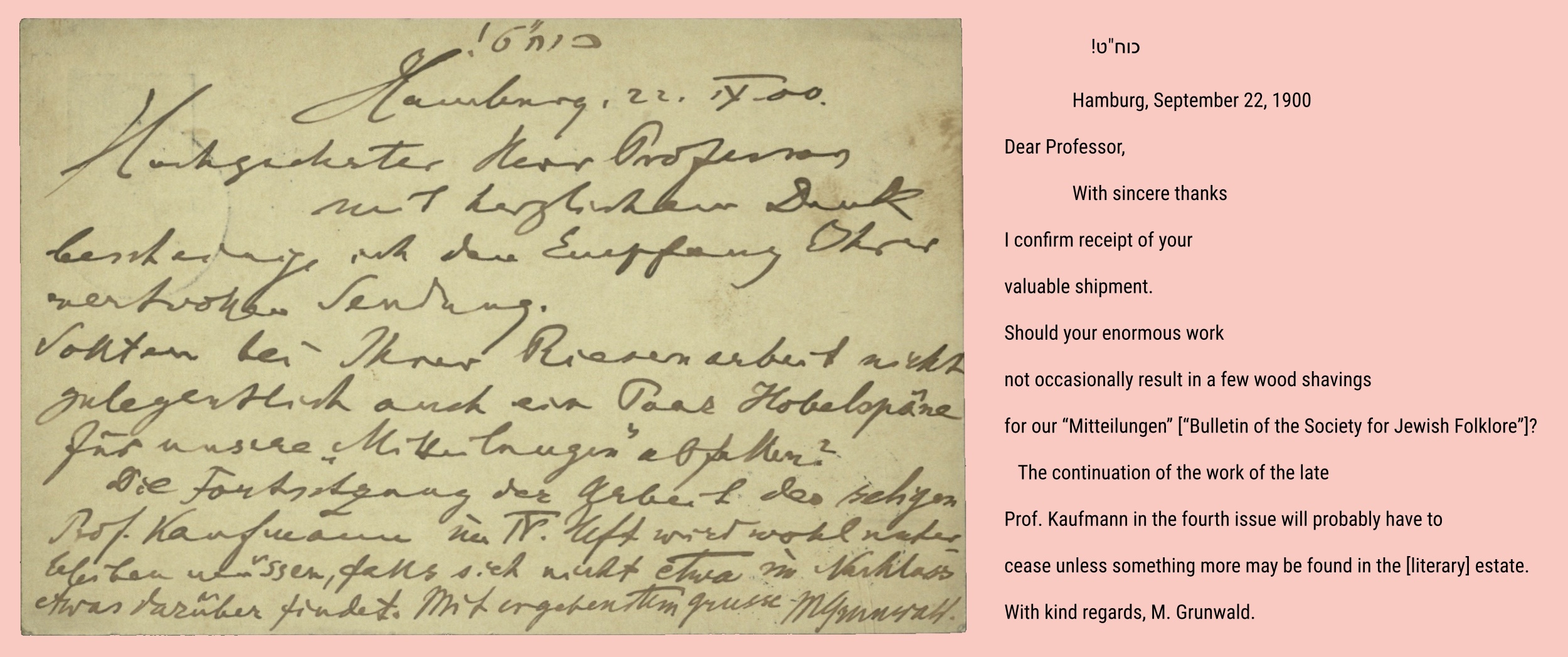
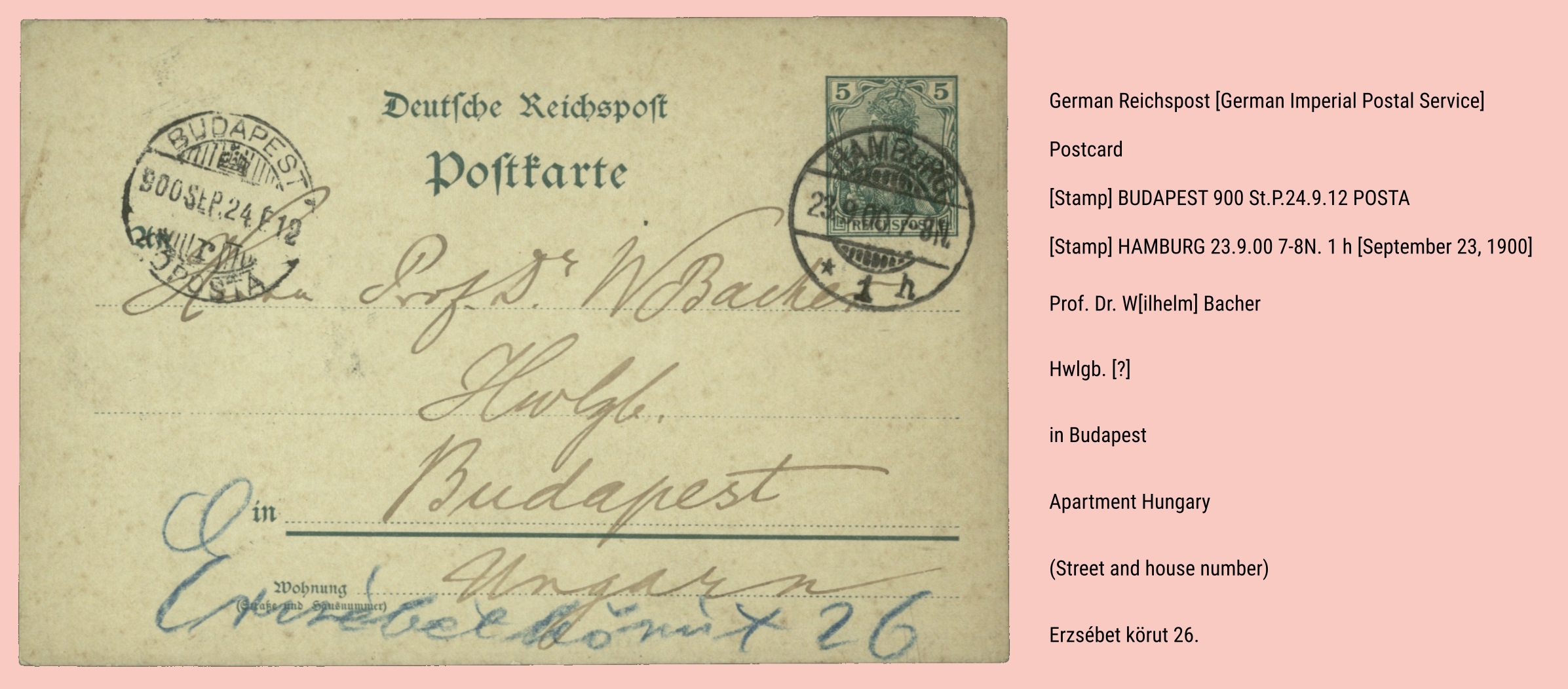
When Max Grunwald wrote this postcard to Wilhelm Bacher, professor of biblical studies at the State Rabbinical School in Budapest, on September 22, 1900, it had been just two years since the Society for Jewish Folklore was founded in Hamburg. The Society had set itself the goal of researching and “reviving” Jewish culture and religion through a comprehensive collection of evidence. Twice a year, Grunwald published Mitteilungen der Gesellschaft für jüdische Volkskunde [“Bulletin of the Society for Jewish Folklore”]. To this end, he also drew on his international scholarly networks. Bacher had been listed as a member of the Hamburg Society for Jewish Folklore as early as 1899 and responded to Grunwald’s request a few months later. His article entitled “Ein hebräisches Lied zu Simchath-Thora aus Buchârâ und Jemen“ [A Hebrew Song for Simchath Thorah from Buchârâ and Yemen”] appeared in the first issue of 1901 and was supplemented with an addendum at the beginning of the following issue.
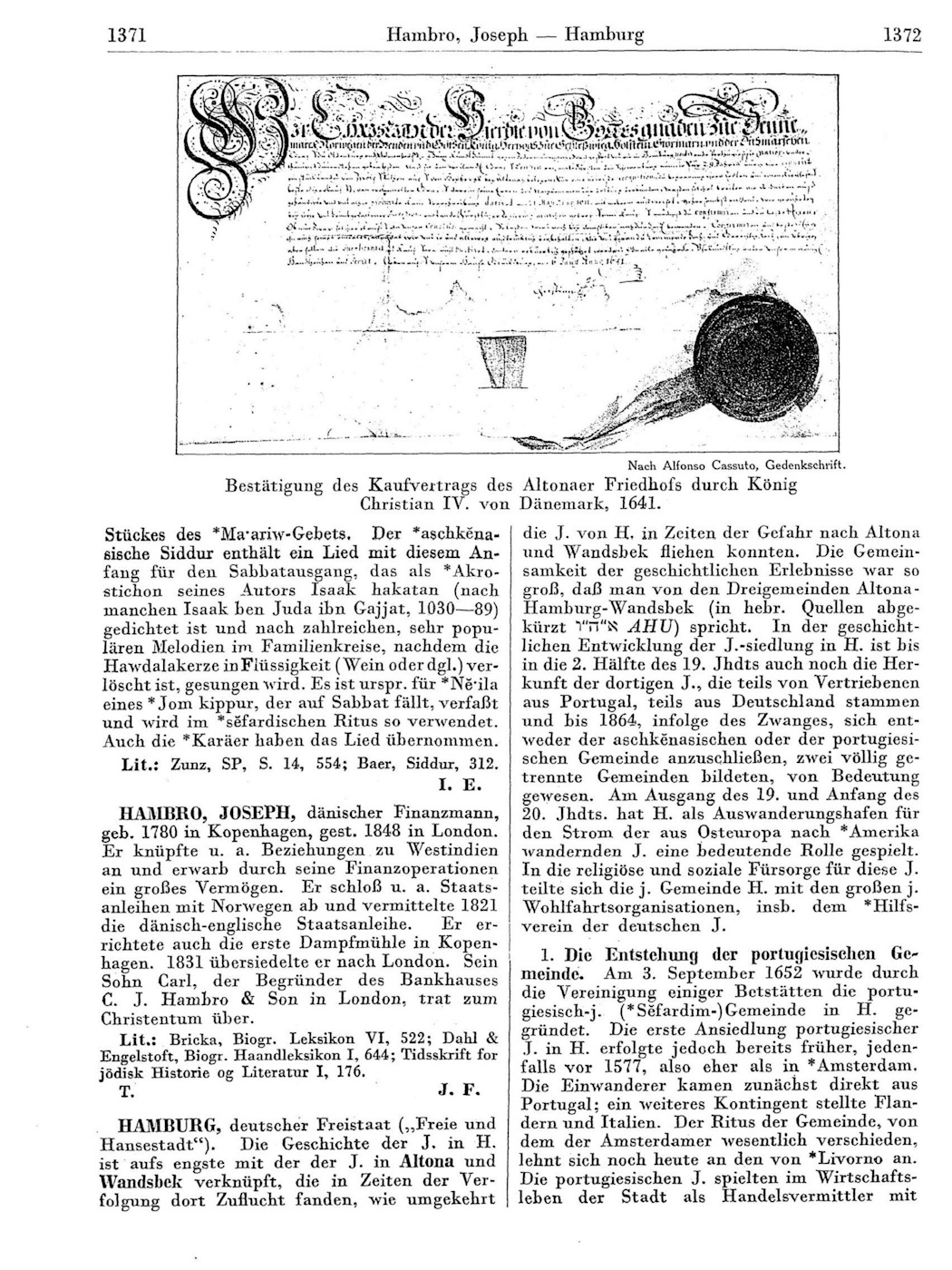
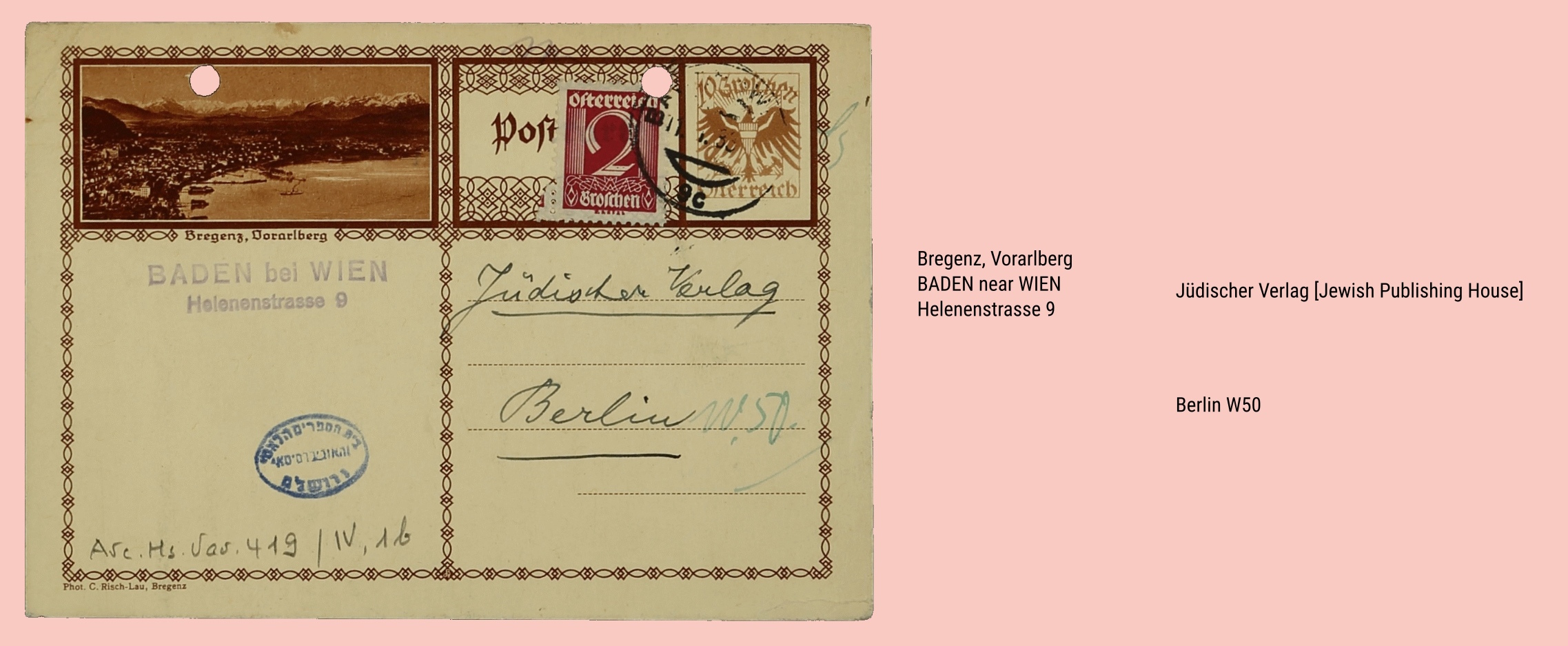
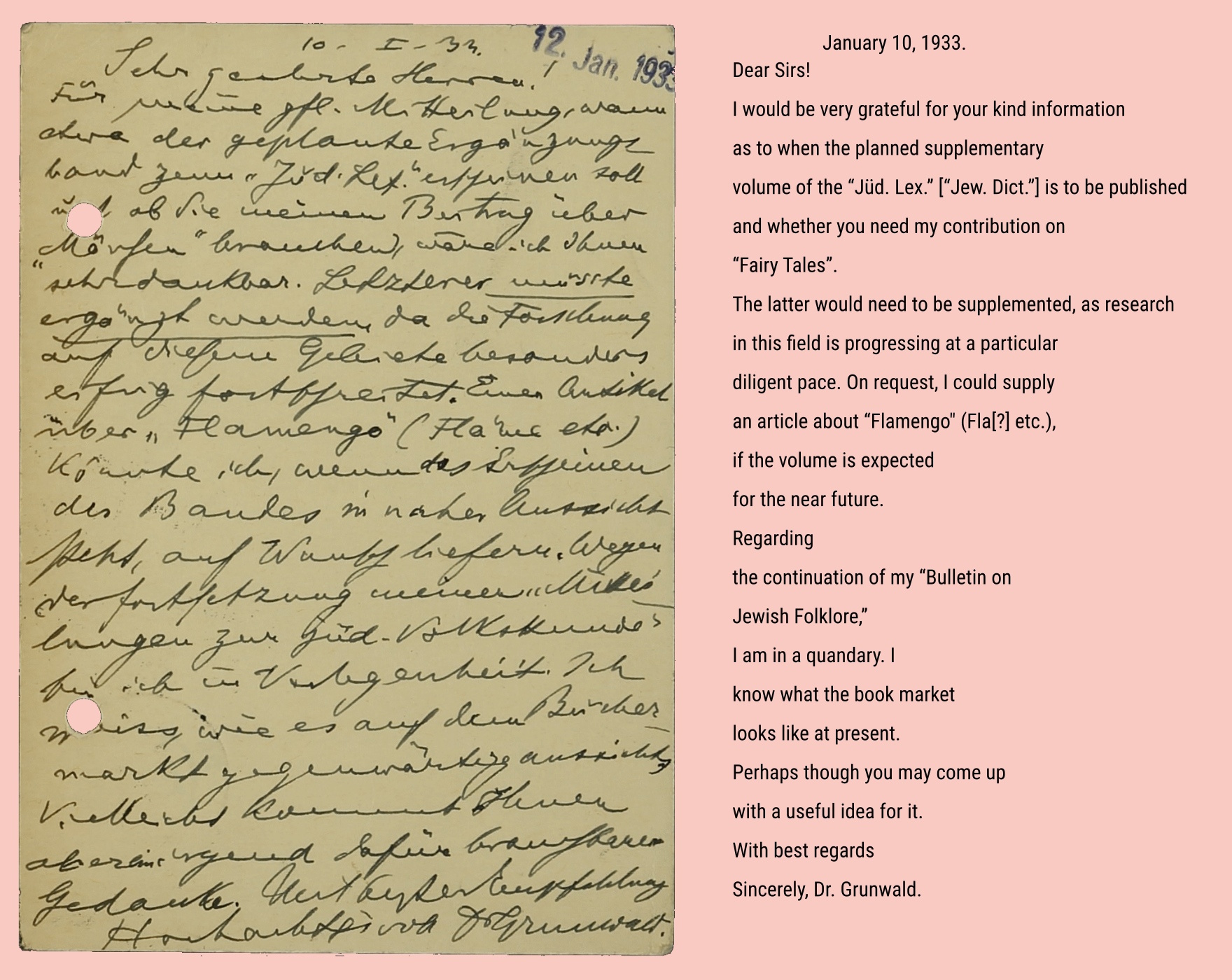
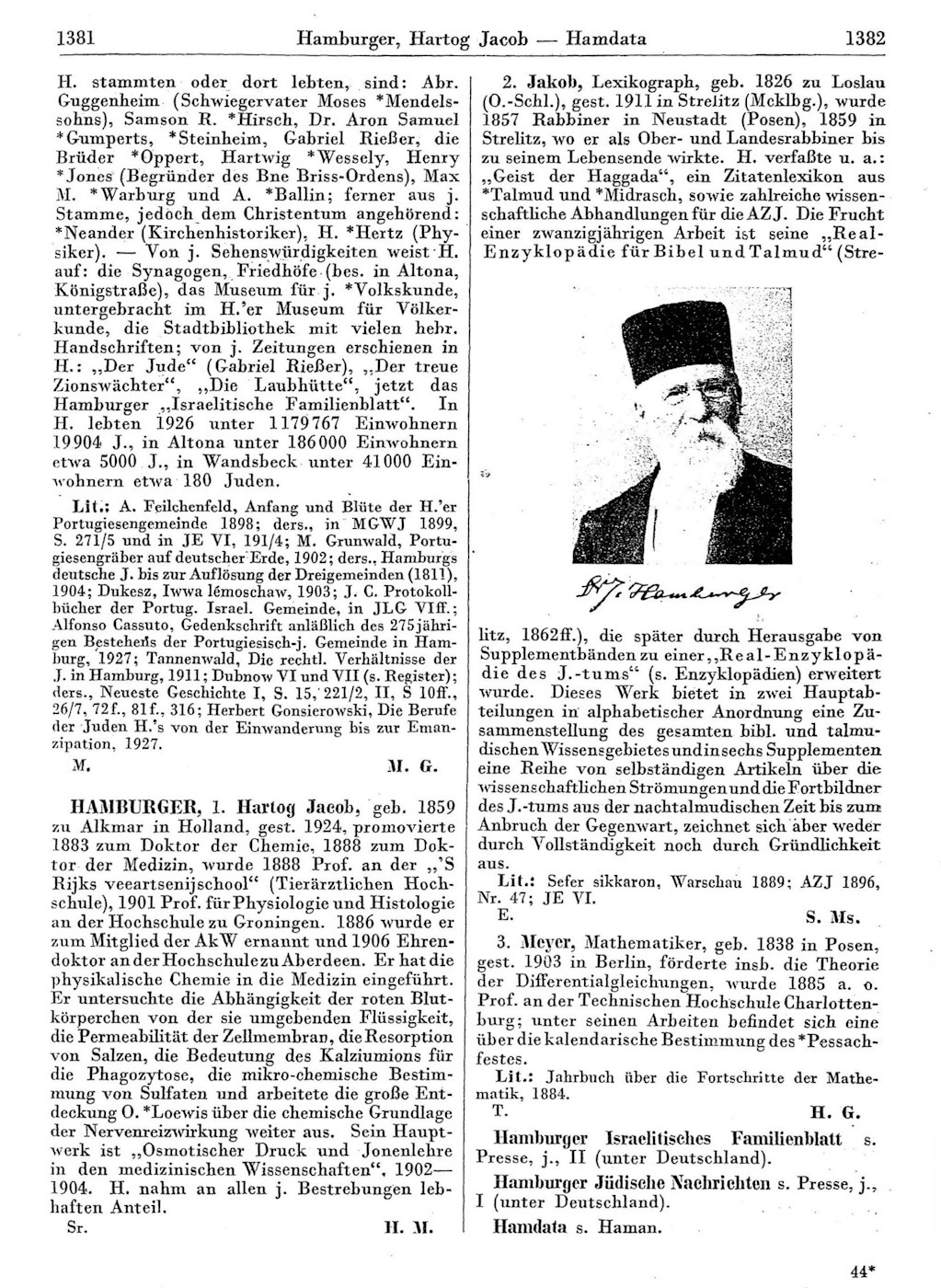
The four volumes of the Jewish Encyclopedia, published between 1927 and 1930, contain numerous entries marked with the abbreviation “M.G.” (Max Grunwald). Grunwald’s substantial contribution to this reference work, which remains the most comprehensive German-language reference work to date, includes both short entries of a few lines on individual religious terms and articles spanning several pages, such as “Memoir Literature,” “Traditional Jewish Costumes,” “Jewish Hygiene,” and “Hamburg.” The postcard shown here, which Grunwald wrote to the encyclopedia’s editorial office in January 1933, comes from the “Correspondence concerning the articles in the planned supplement volume of the Jewish Encyclopedia” – the title of four voluminous folders in the literary estate of editor and publisher Siegmund Kaznelson, who was director of Jüdischer Verlag (Jewish Publishing House) at the time. Grunwald inquired about the status of the project and made further suggestions for additional entries. However, the political situation in Germany in 1933 prevented the supplement volume from being published. Only the correspondence with the authors and a few other folders containing submitted, reviewed, and rejected manuscripts still bear witness to its approximate form today.
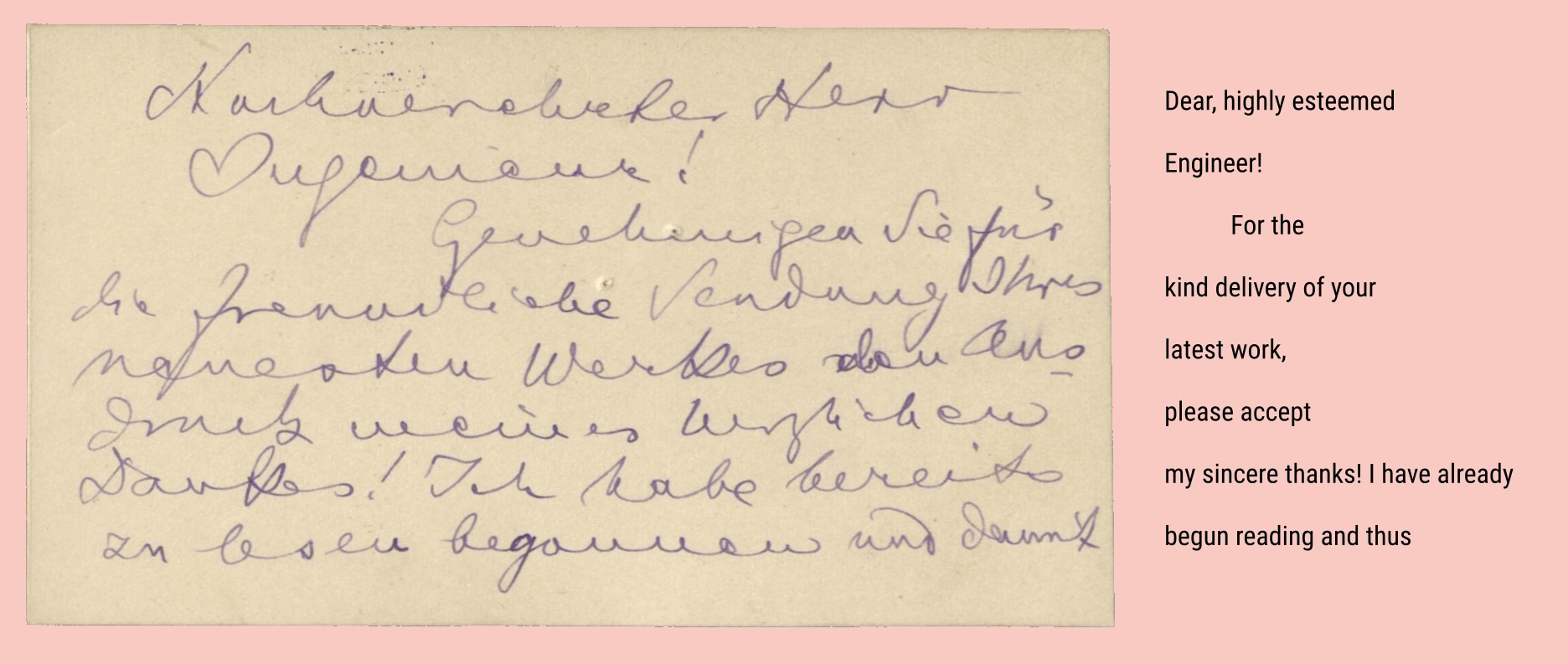
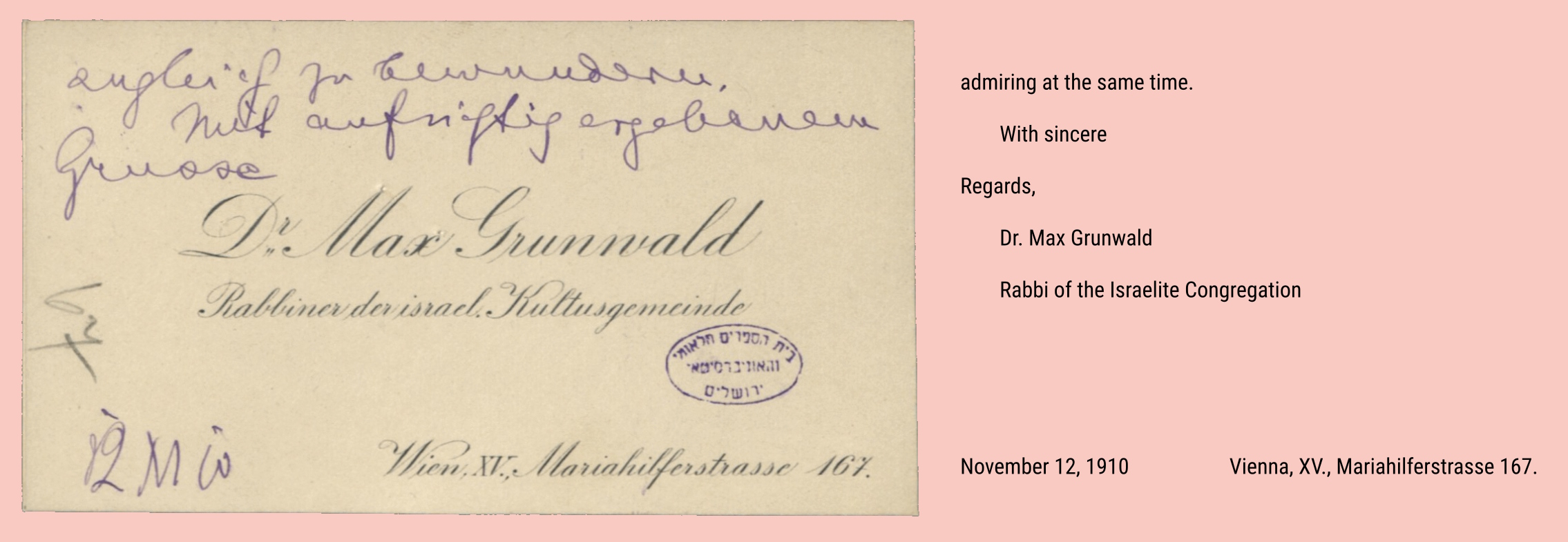
Among the German-language Jewish literary estates preserved at the National Library of Israel, that of Josef Popper-Lynkeus is one of the least noticed to date. The person and his writings have largely been forgotten. In 1960, in an article about the literary estates held by the library as the “legacy of a generation,” chief librarian Felix Weltsch emphasized the special significance of Popper-Lynkeus as an engineer, visionary, and social reformer, and predicted that his literary estate would be of great and lasting interest to researchers. However, this never really materialized, even though Albert Einstein himself had been an avowed admirer of Popper-Lynkeus. At the turn of the century, Josef Popper’s Phantasien eines Realisten [“Fantasies of a Realist”], 1899, published under the pseudonym Lynkeus, caused a great stir; in Austria, the book was even banned until 1922 for “moral reasons.” Like many other intellectuals of his time (such as Sigmund Freud, Arthur Schnitzler, and Stefan Zweig), Max Grunwald was also in contact with Popper-Lynkeus and thanked the “dear, highly esteemed engineer [hochverehrter Herr Ingenieur]” effusively for sending him an unspecified publication with this double-sided business card from 1910. This was probably the book Das Individuum und die Bewertung menschlicher Existenzen [“The Individual and the Evaluation of Human Existence”], which was published in Dresden in the same year.
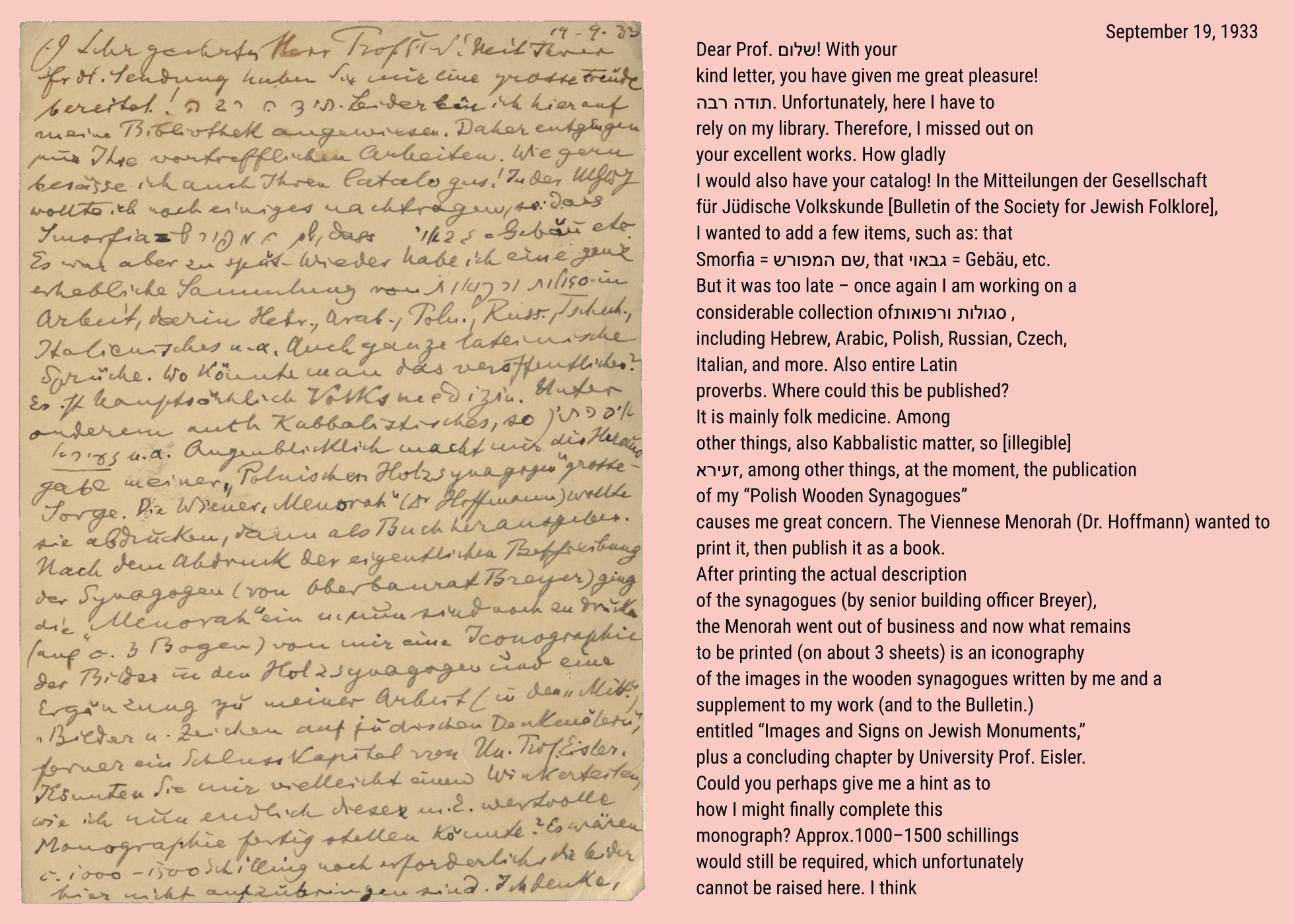
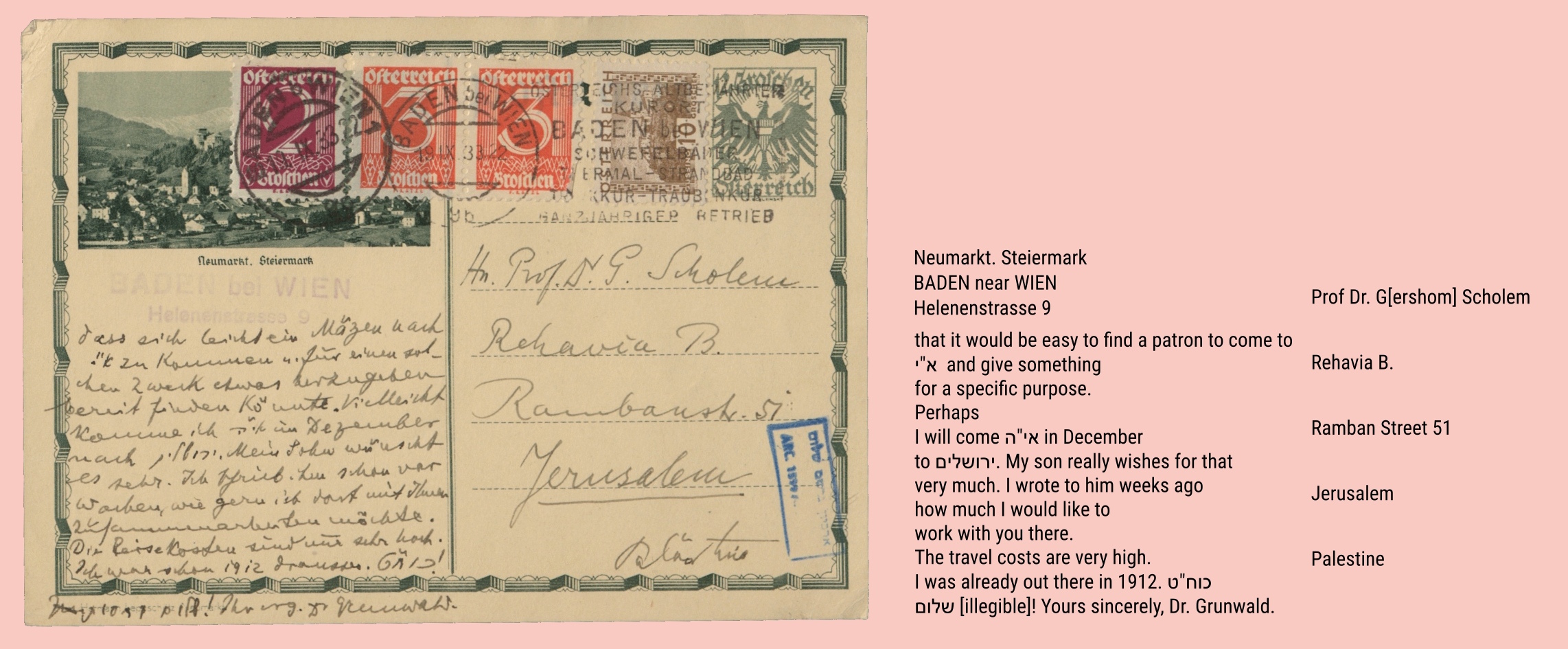
Sending a postcard from Austria to Palestine in September 1933 was not cheap, as evidenced by the numerous additional stamps on this example, which even partially cover up the panorama of Neumarkt in Styria: 30 groschen instead of the pre-printed 12 groschen for domestic mail. However, publishing scientific publications and traveling to Jerusalem was even more expensive. Max Grunwald’s message to Gershom Scholem, pervaded by numerous Hebrew terms, deals with these hardships. Along with reports on various discoveries on the subject of Jewish folk medicine, he asks for references to possible financial backers in order to publish a study on wooden synagogues in Poland, which had already been printed in the journal Menorah, as a book. At the same time, he announces his intention to travel to Palestine again after more than 20 years to visit his son and meet Scholem in person. However, no further correspondence with Grunwald has been preserved in Scholem’s literary estate, so it remains unclear whether the anticipated meeting took place. The planned book on Polish wooden synagogues was published in Vienna in 1934 without any publisher information.
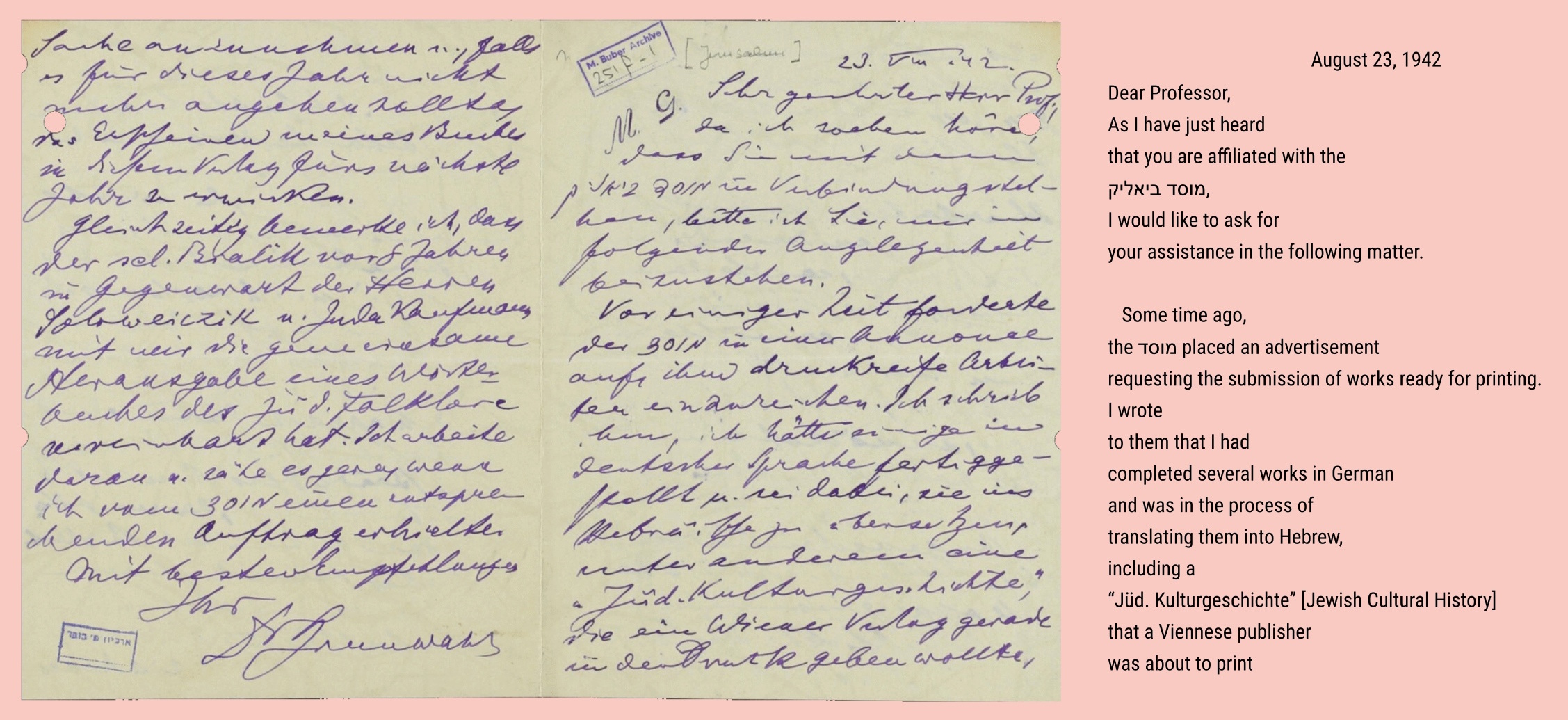
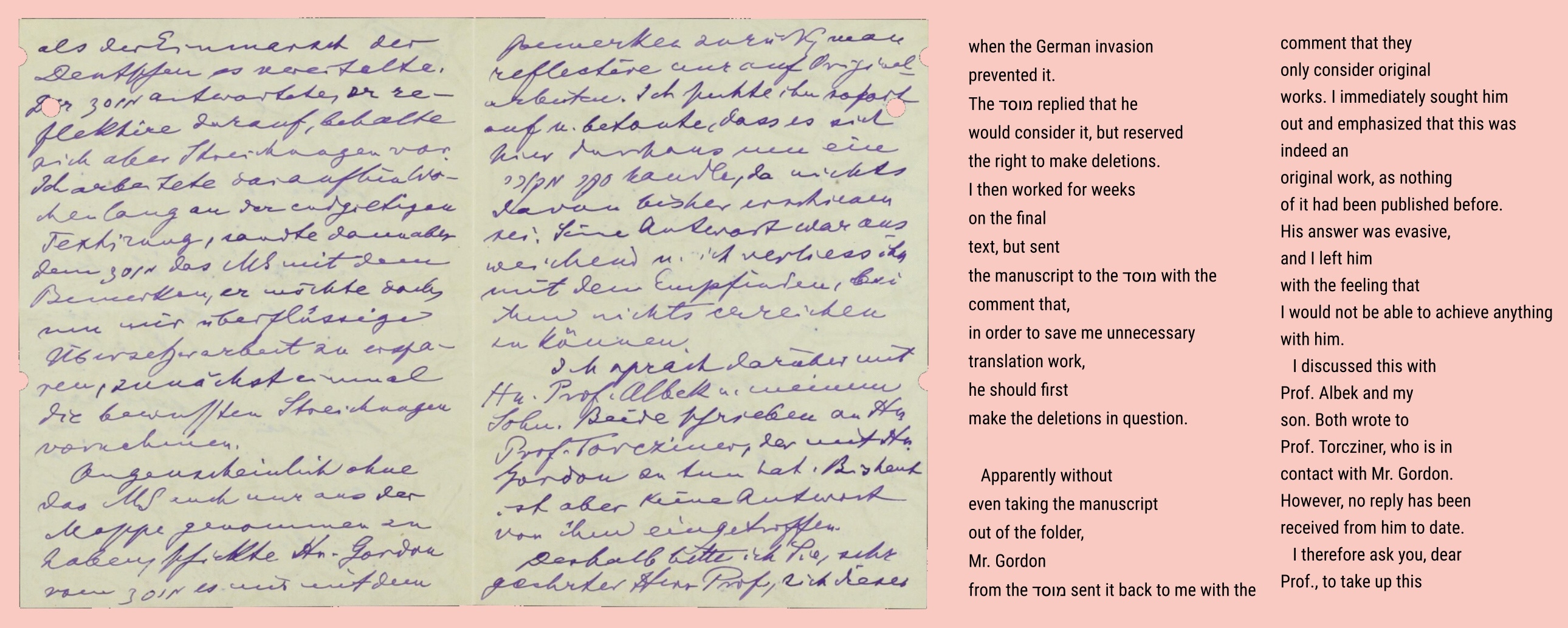
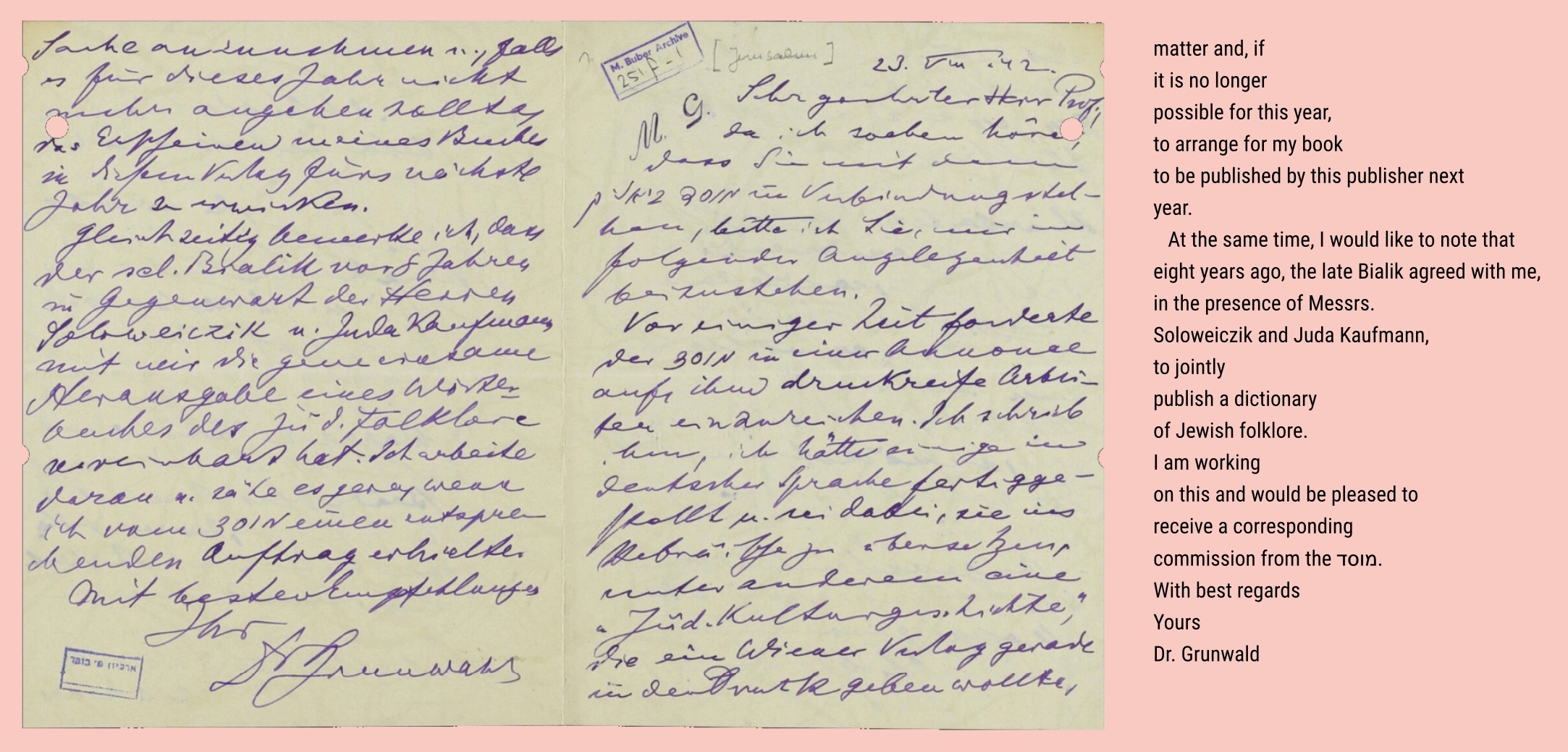
Even after his escape from Vienna to Jerusalem in 1938, Max Grunwald’s academic work was marked by recurring challenges. Publications by Hebrew publishers now required the additional translation of his works, which were written in German. His efforts to publish a Jüdische Kulturgeschichte [“Jewish Cultural History”] in Palestine, the publication of which had been thwarted in Vienna by the German invasion, proved difficult. Grunwald therefore fell back on his existing (correspondence) networks and asked Martin Buber to intervene directly with the Mossad Bialik publishing house. In his letter, Grunwald also mentions by the way all the other gentlemen he had already consulted on the matter. In the end, all this networking seems to have been in vain. There is no evidence of the publication of Grunwald’s Jewish Cultural History, nor of the Dictionary of Jewish folklore mentioned in the letter, the compilation of which is said to have been personally agreed with the national poet Chaim Nachman Bialik in 1934.
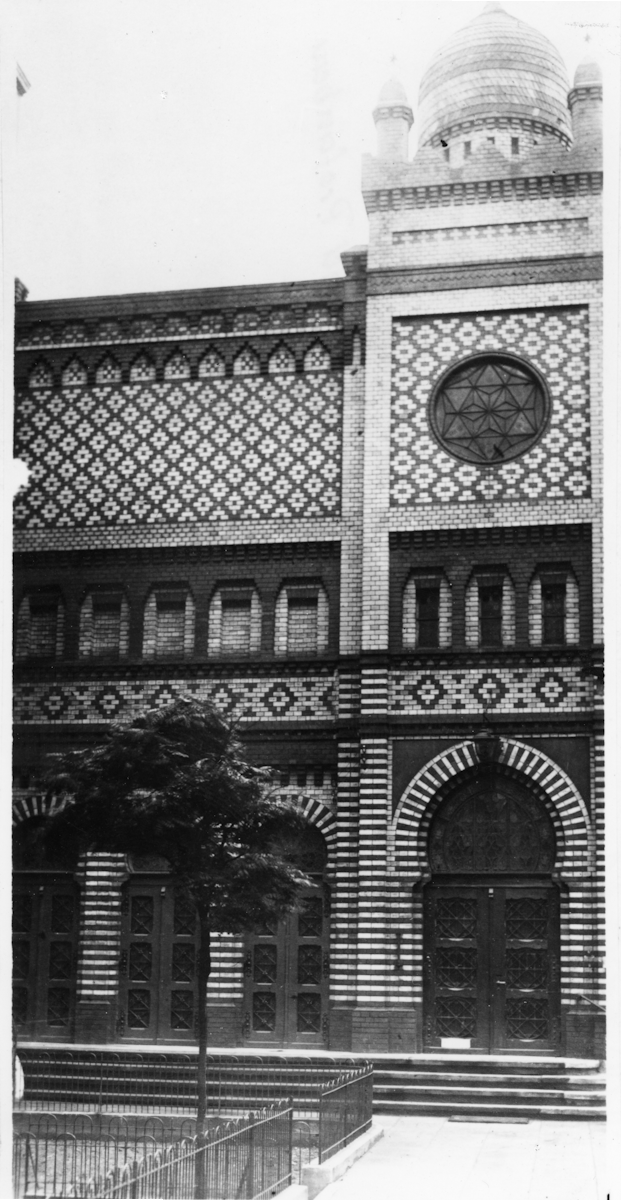
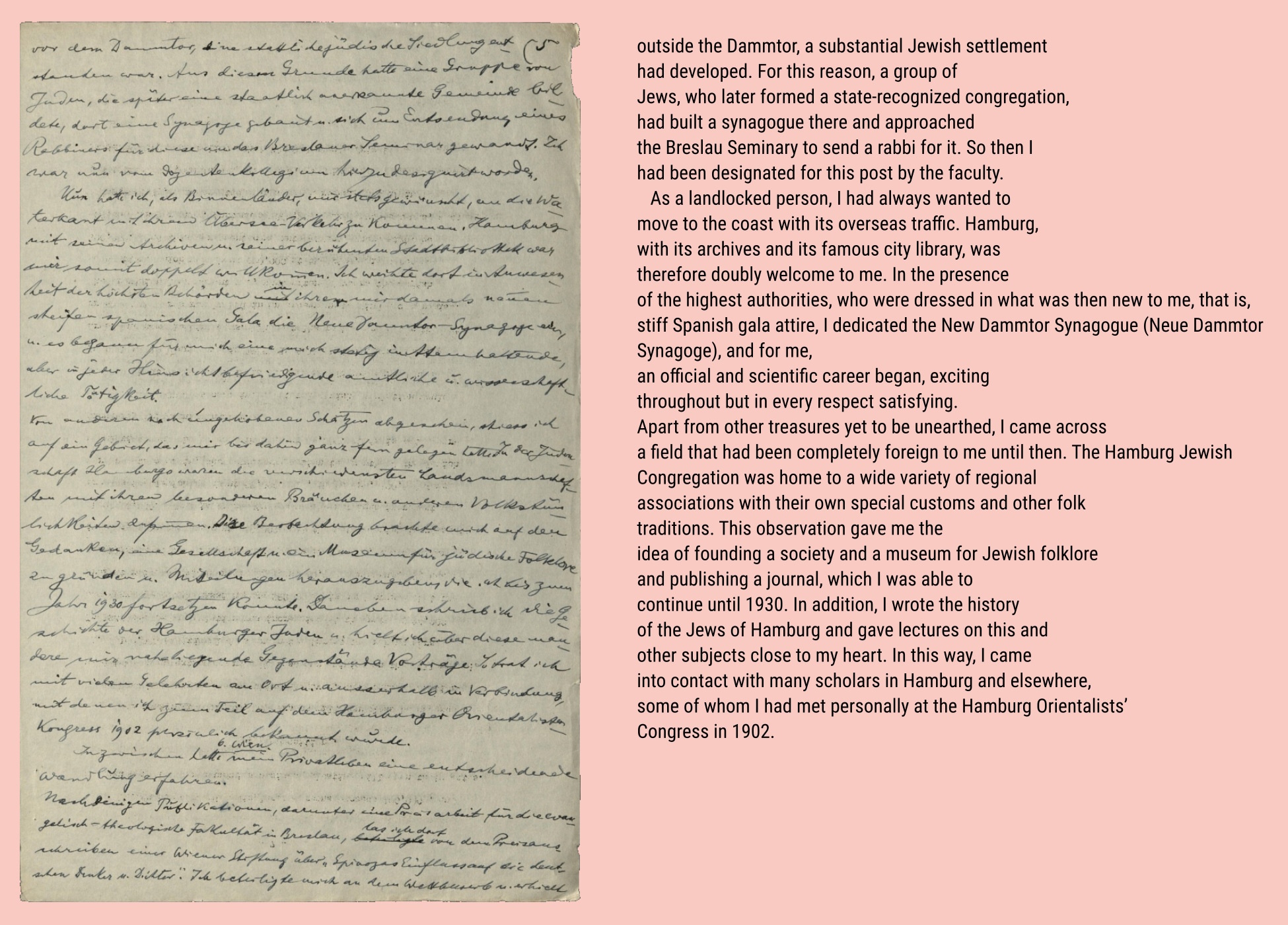
Although Max Grunwald’s literary estate has not yet been cataloged, handwritten and other documents by him can be found in numerous collections at the NLI and the Central Archives for the History of the Jewish People. These include the more than 100-page handwritten draft of his autobiography, Eighty Years of My Life, which he probably wrote in Jerusalem in the early 1950s. Right at the beginning, Grunwald gives an overview of the stages of his life in Europe: Breslau, Hamburg, and Vienna. He considered the eight years he spent as a rabbi in the Hanseatic city from 1895 to 1903 to be particularly formative for his academic career. He only briefly describes the inauguration of the New Dammtor Synagogue, which was attended by the Hamburg authorities in full “Spanish” regalia. At the same time, the text makes it clear that the various religious movements and traditions that Grunwald experienced, helped shape, and observed during his time in Hamburg were the impetus and starting point for his interest in Jewish folklore. With the founding of the Society for Jewish Folklore and the publication of Mitteilungen [“Bulletin”], he had already created an academic and journalistic network for his life’s work in Hamburg, which he also made extensive use of in Vienna and later in Jerusalem.
The prestige of cultural prizes always shines in two directions. In the best case, the general reputation of both the award winners and the awarding bodies increases. The minutes of the board of trustees meeting of the Hanseatic Goethe Prize on December 1, 1951, exemplify the complex considerations involved in awarding an important prize. Martin Buber is at the top of a list of 24 personalities, some of whom very well known, whose respective suitability (or unsuitability) for the Goethe Prize is briefly explained. But it was only Buber’s assurance that he would actually accept the prize if awarded, and the overcoming of the concerns of the founder Alfred Töpfer “due to the ongoing state of war with Israel” that made it possible to implement the unanimous decision. The official letter from University Rector, Bruno Snell, to Martin Buber suggests that the “honor and joy” that Buber was able to bestow upon the university and the City of Hamburg by personally accepting the prize was probably much greater than the gain in prestige for the prize winner himself. The reservations and hostility to which Buber was subjected after the award was announced once again underscore the asymmetry of the honor.
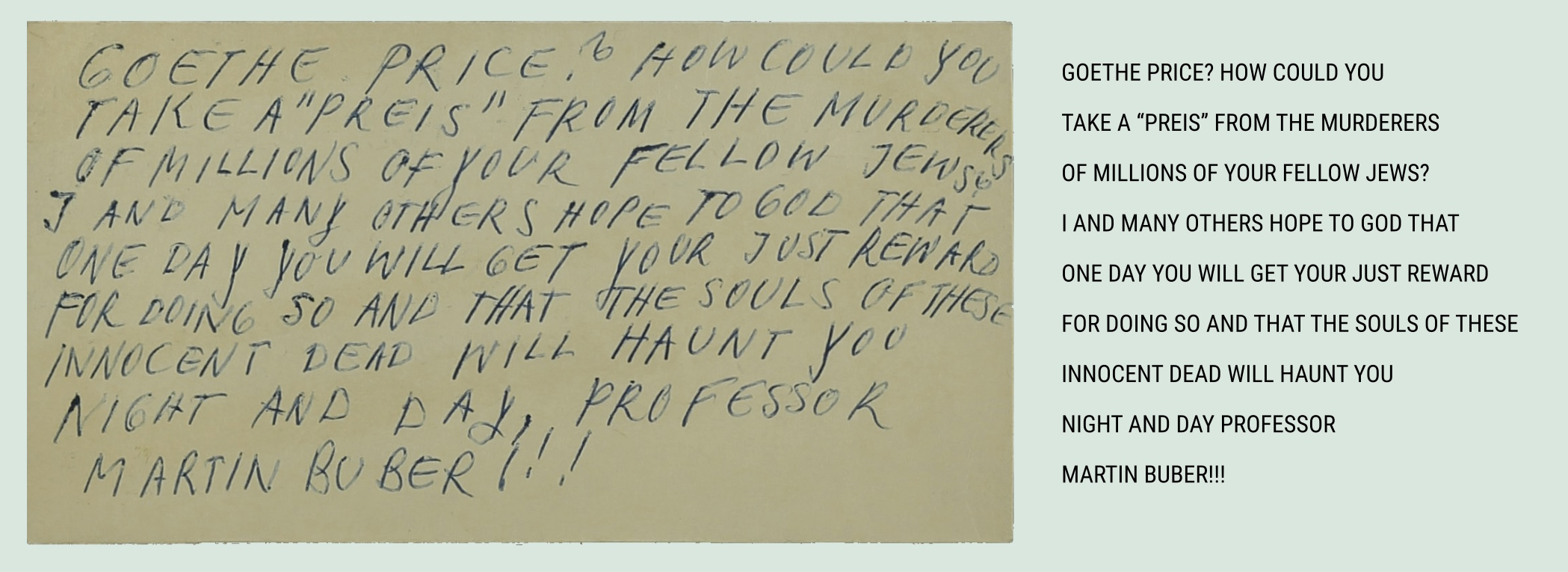
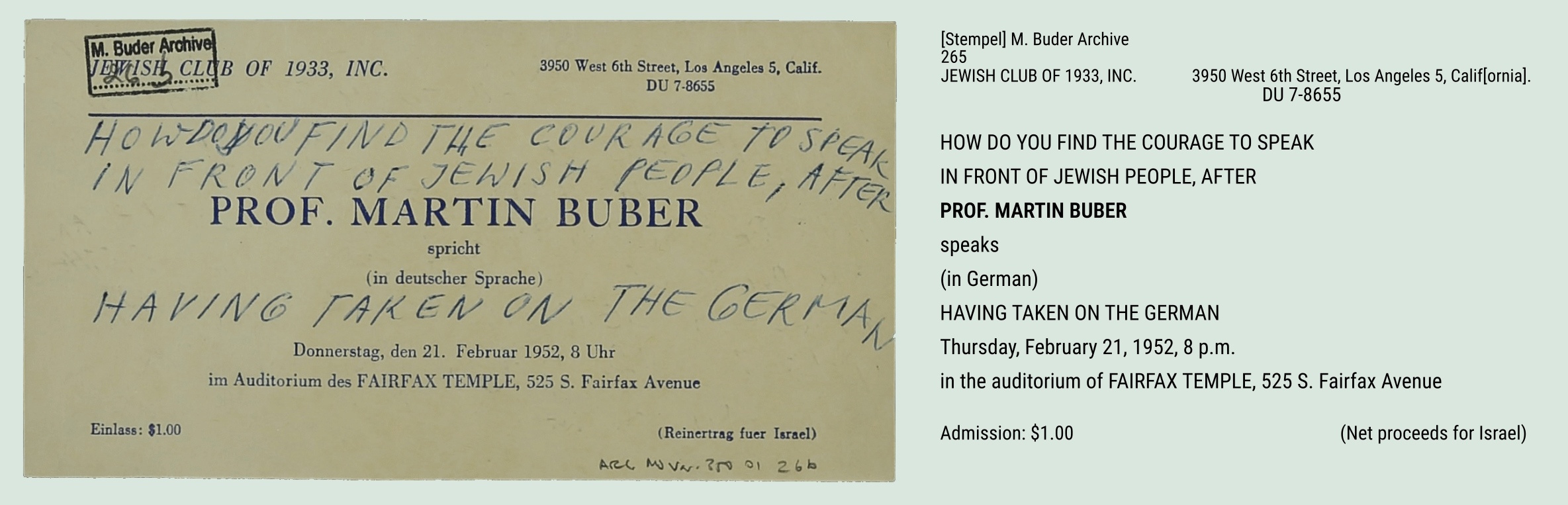
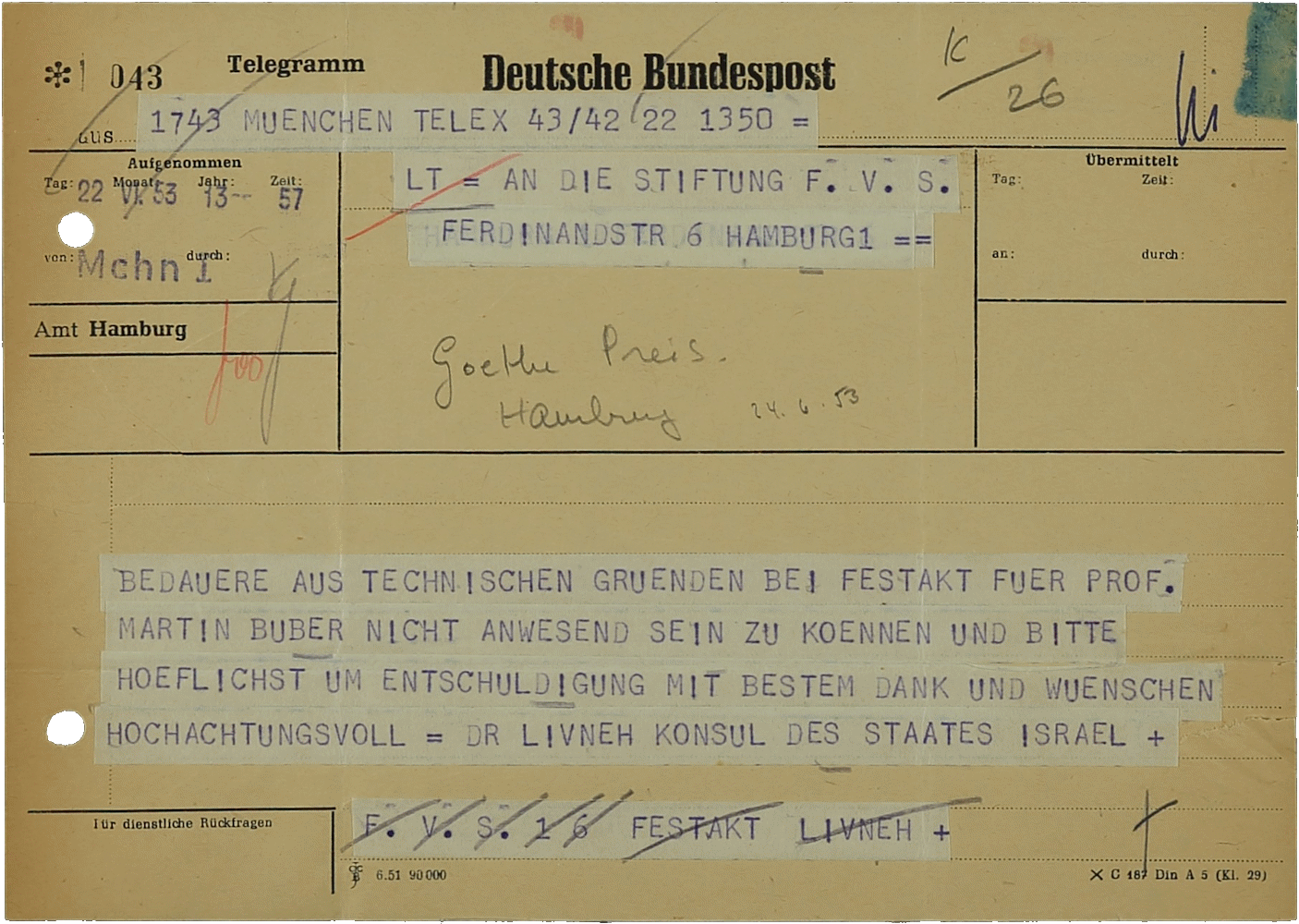
The awarding of the Hansischer Goethe-Preis to Martin Buber came at an extremely sensitive time, just a few years after the end of World War II, when there were no official relations between the State of Israel and the Federal Republic of Germany. At the same time, restitution payments for Nazi crimes were being negotiated, which caused strong protests in Israel and, in 1952, resulted in the Luxembourg Agreement. Martin Buber also faced fierce criticism both in Israel and in the Jewish diaspora for his decision to accept the Goethe Prize and thus accommodate Germany’s “efforts at moral reparation” (Erich Lüth). The anonymous note on the invitation card to a Buber lecture in Los Angeles in February 1952 sums up the reservations. At around the same time, Mascha Kaléko in New York expressed her criticism of Buber's decision in her own way—in the short poem “Die Preisgabe” [The Betrayal]. It can be assumed that the Israeli consul Eliahu Livneh’s refusal to attend the award ceremony in June 1953 was not based solely on “technical reasons.” The consulate in Munich was in fact closed shortly afterward and replaced by the Israeli trade mission in Cologne. Official diplomatic relations between Israel and Germany did not begin until 1965.
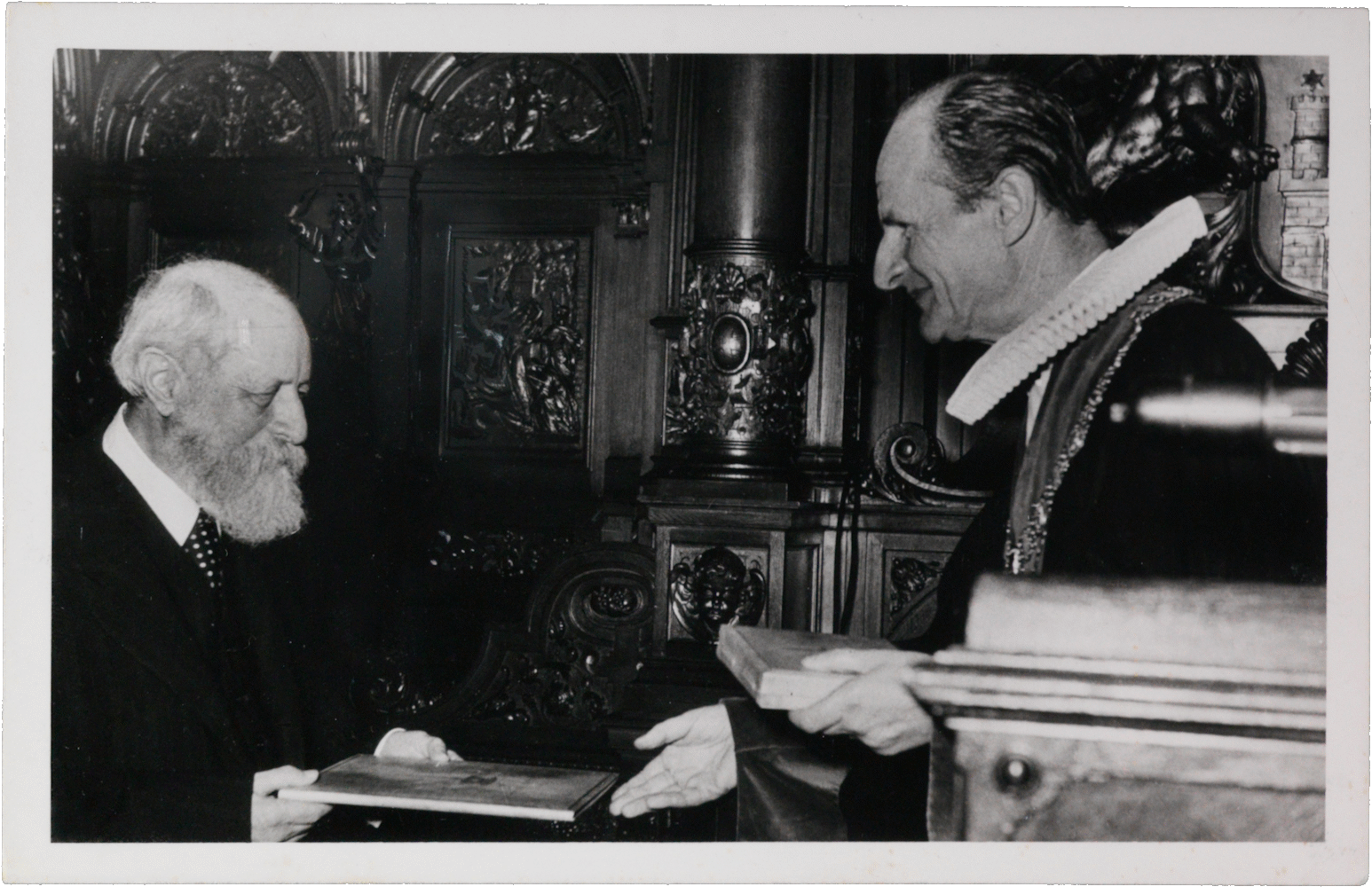
Although the presentation of the Hanseatic Goethe Prize for 1951 was initially scheduled for February 1952, it was not until June 24, 1953, that Martin Buber personally went to Hamburg and accepted the award in the banquet hall of Hamburg City Hall. The certificate lists in detail the philosophical, moral, and educational achievements of Buber, who “always courageously advocated for understanding among people.” In contrast to the opulence of the wooden decorations in the ceremonial hall and the solemn gown of the University Rector, Bruno Snell, adorned with a stiff collar and chain of office, the Jerusalem philosopher, revered by many, almost disappears in his modest dark suit at the left edge of the photograph of the ceremony shown here.
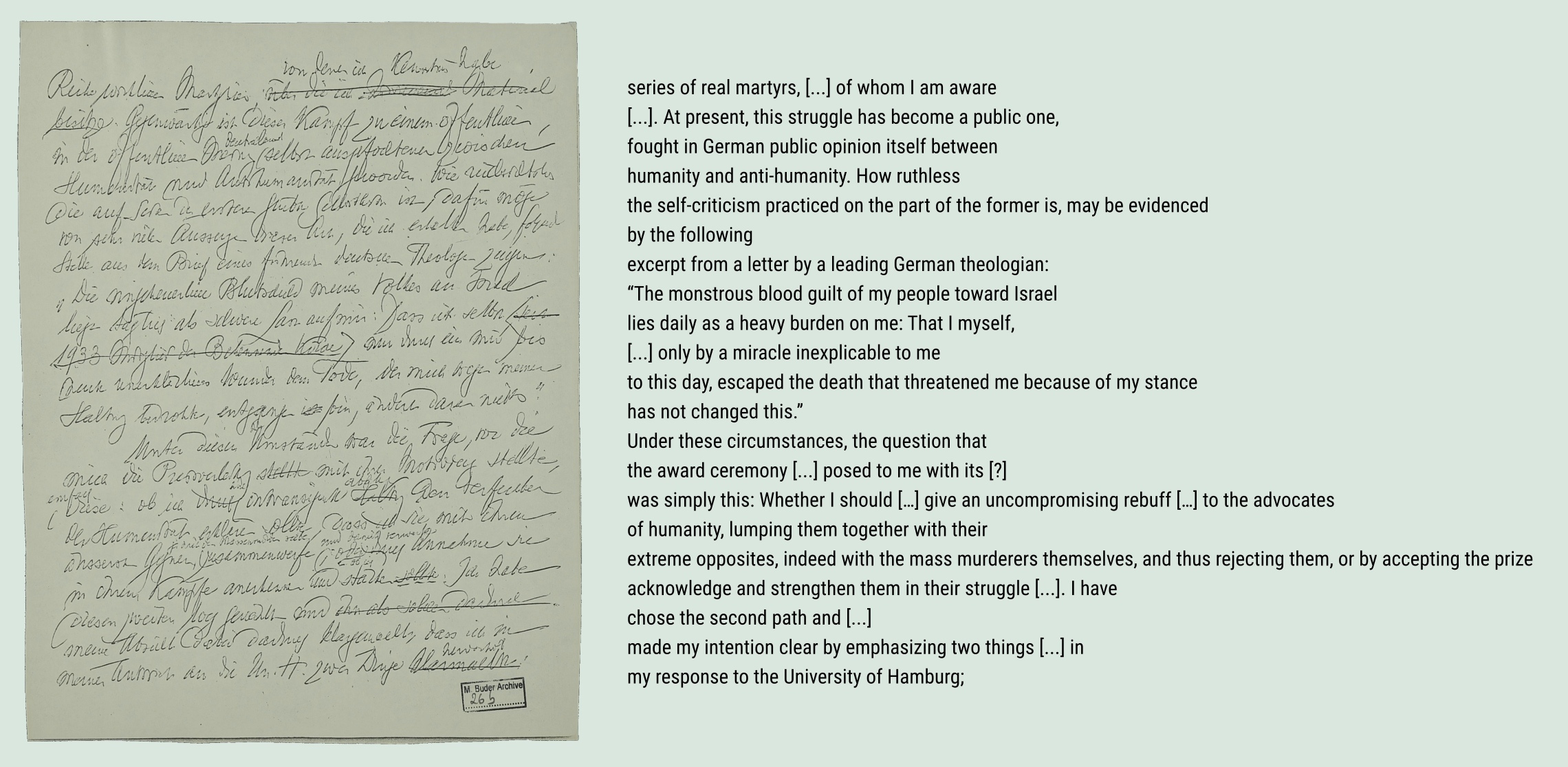
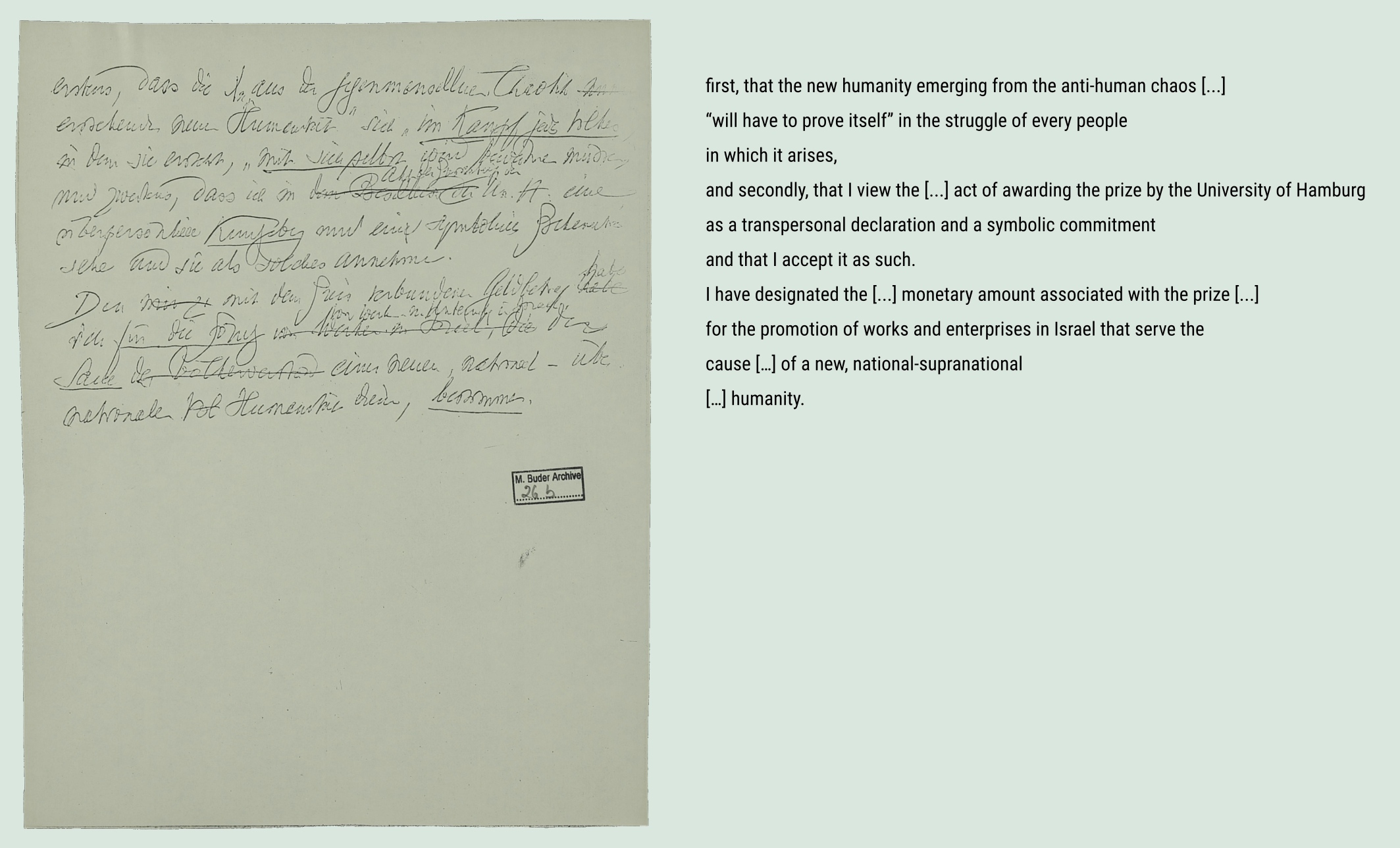
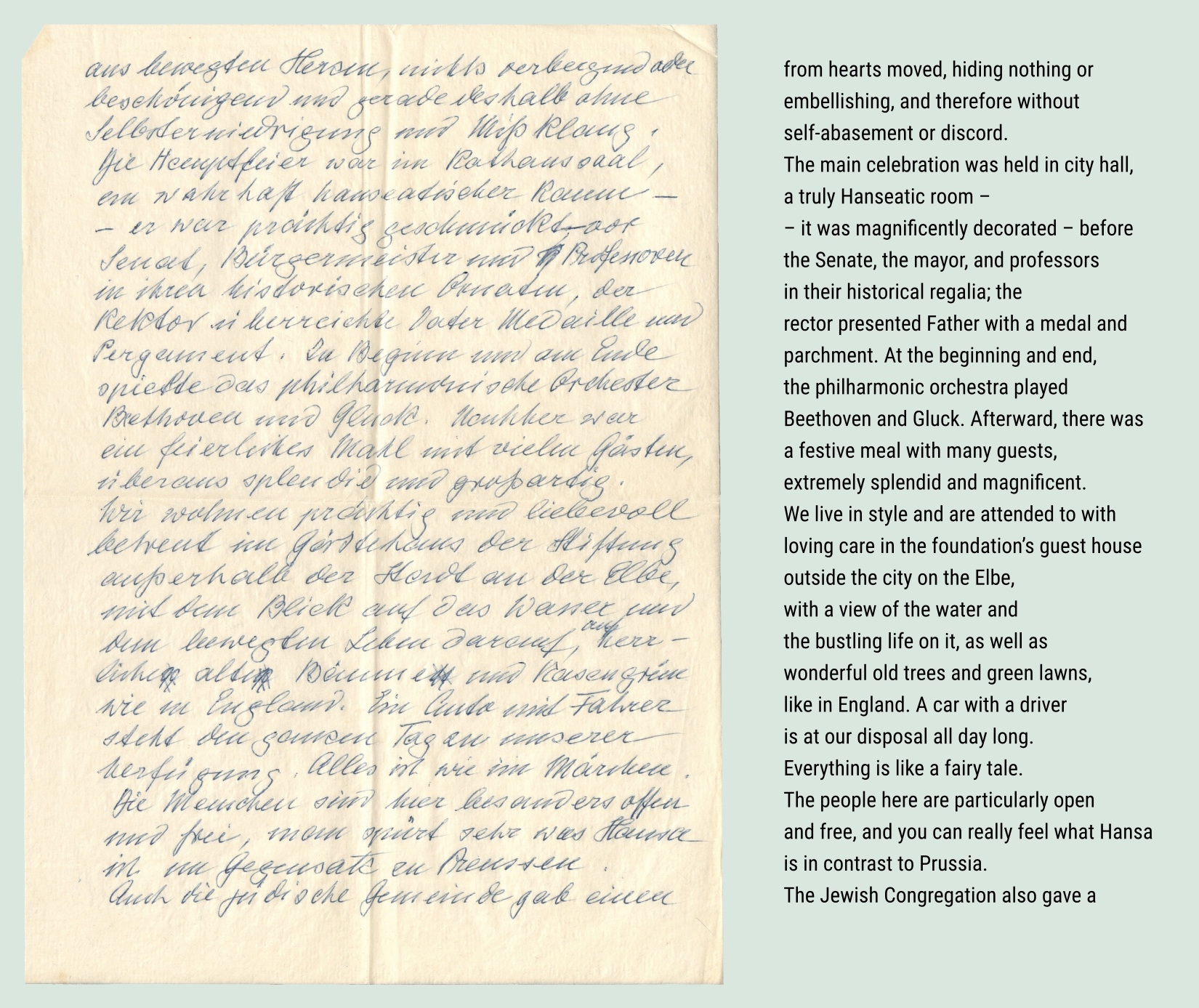
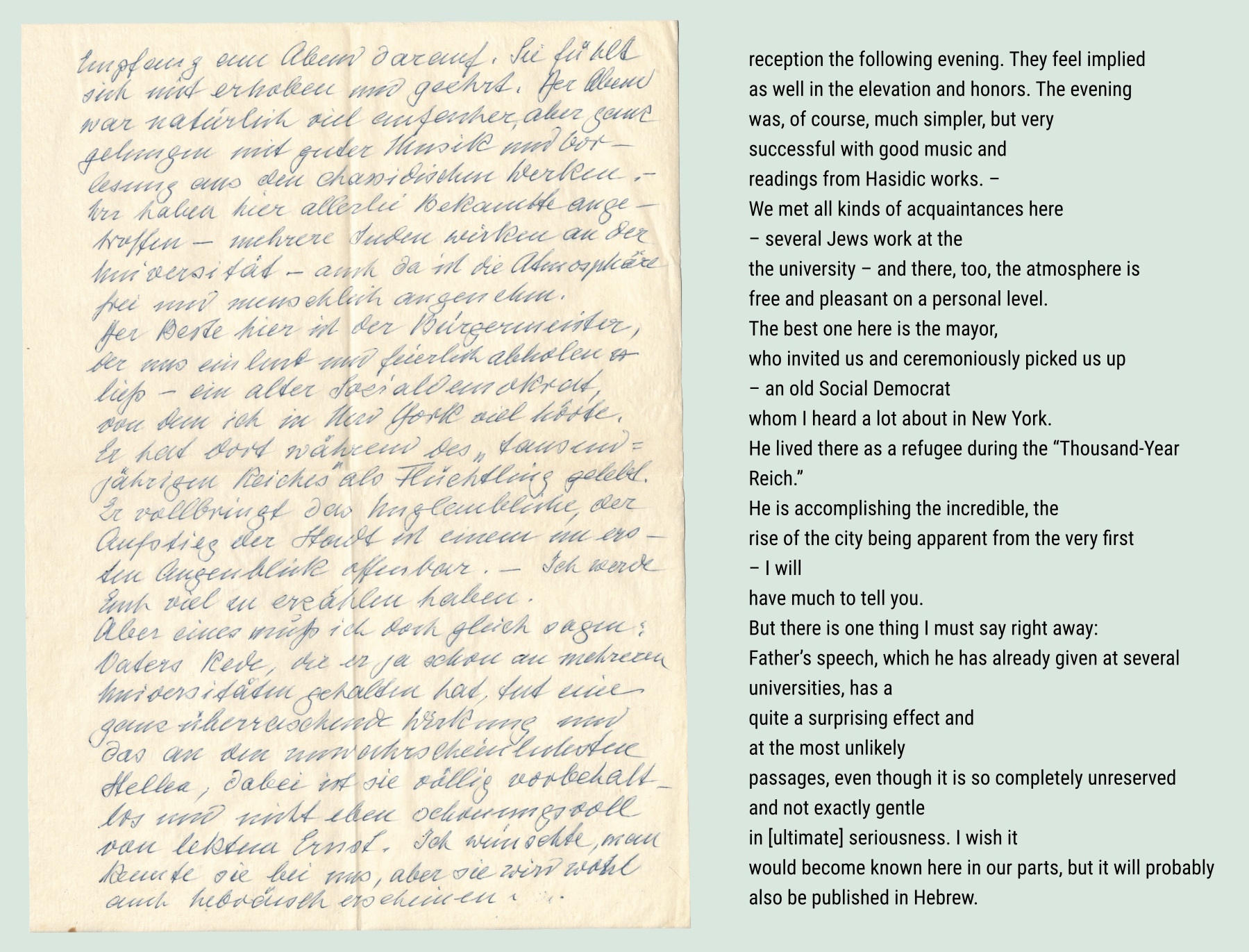
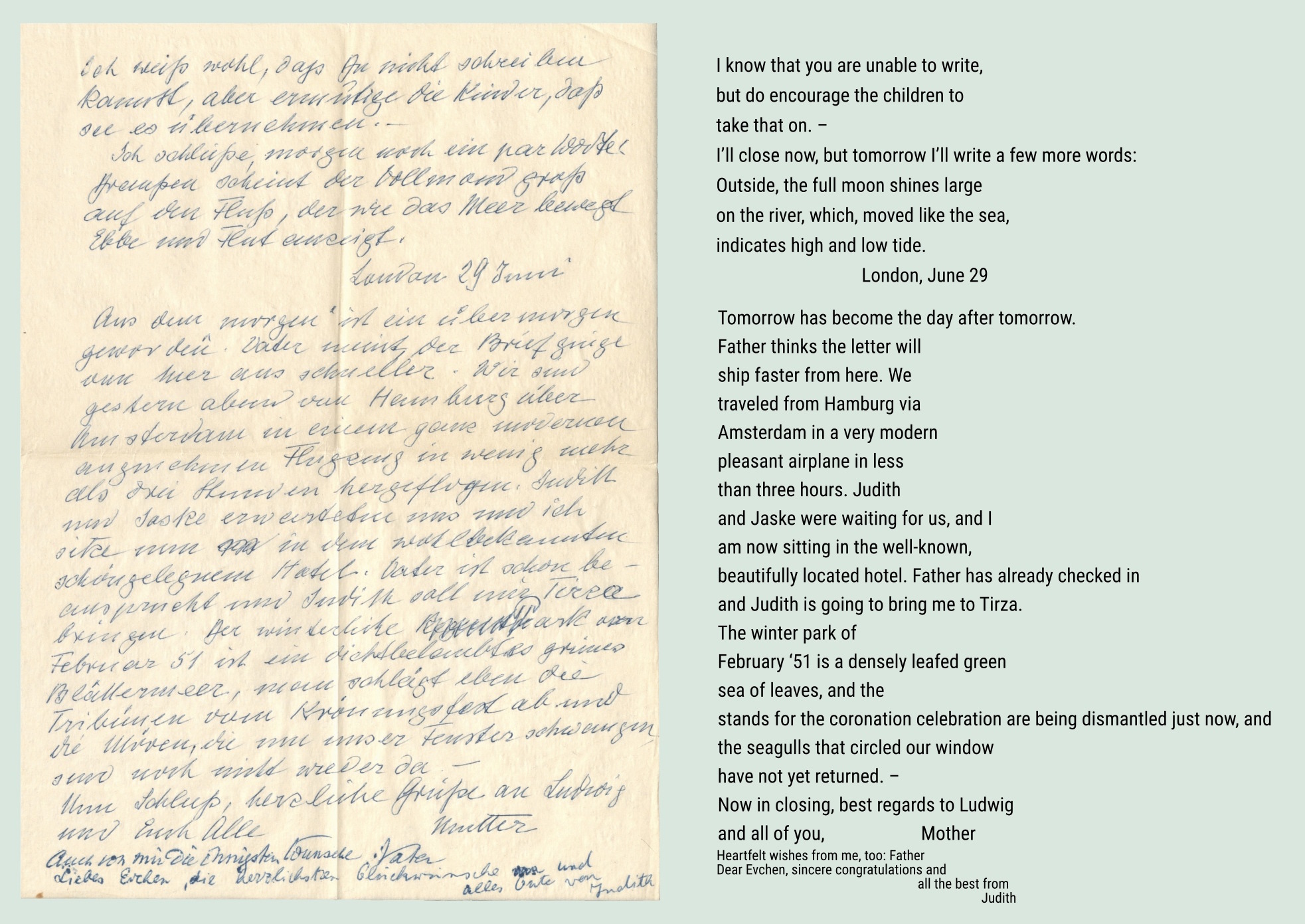
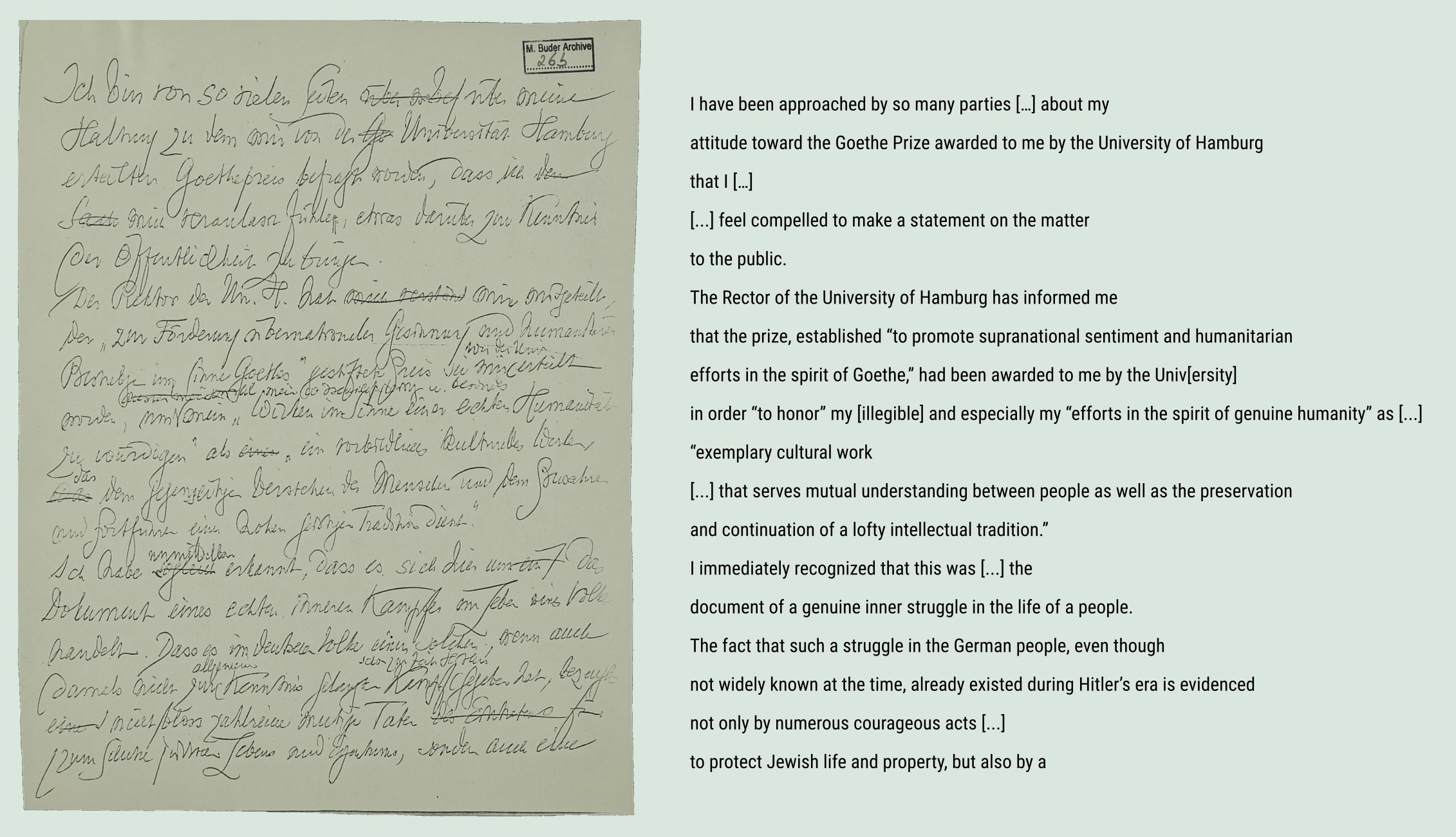
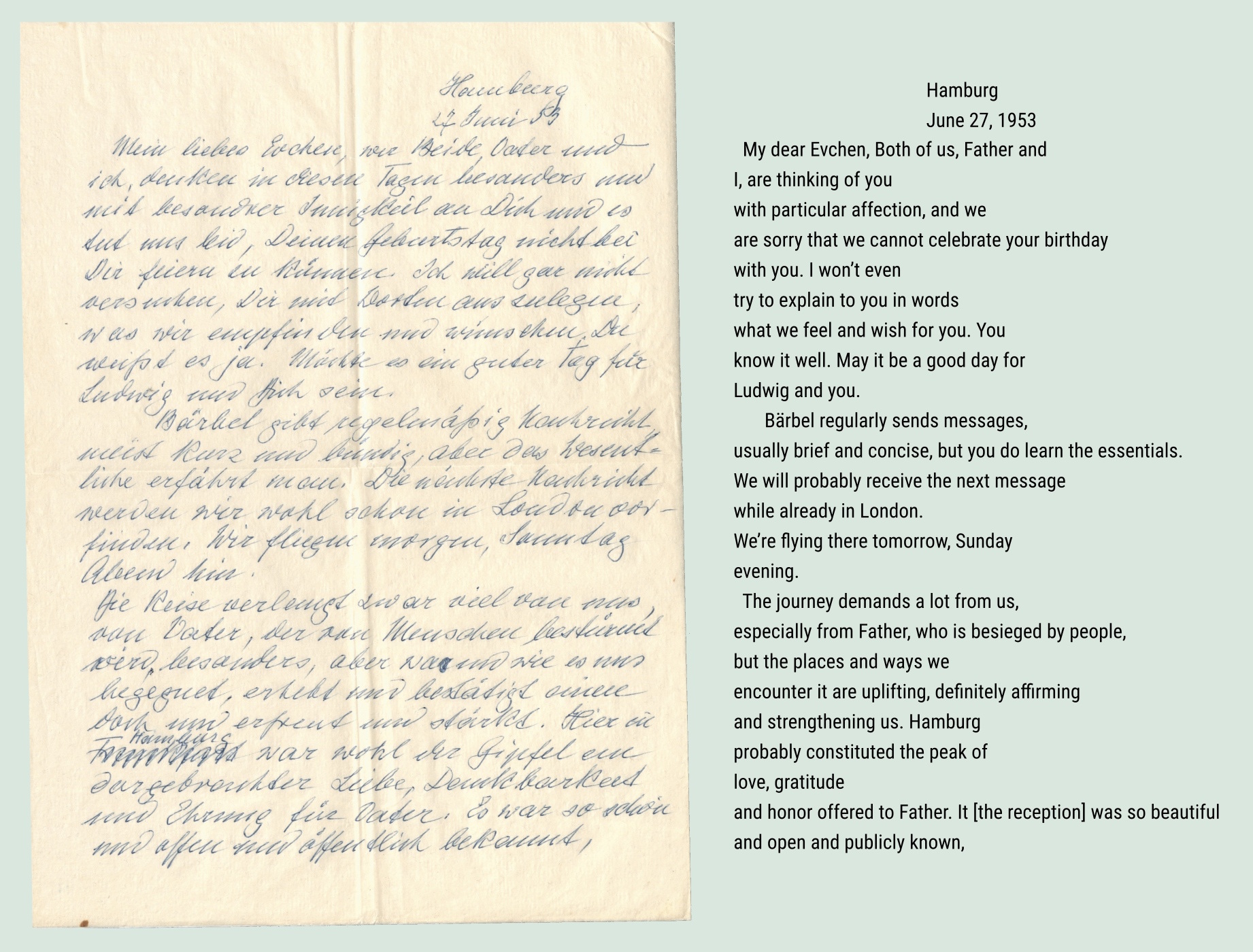
In response to criticism of the award ceremony, Martin Buber obviously felt compelled to justify his decision to accept the prize. His handwritten draft of a reply, a copy of which is preserved in his literary estate, draws a parallel between resistance to National Socialism and the current struggle for humanity. He stated that he wished to strengthen the forces of humanity and therefore accepted the prize as a “symbolic commitment” and donated the prize money to appropriate causes in Israel. A somewhat different, more private view of Buber’s trip to Hamburg is provided by the letter from his wife Paula Buber to their daughter Eva Strauss in Israel. She describes in detail the hospitality and goodwill shown to Martin Buber in particular, both by the city of Hamburg and by the local Jewish congregation. Everything was “like a fairy tale.” She attests to the visible successes of First Mayor Max Brauer – “an old Social Democrat whom I heard a lot about in New York” – in rebuilding the city. The last page of the letter includes a short greeting from “Father,” who sends his daughter his “most heartfelt wishes.”
“At the heart of his teaching is the idea of conversation, of dialogue between people and between people and God. He transcends narrow religious boundaries and becomes an important voice in Christian-Jewish encounters during the interwar period and after the end of World War II.”presumably introductory text to the exhibition entitled “Martin Buber 1878–1978. Werk und Wirkung“ [“Martin Buber 1878–1978. Work and Impact”], 1978
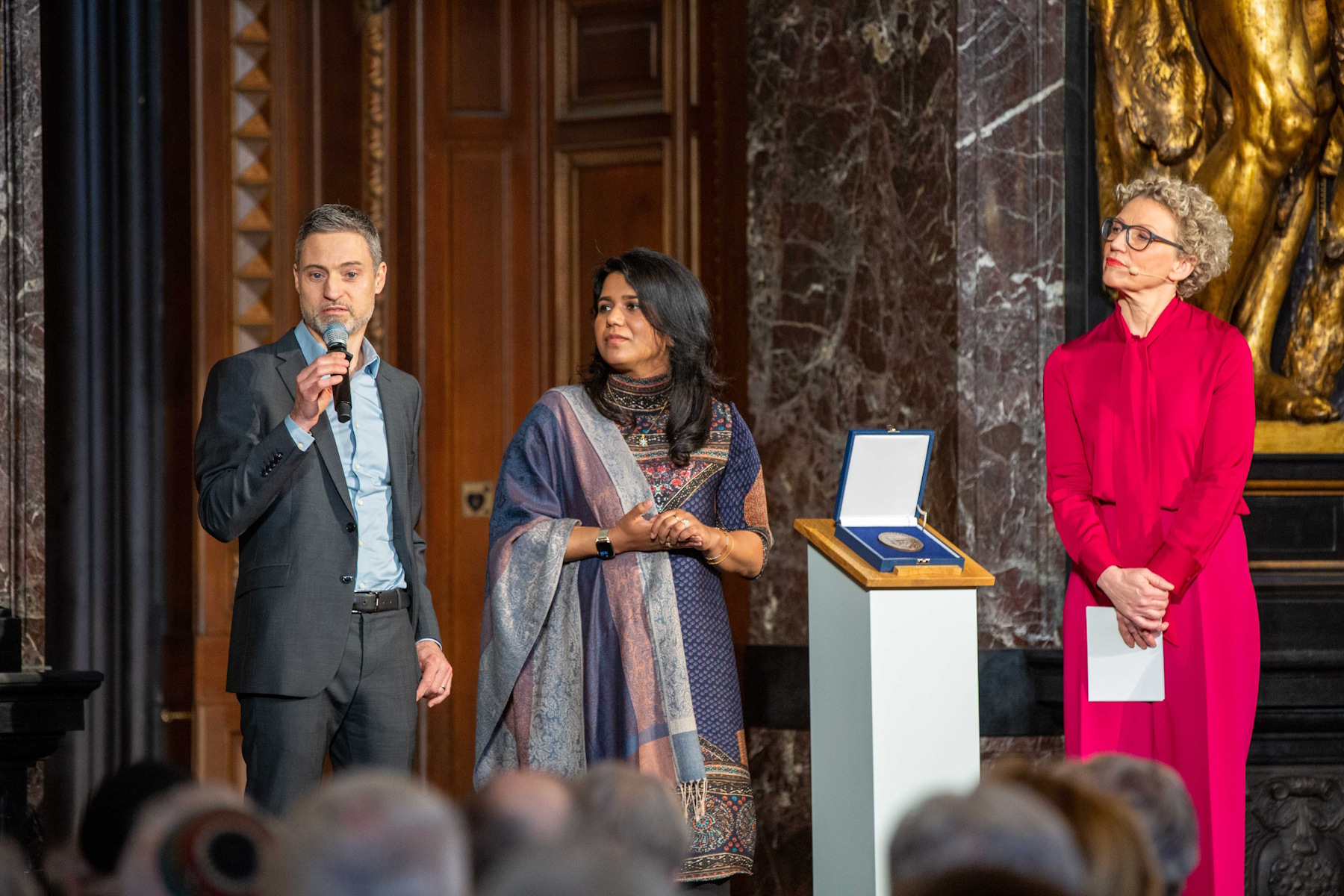
Martin Buber remained a central reference point and object of projection in non-Jewish-Jewish and German-Israeli rapprochement processes in the following decades. On the occasion of the 100th birthday of the religious philosopher, the German Coordinating Council of Societies for Christian-Jewish Cooperation initiated exhibitions across Germany on Buber’s work during the “Week of Brotherhood” in 1978. “Martin Buber wanted to build a bridge not only between Christians and Jews, but also between Germans and Jews. To us, he is one of the fathers of our work,” wrote Wolfgang Zink, Secretary General of the German Coordinating Council, to the First Mayor of the City of Hamburg in 1977. The impetus for the “revival” of Buber’s work was taken up by the city’s culture office and implemented by Rolf Burmeister of the State and University Library and Peter Freimark, Director of the Institute for the History of German Jews. In March 1978, the exhibition entitled “Martin Buber 1878–1978. Werk und Wirkung” [“Martin Buber 1878–1978. Work and Impact”] was presented at the State Library, which was extended by two weeks due to “multiple requests”. More than 50 years later, during the theme year of “Füreinander Streiten” (“Contending for Each Other”), the German Coordinating Council awarded the Buber-Rosenzweig Medal to political scientist and journalist Saba-Nur Cheema and historian Meron Mendel. The award ceremony took place on March 9, 2025, in the ballroom of Hamburg City Hall, where Martin Buber had received the Hanseatic Goethe Prize 72 years earlier.
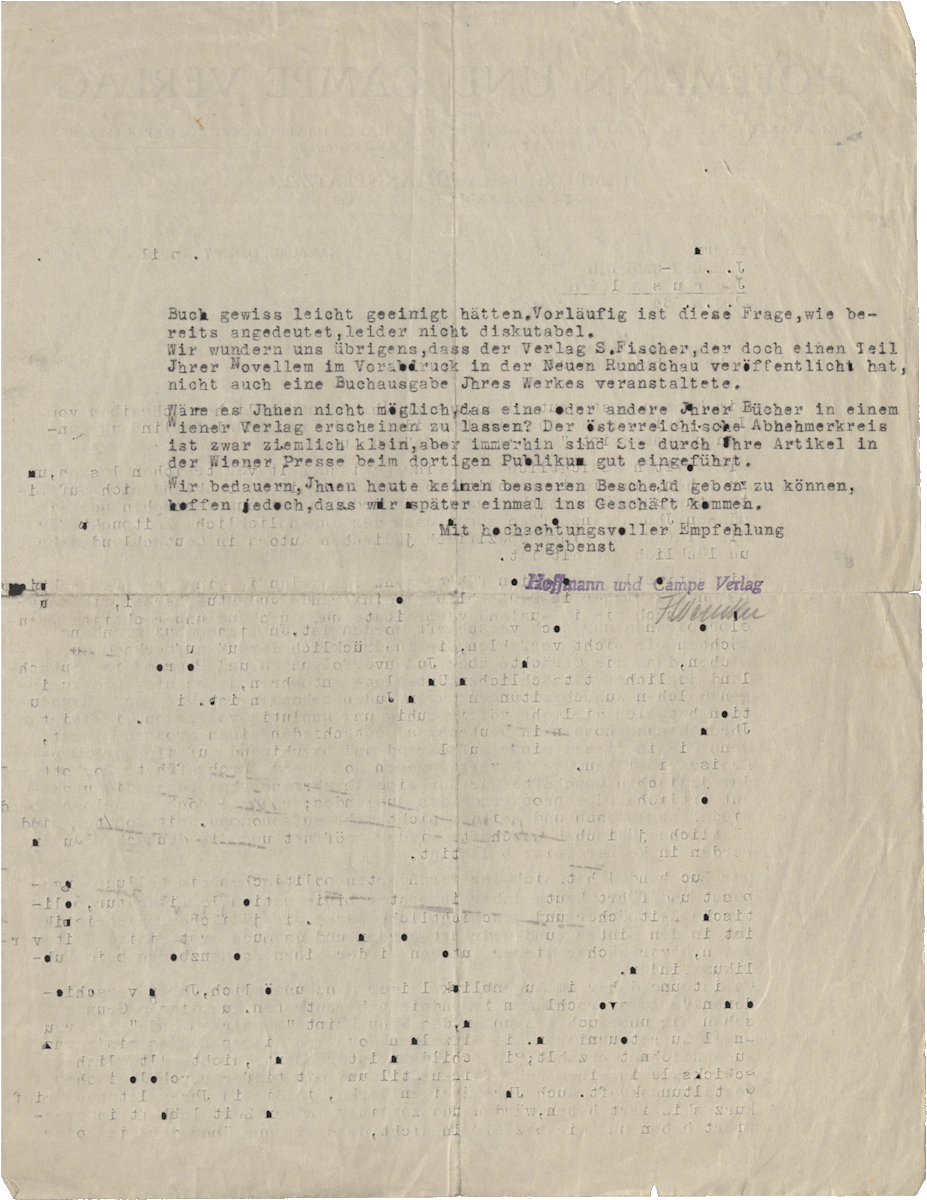
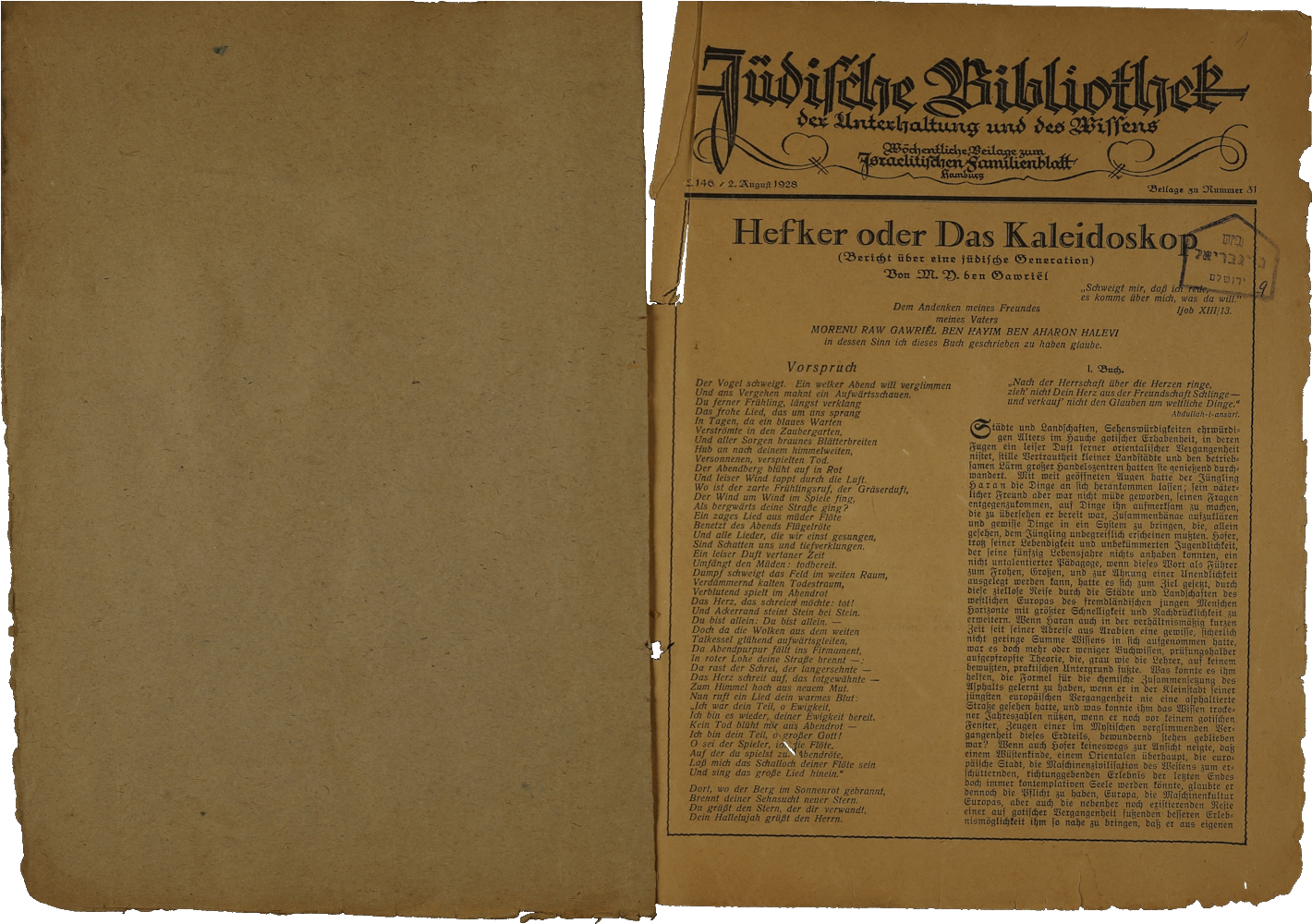
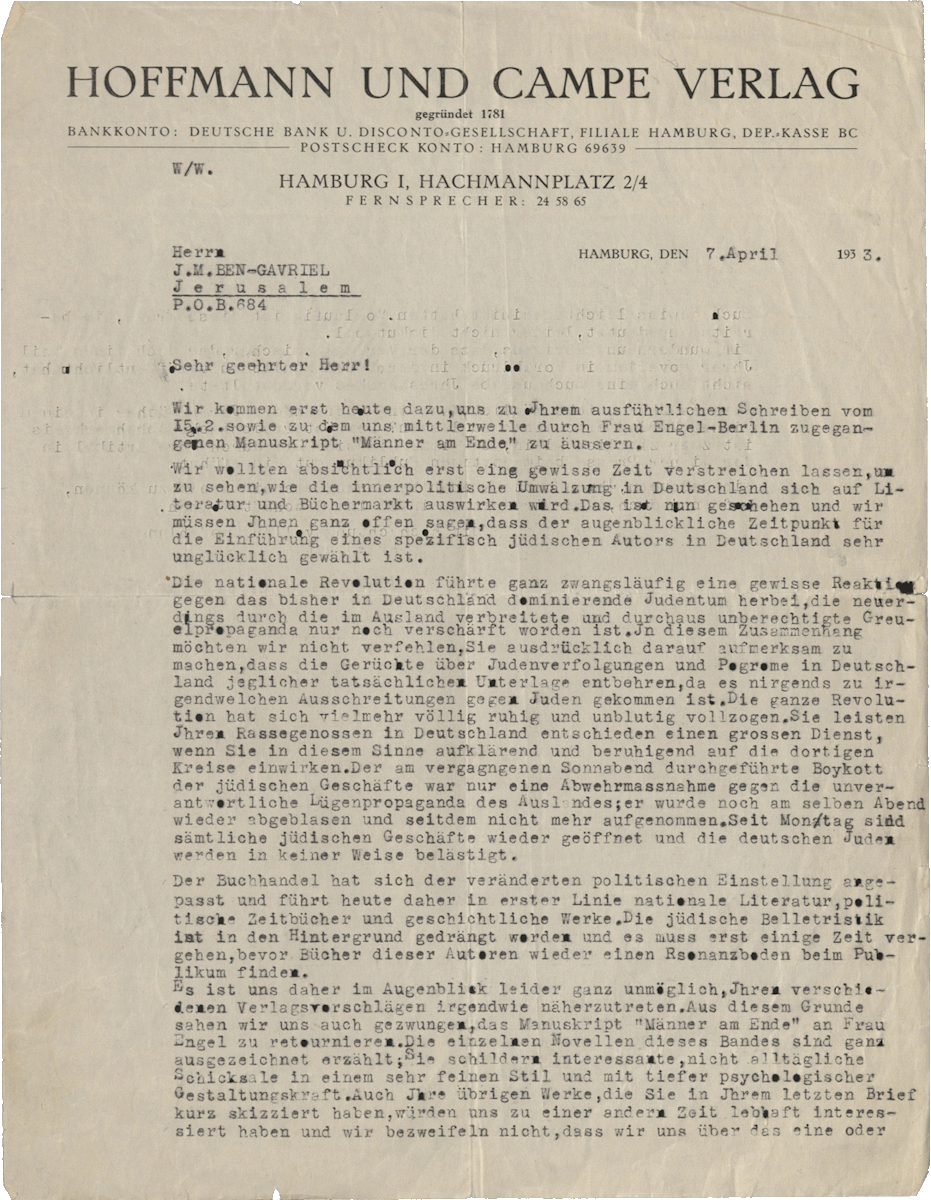
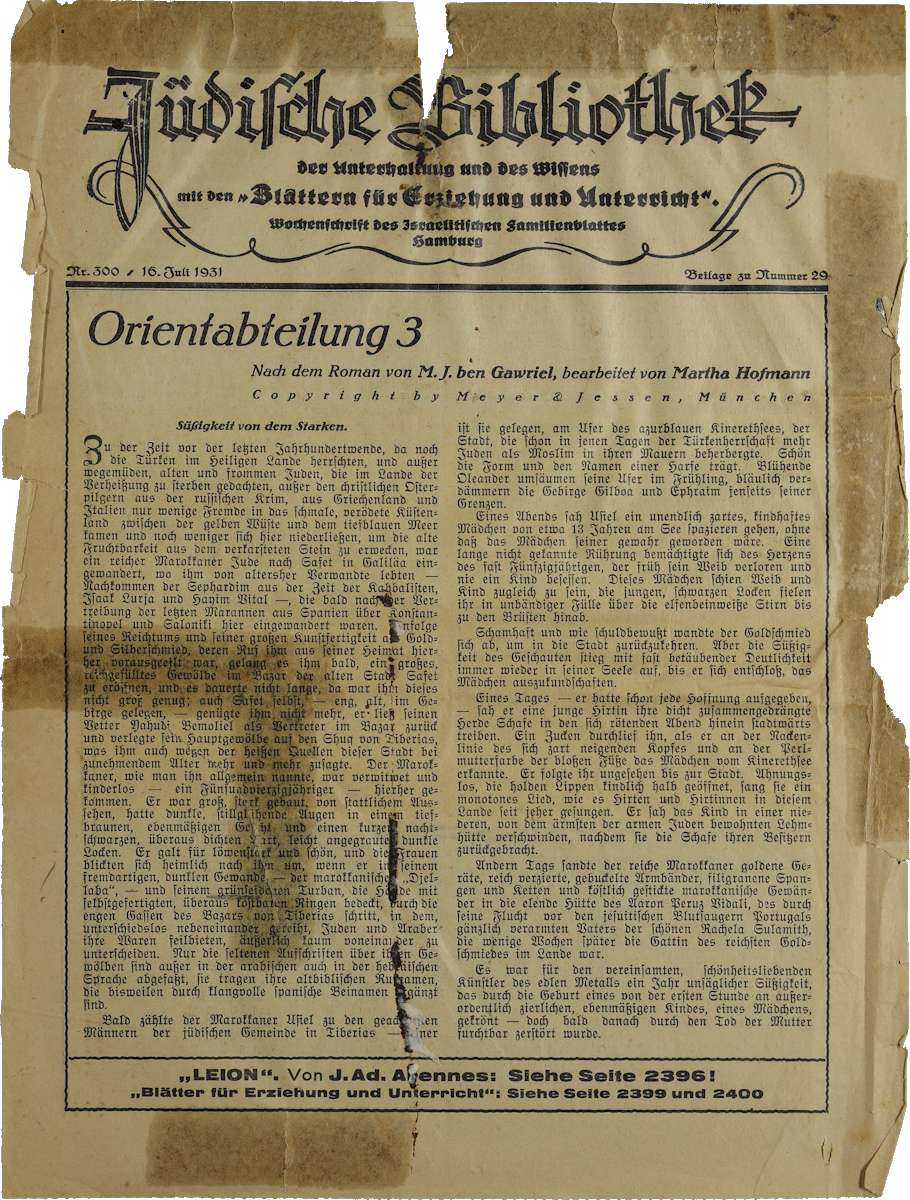
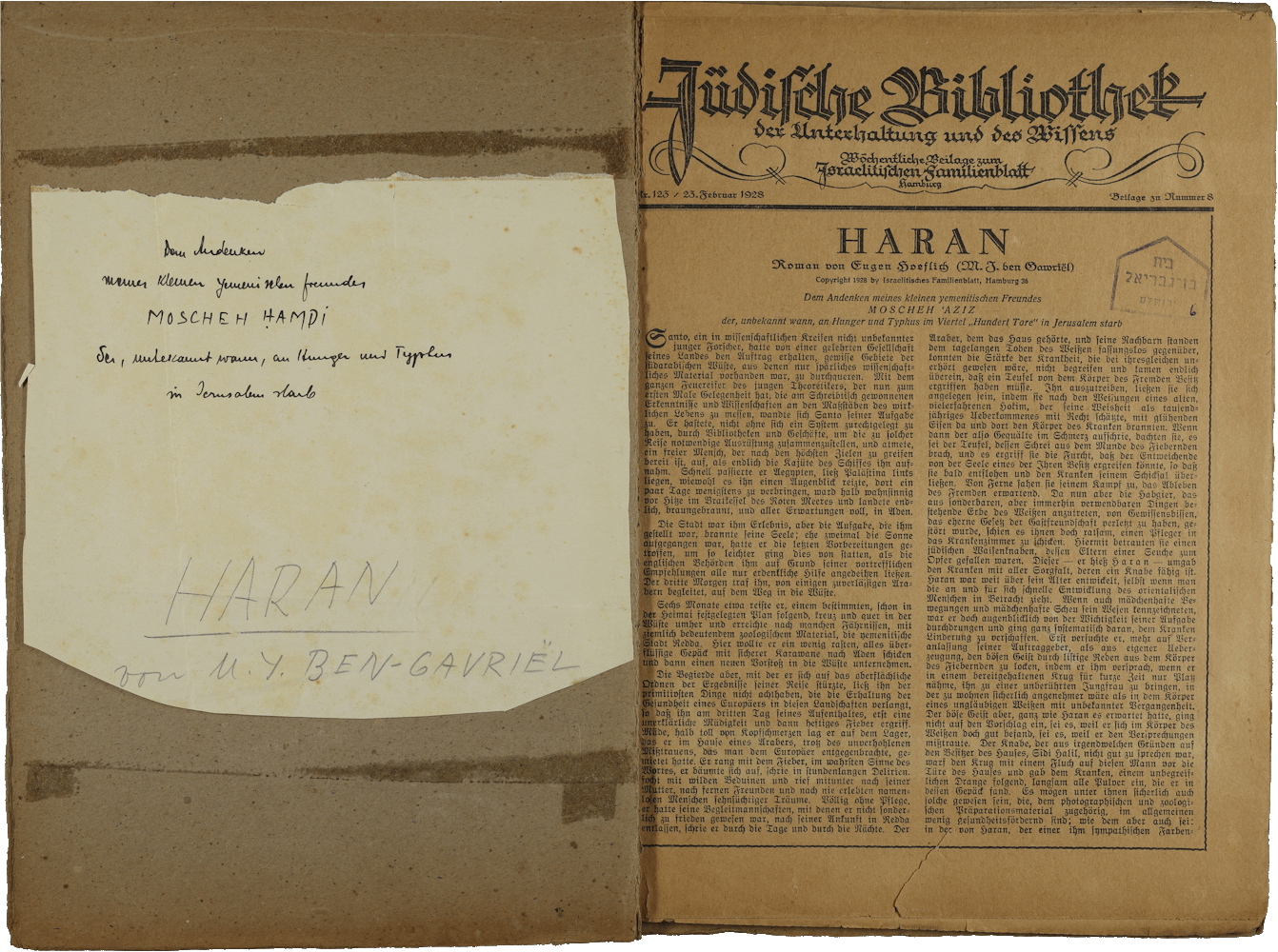
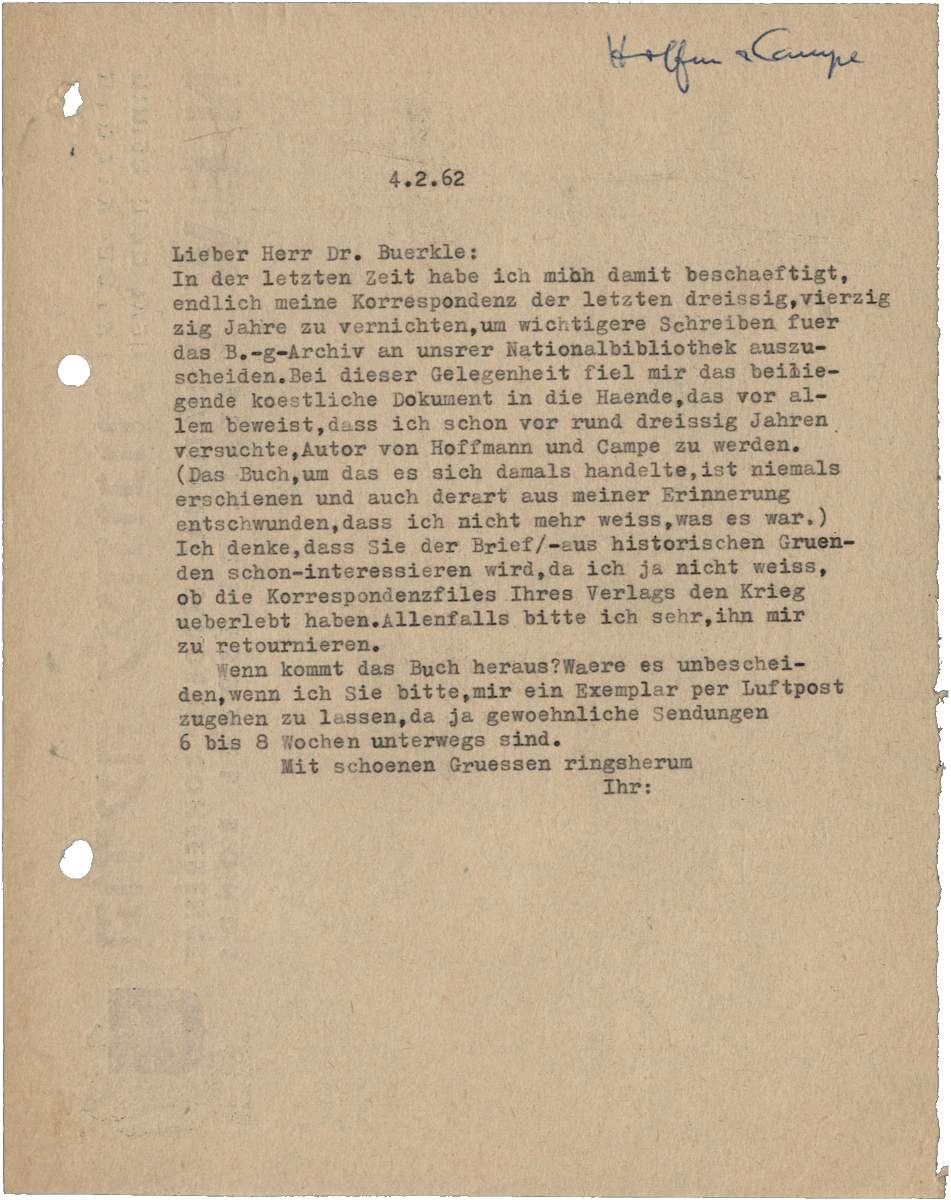
Complaints about the futile search for publishers for his books are a recurring theme in the letters and diaries of author M. Y. Ben-Gavriêl (Eugen Hoeflich), who had been living in Jerusalem since 1927 but continued to write in German. In 1928, he was able to publish the novels Haran and Hefker, dealing with the experiences of a young Yemeni Jew in Europe, in serial form in Israelitisches Familienblatt Hamburg, and in 1931 his adventure novel Orientabteilung 3. However, he was unable to achieve a ‘real’ book publication. The detailed rejection letter from the publisher Hoffmann und Campe dated April 7, 1933 clearly shows the German book market’s hasty adaptation to the changed political conditions after the National Socialists came to power, which meant that “Jewish fiction was pushed into the background.” Although the tone of the two-page letter is quite benevolent and praises the literary quality of the submitted manuscripts of Orientabteilung 3, it is verbose and ends with the hope of “doing business [with him] at a later date.” However, almost 30 years would pass before that happened.
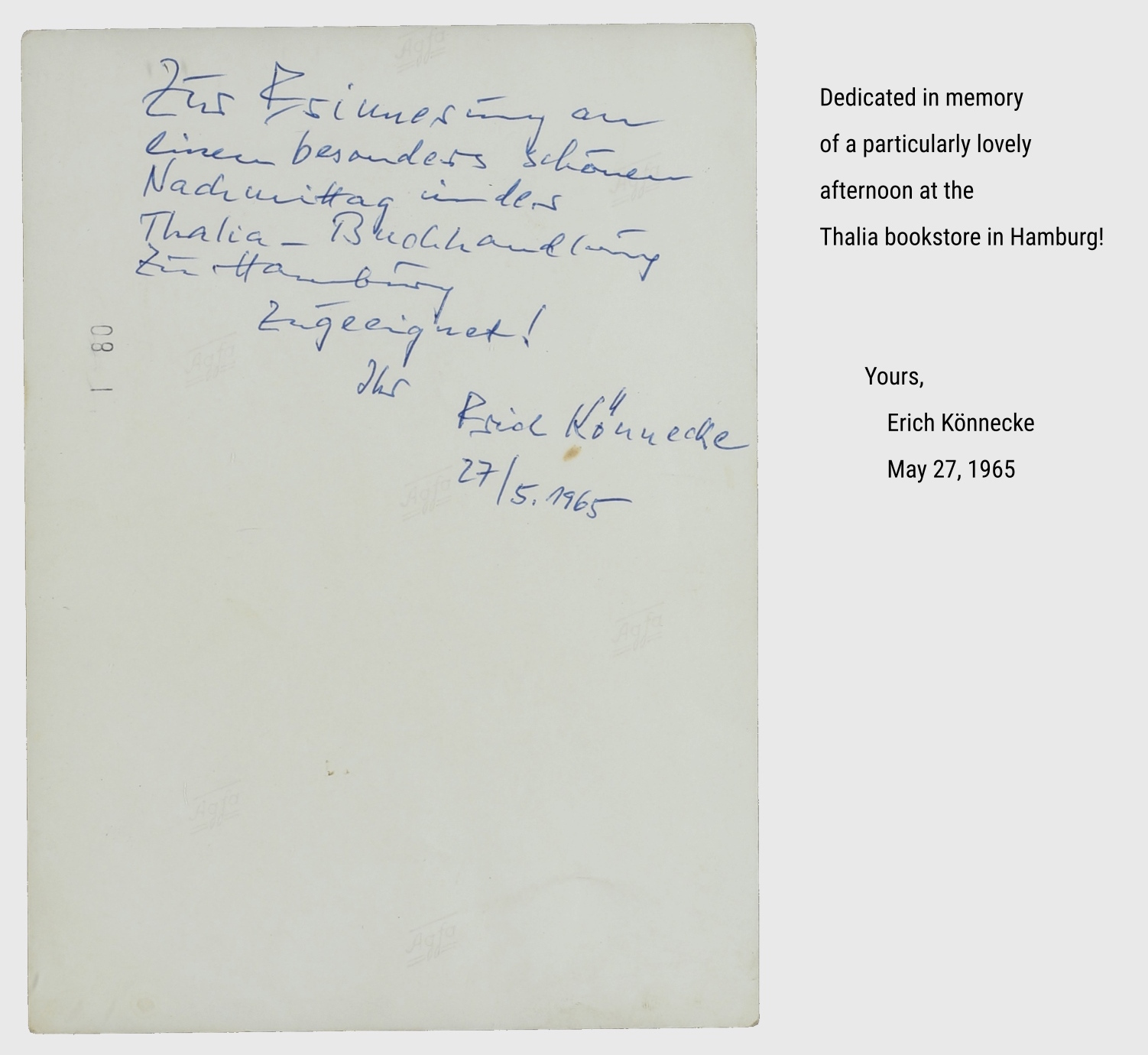
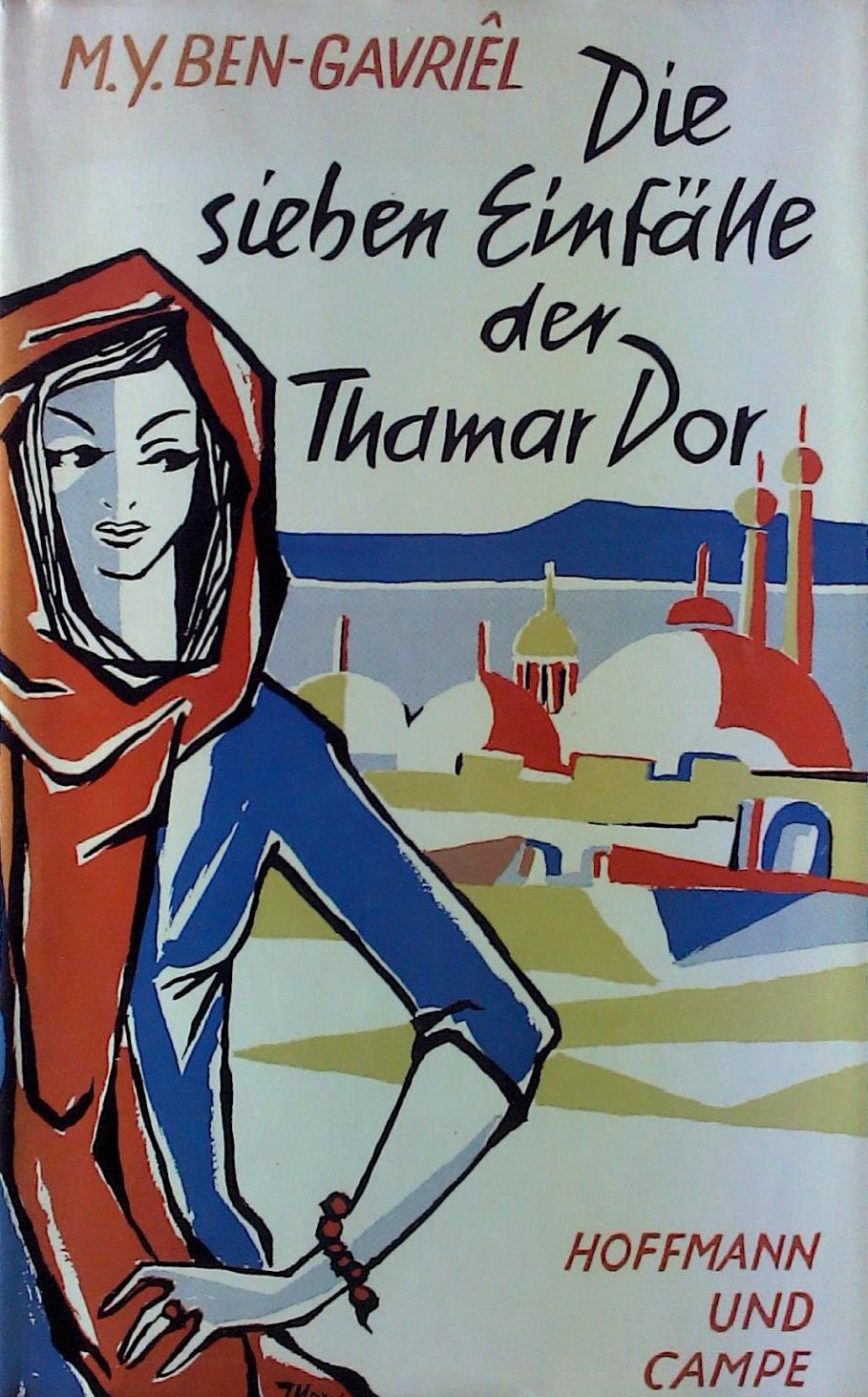
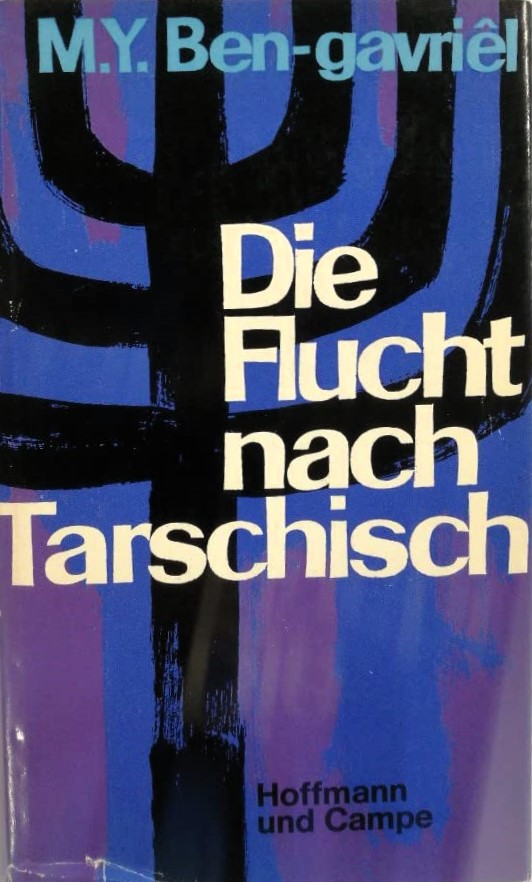
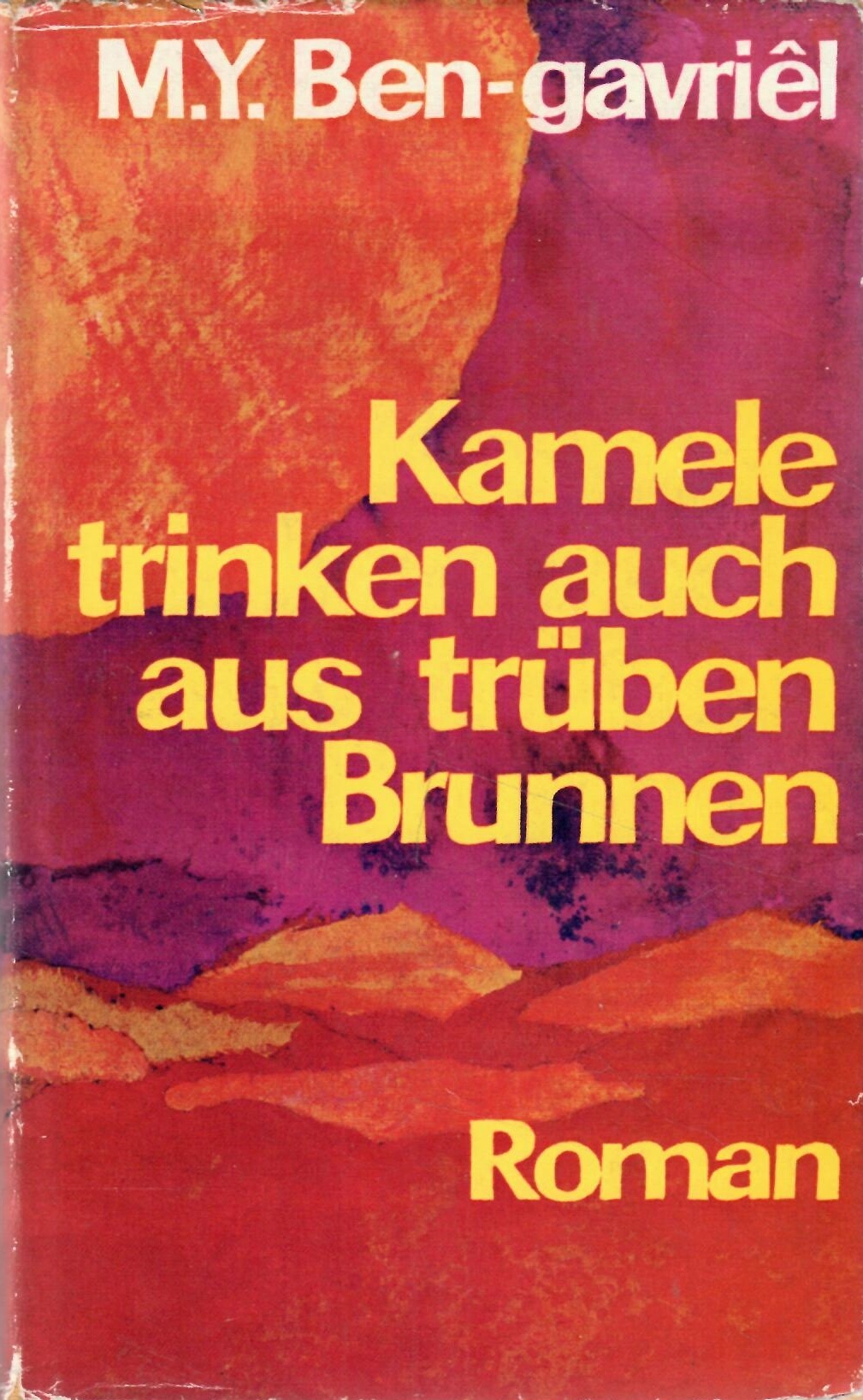
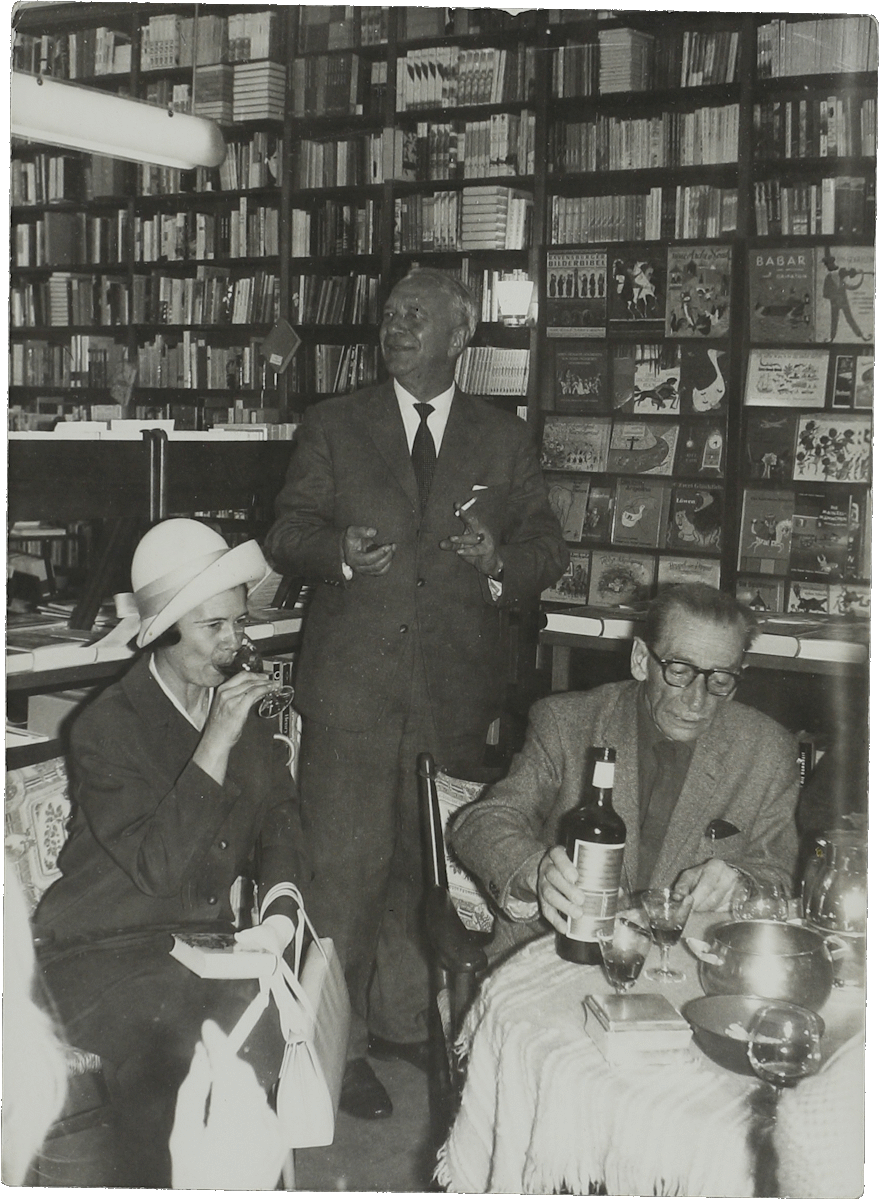
In the 1950s, M. Y. Ben-Gavriêl achieved his long-awaited breakthrough with German readers with his humorous stories from the Middle East. Works such as Krieg und Frieden des Bürgers Mahaschavi [“Mahaschavi in Peace and War”] (1952), Das anstößige Leben des großen Osman [“The Offensive Life of the Great Osman”] (1955), Kumsits. Geschichten aus der Wüste [“Kusmits. Stories from the Desert”] (1956), and Das Haus in der Karpfengasse [“The House on Karpfengasse”] (1958) were in high demand at the Hamburg public libraries, as Erich Lüth reported to him in a short letter in 1959. In the 1960s, four of his books were finally published by Hoffmann und Campe in Hamburg. When Die sieben Einfälle der Thamar Dor [“The Seven Ideas of Thamar Dor”] (1962) was about to be published, Ben-Gavriêl sent a “delicious document” that he had come across while organizing his archive for the National Library to the publishing director Albrecht Bürkle, whom it “might well interest for historical reasons”: it was the rejection letter from 1933. By way of reminding the publisher of its earlier conduct, Ben-Gavriêl also asked for return of the letter, which today is in his estate in Jerusalem, illustrating the eventful relationship. With his last book, Kamele trinken auch aus trüben Brunnen [“Camels Also Drink from Murky Wells”] (1965), the circle was finally closed. It was a revised version of the novel Orientabteilung 3, which had been printed in Israelitisches Familienblatt Hamburg in 1930. Shortly before his death in September 1965, Ben-Gavriêl had come to Hamburg for a reading, as shown in the photograph with a handwritten dedication by the owner of the Thalia bookstore, Erich Könnecke, from May of the same year.
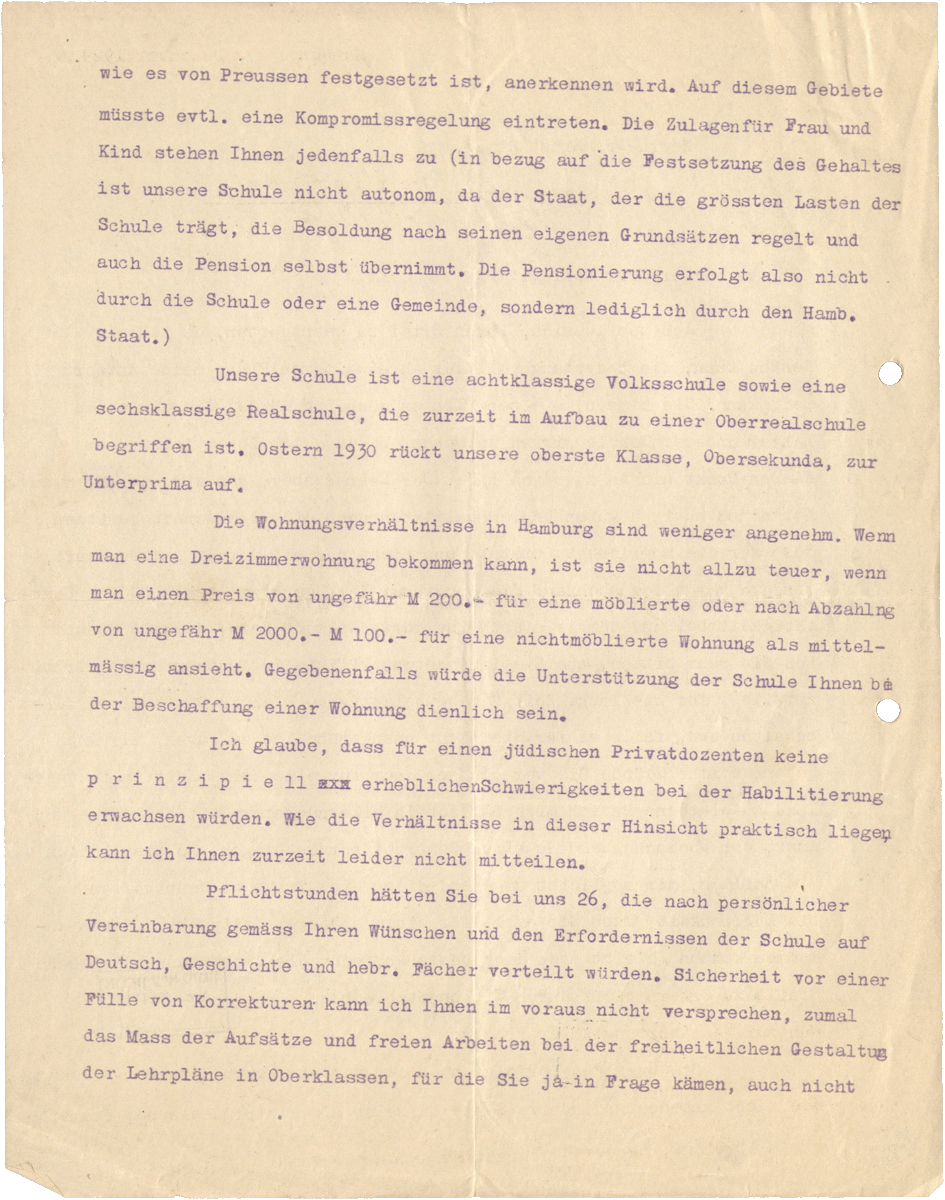
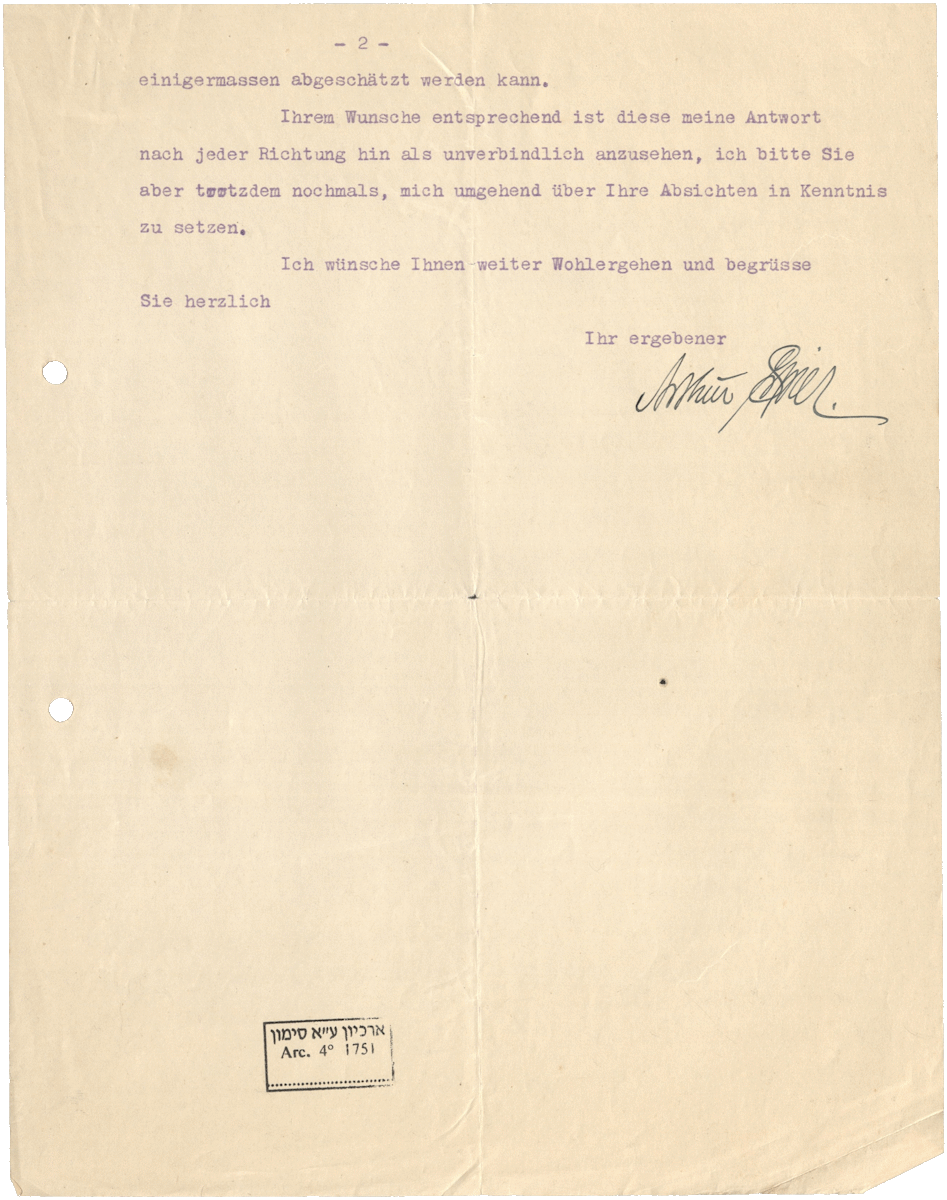
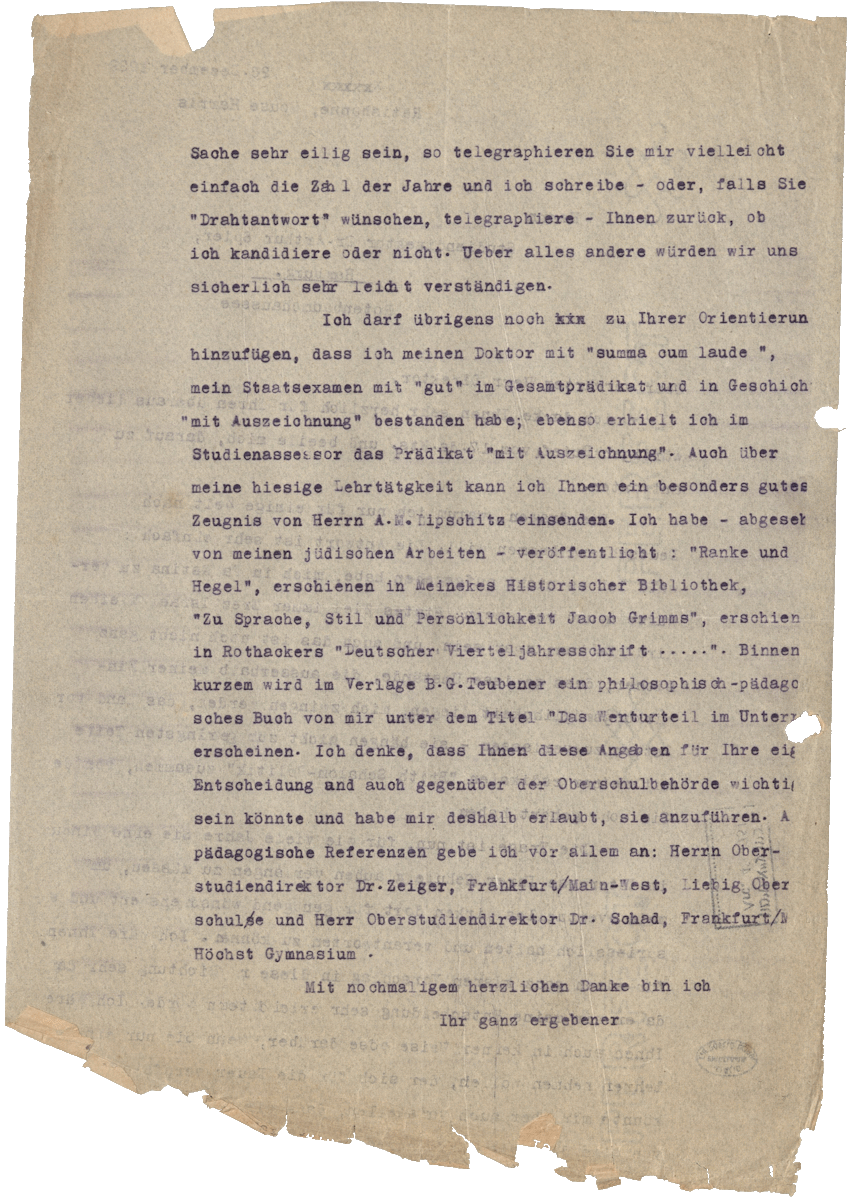
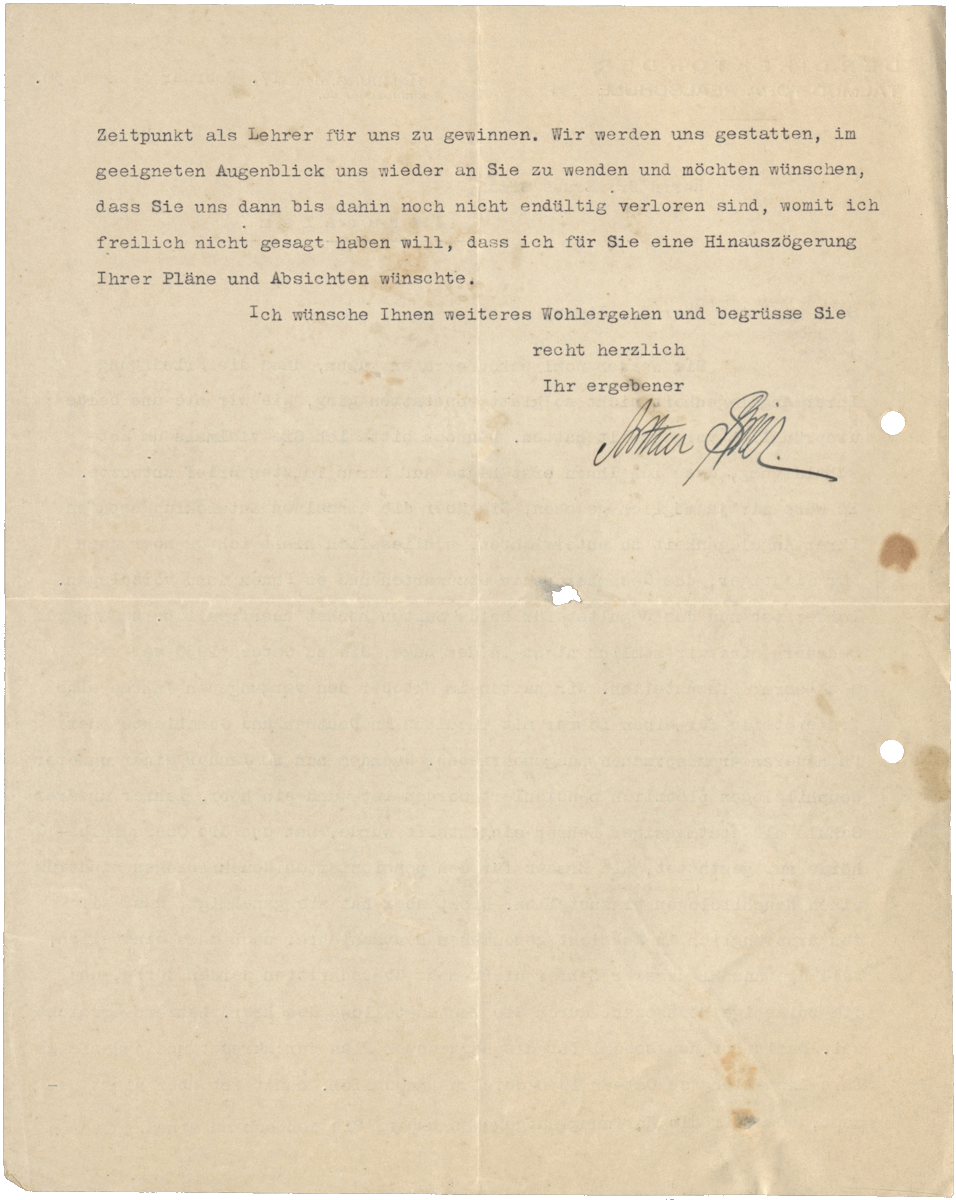
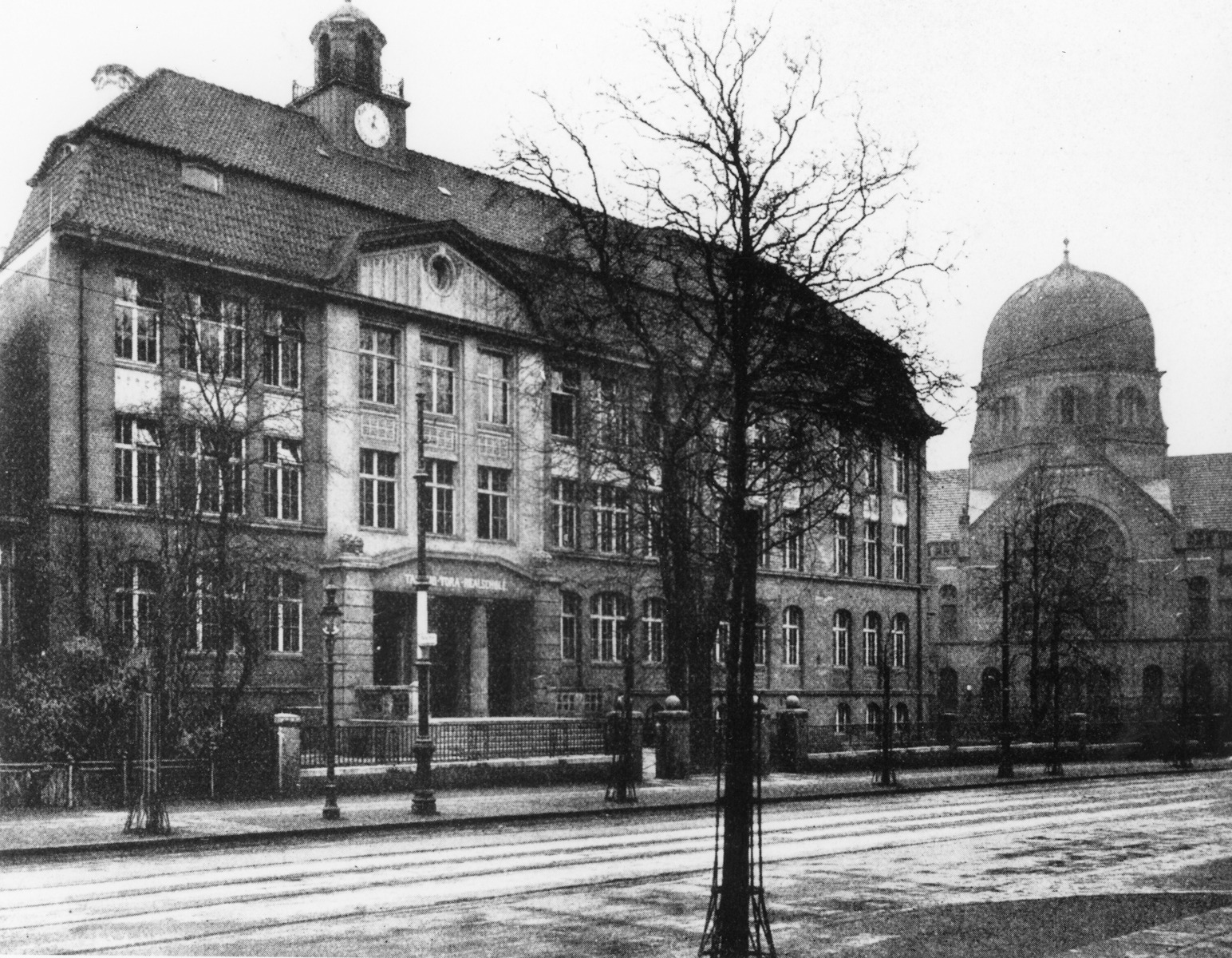
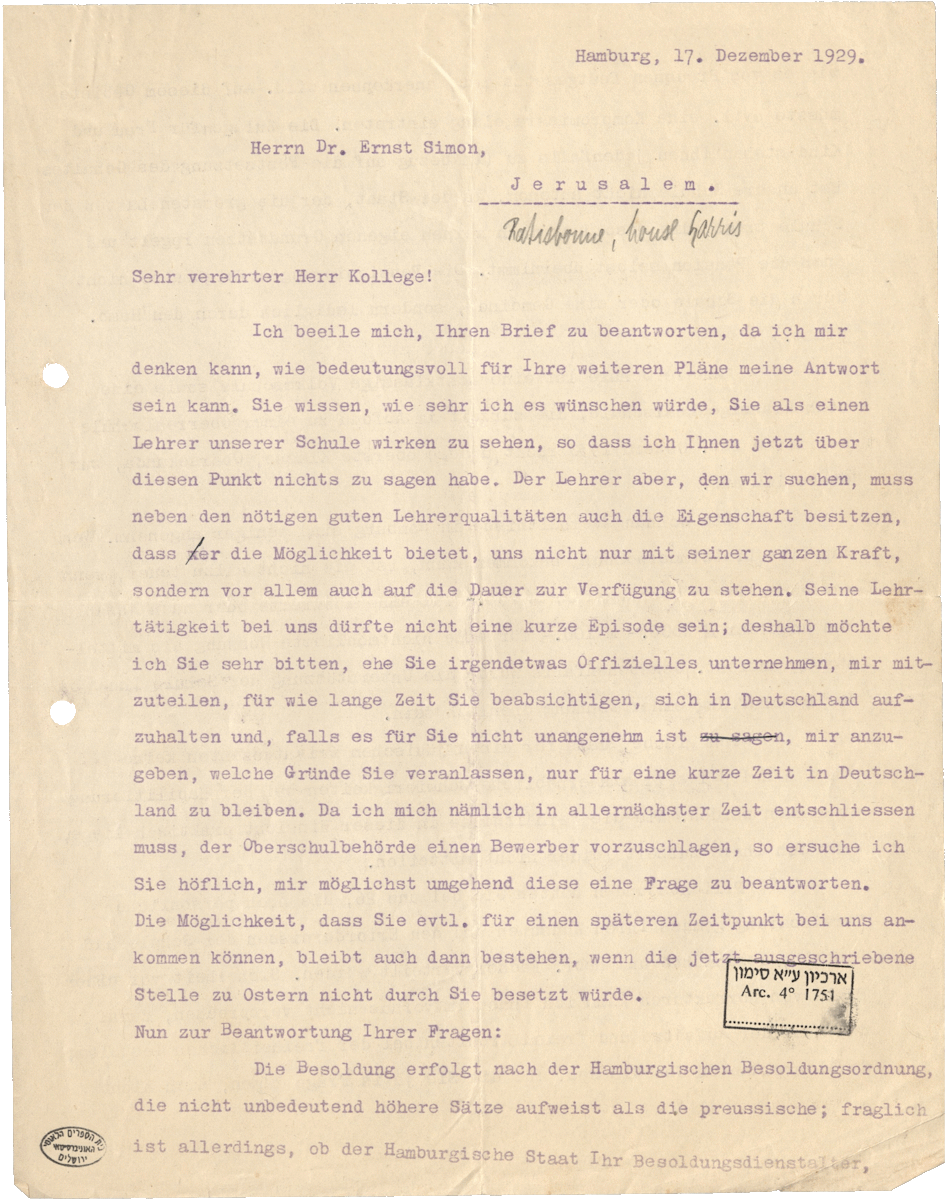
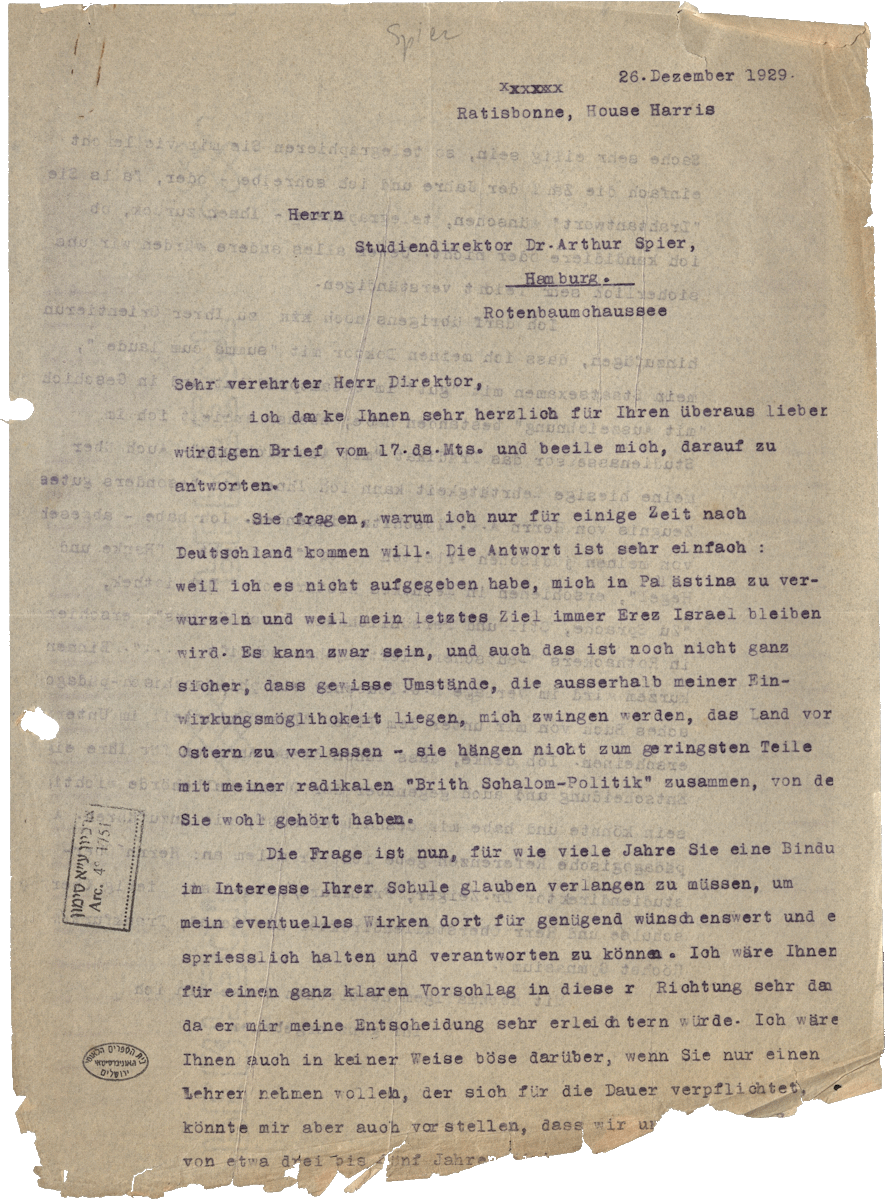
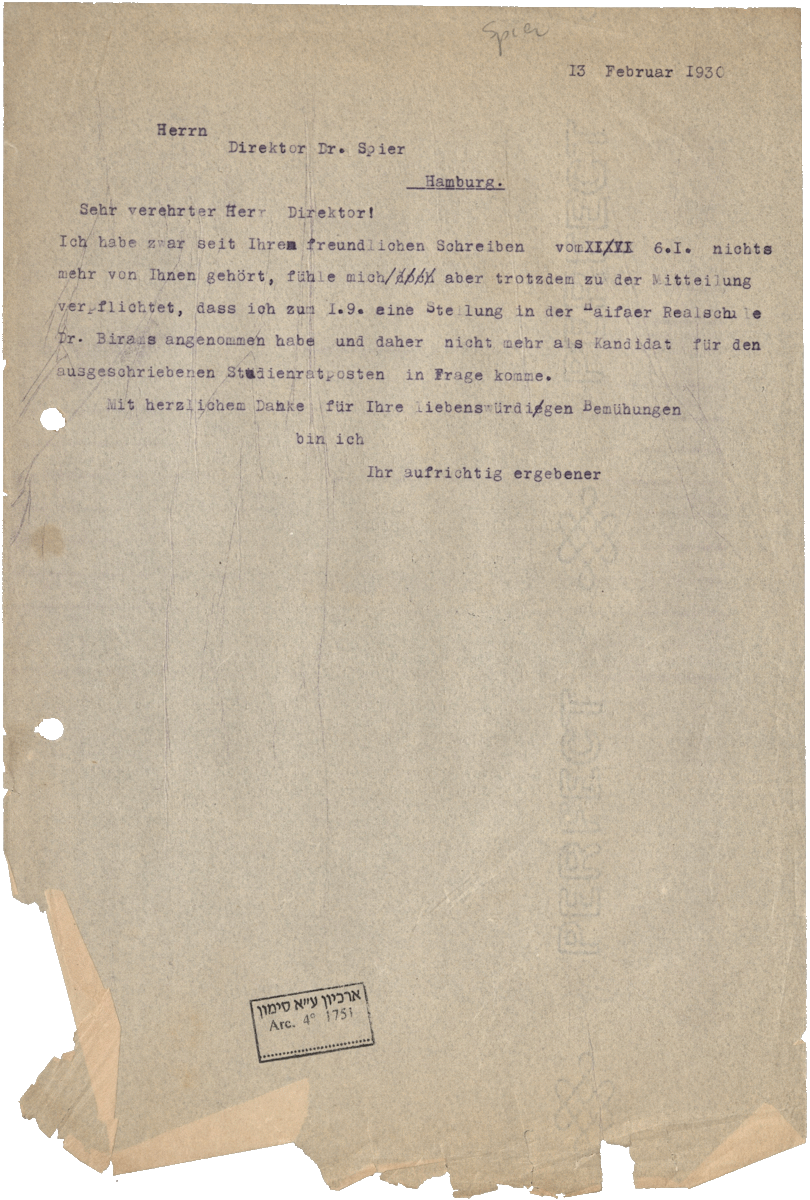
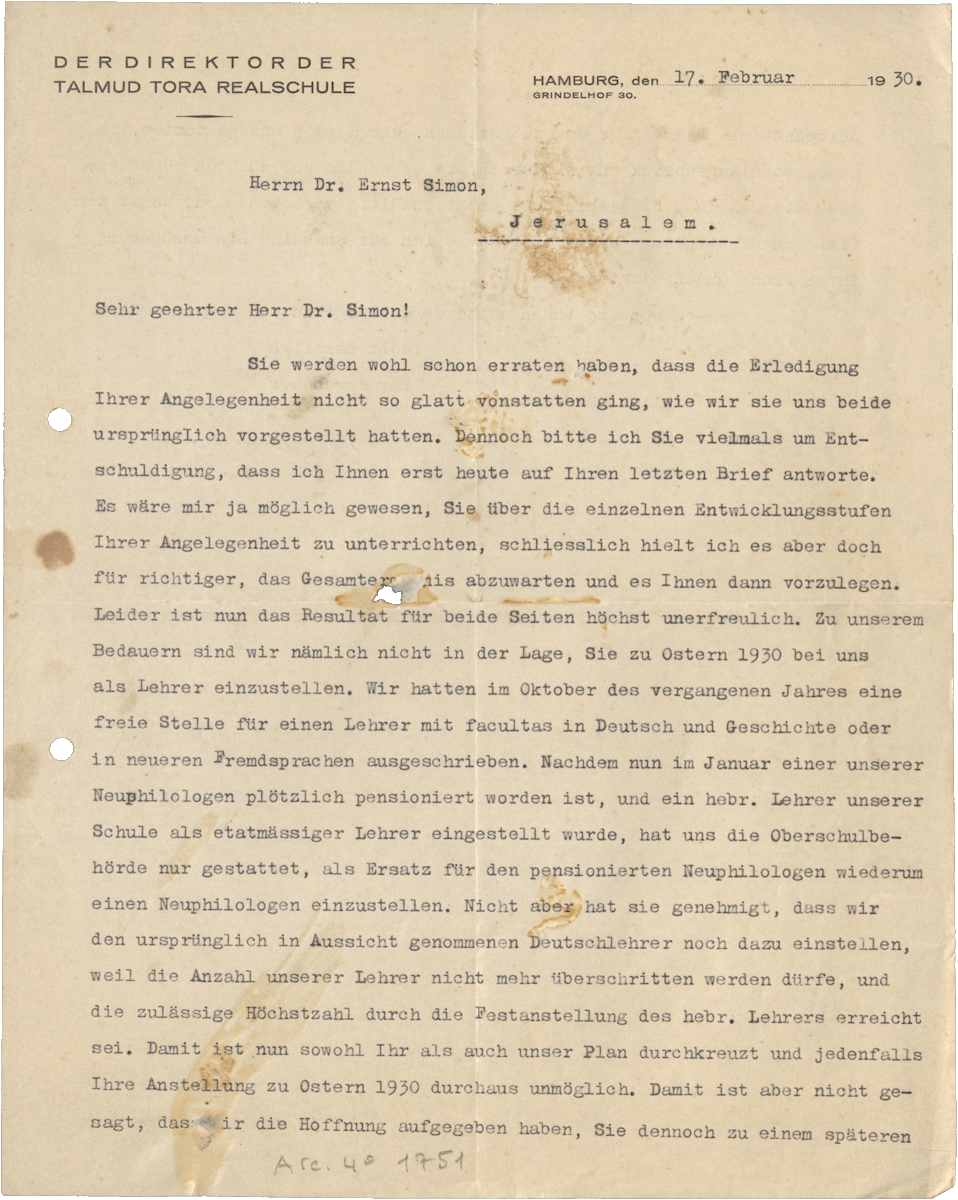
The correspondence between Arthur Spier, director of the Talmud Torah School in Hamburg, and Ernst Simon, educator and philosopher of religion, documents the negotiations regarding Simon’s possible appointment as a teacher in Hamburg. The Talmud Torah School, which had just been expanded into a secondary school, was very interested in recruiting Simon, but the first hurdle arose – as Spier’s letter of October 17, 1929 makes clear – in the question of where he would reside. From the school board’s point of view, permanent residence in Hamburg was necessary. Simon, who had decided to emigrate to Palestine in 1928, rejected this, as the quote from his letter of December 26, 1929, clearly shows: “[...] because I have not given up on putting down roots in Palestine and because my ultimate goal will remain Erez Israel throughout.” The fact that he nevertheless applied for a position in Hamburg underscores the difficulties of gaining a foothold professionally in Palestine. Simon also cites his political stance in favor of Jewish-Arab reconciliation as an obstacle in his letter. In February 1930, however, he found a position at a secondary school in Haifa and subsequently withdrew his application in Hamburg. Circumstances had also changed in Hamburg, so that Spier, referring to the needs determined by the school authorities, also sent Simon a rejection letter – apparently without knowing about the other’s letter.
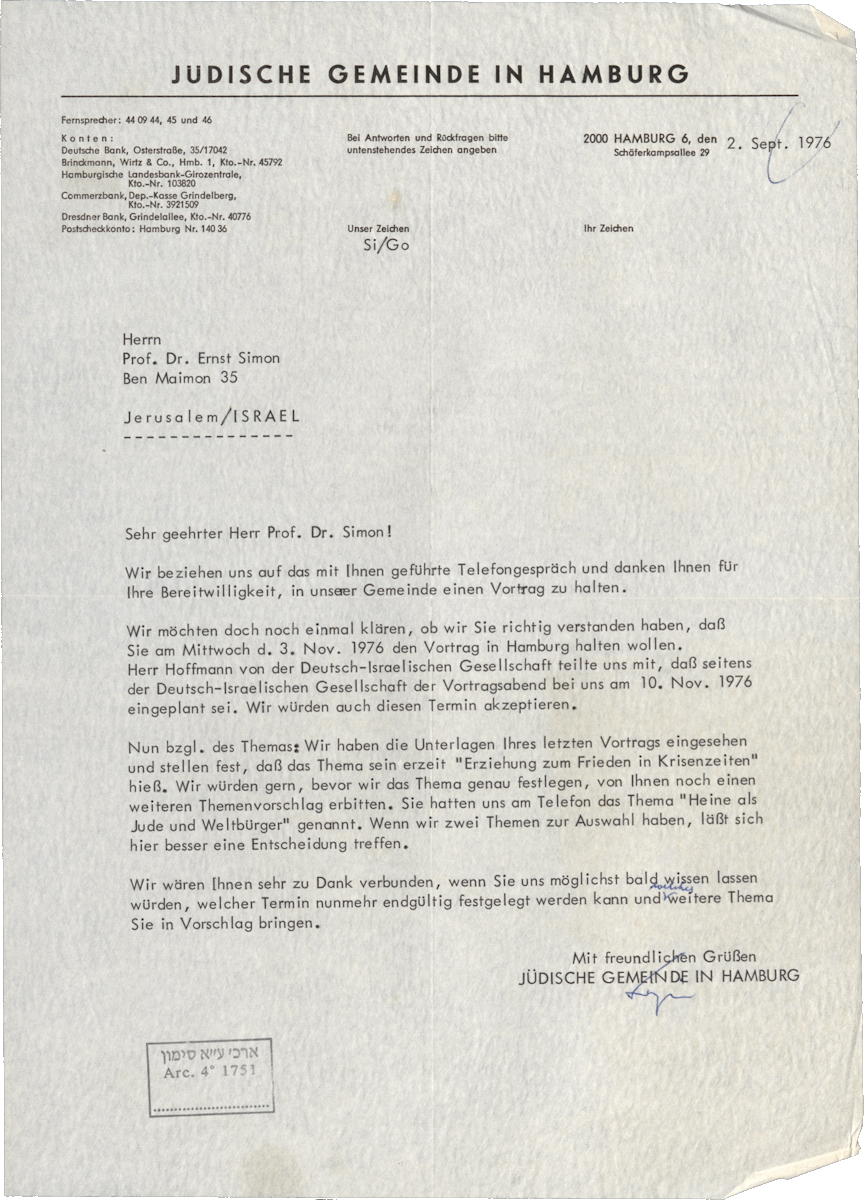
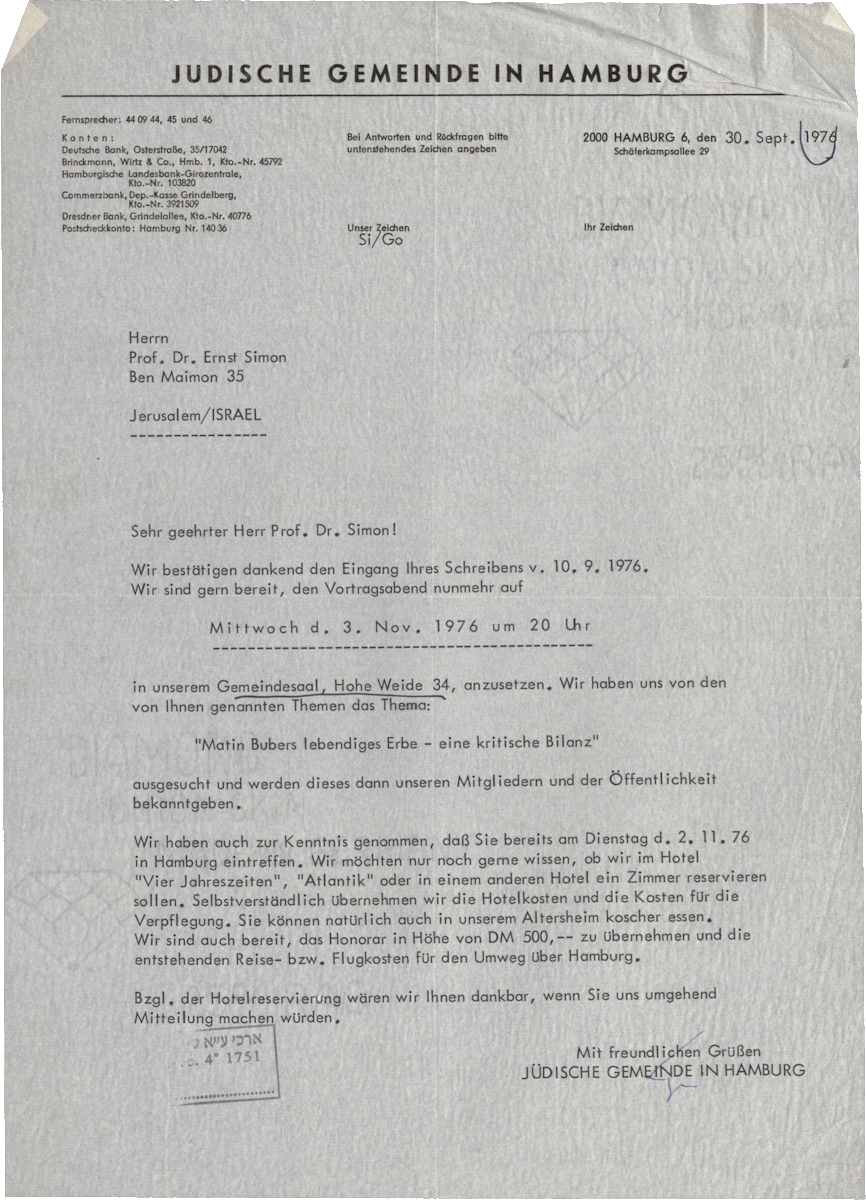
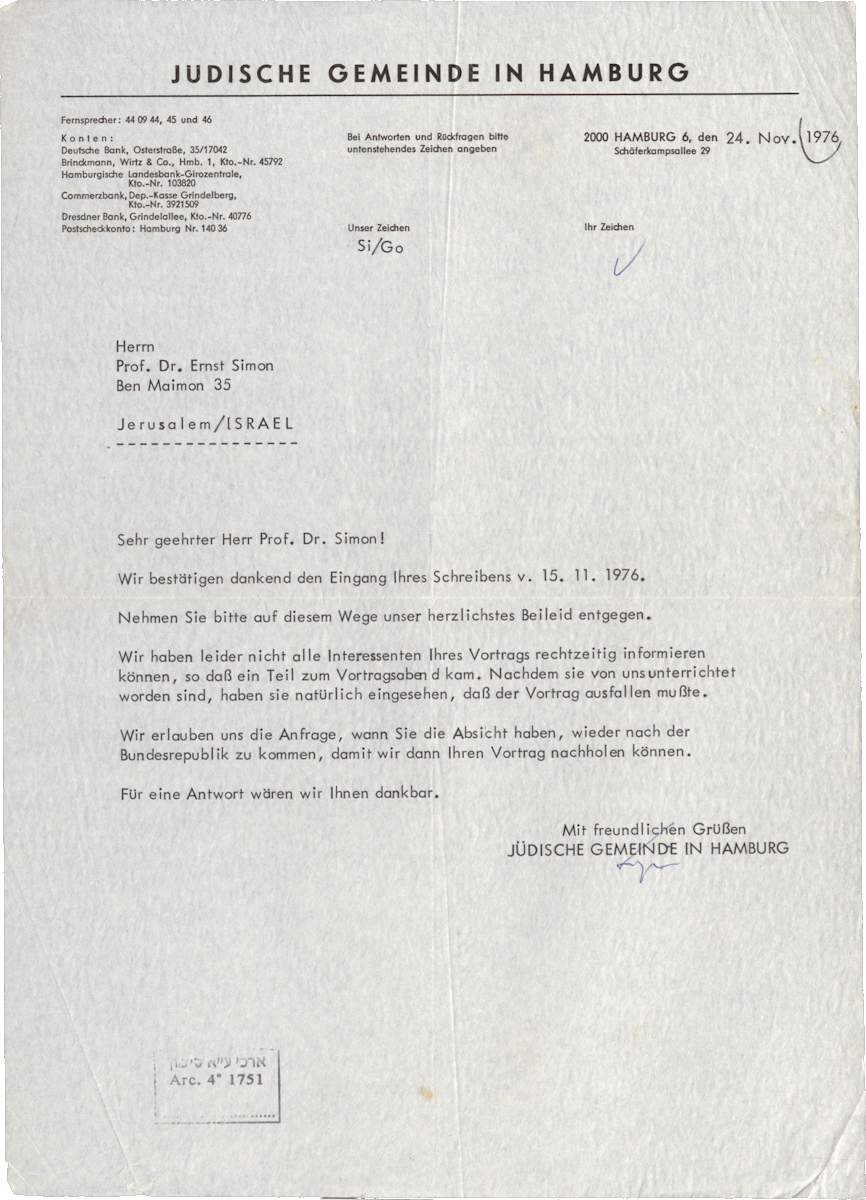
After Ernst Simon visited the Hamburg Jewish Congregation in the early 1970s to give a lecture on “Education for Peace in Times of Crisis,” a few years later, telephone conversations and letters discussed a suitable topic for another lecture evening. Together with the German-Israeli Society, the Congregation finally announced the lecture “Martin Buber’s Living Legacy – A Critical Assessment” for November 3, 1976. Accommodation in an upscale Hamburg hotel and the possibility of kosher meals in the Jewish retirement home had also been discussed already. A bereavement in Simon’s family prevented his trip to Hamburg at the last minute. In his letter of condolence, Congregation chairman Günter Singer immediately asked for a new date, thus signaling once again the great interest of the congregation, numbering about 1,500 members in the 1970s, in active cultural work that would have an impact both internally, for its own self-assurance, and externally, on the surrounding society, and would increase its visibility.
The correspondence included in the exhibition took place between a total of 30 individuals. Some correspondents appear more frequently than others because they were contacted by different parties (such as Gershom Scholem, Erich Lüth, or Martin Buber), because they contacted a series of individuals as writers (Max Grunwald), or because they corresponded several times on a specific matter (Ernst Simon). Most of the people corresponding here were men; only five women, namely Dora Hirsch, Paula Buber, Rahel Estermann, Eva Strauss and Else Escha Bergmann (Scholem) in one quote, appear as writers. With one exception, their letters and cards have been preserved in the literary estates of their husbands or correspondents.
A similar imbalance can be found when one broadens the view from the individuals who are in direct contact with one another to those who are written about or mentioned in the letters or publications shown in this exhibition. The approximately 150 names indicate extensive (male) networks within a group of German-Jewish intellectuals that had their local hub in Jerusalem with Martin Buber, Gershom Scholem, and Hugo Bergmann and that participated in their own historicization by helping to determine what was archived and how it was being recorded.
Recurring motifs and thematic clusters often only become visible at the end of the curatorial process, revealing overarching and connecting perspectives that were not explicitly included in the original question, which in turn raises new questions. It is striking, for example, that a surprising number of the correspondences shown in the exhibition contain New Year’s greetings – without this having been a search criterion. However, it is possible that the social convention of New Year’s greetings is particularly suitable for addressing other concerns ‘on the side’ or simply for actively maintaining networks and reminding people of oneself at the beginning of the new year. In addition, at least three major themes can be identified in the sources: 1. scientific or professional concerns, 2. personal letters and documents, and 3. aspects of appreciation and public remembrance. In the latter case, Martin Buber and Heinrich Heine in particular play a special role as recurring points of reference.
The various areas often overlap, and professional and private networks merge into one another. While the aspect of commemoration becomes particularly relevant after 1945, scientific, professional, and private networks play a role before 1933 and after 1945. While the sources from before 1933 tend to indicate comprehensive networks, the sources from after 1945 sometimes reflect attempts to reestablish contact(s) through writing. Which contacts could no longer be reestablished can only be guessed at from the absence of names and sources in the preserved materials. The sources presented here and the continuity they document are therefore not a representative panorama, but rather the outline of what has been irretrievably destroyed and lost.
Conception and texts: Dr. Sebastian Schirrmeister (University of Hamburg) and Dr. Anna Menny (IGdJ). Technical implementation: Helena Geibel (IGdJ). Transcripts: Hauke Heymann (IGdJ). Translation: Erwin Fink (exception: last paragraph of the poem “Deutschland, ein Kindermärchen“ [“Germany, a Children’s Tale"] by Mascha Káleko and the letter written by Max Grunwald to Martin Buber).
A cooperation between the IGdJ and the University of Hamburg in the context of the project Visualising Digitised German-Jewish Archives. Funded by the Deutsche Forschungsgemeinschaft (DFG, German Research Foundation) under Germany's Excellence Strategy – EXC 2176 „Understanding Written Artefacts: Material, Interaction and Transmission in Manuscript Cultures“, project no. 390893796.
We have made every effort to locate all rights holders. If we have overlooked anything, we would appreciate a message: schluesseldokumente@igdj-hh.de. Any use of the material shown in the exhibition that goes beyond private purposes requires the consent of the respective copyright holders.
Status as of January 8, 2026.






![M. Y. Ben-Gavriêl, “Vergebliche Korrespondenz mit Prominenten” [“Futile Correspondence with Prominent Figures”], in: [Place of publication unknown], November 20, 1961, p. 79, NLI, Moshe Ya’aqov Ben Gavriel Archive, ARC. Ms. Var. 365 3 32.](/viewer/exhibition/hamburg-jerusalem/2-2_3430609-10_0021.png)
![Ernst Simon, Heines Stellung zum Judentum. Spätzeit [“Heine‘s Position on Judaism. Late Period”] (typescript), page 1, NLI, Akibah Ernst Simon Archive, ARC. 4* 1751 15 3360a.](/viewer/exhibition/hamburg-jerusalem/2-3_3635899-10_0033.png)
![W. Bacher, “Ein hebräisches Lied zu Simchath-Thora,“ [A Hebrew Song for Simchath Thorah“] in: Mitteilungen der Gesellschaft für jüdische Volkskunde [“Bulletin of the Society for Jewish Folklore”], 1 (1901), VII, pp. 68-75, p. 68, Johann Christian Senckenberg University Library, Frankfurt am Main, online at: https://sammlungen.ub.uni-frankfurt.de/.](/viewer/exhibition/hamburg-jerusalem/3-1_hebrLied.jpg)
![Book cover by Josef Popper-Lynkeus, Das Individuum und die Bewertung menschlicher Existenzen [“The Individual and the Evaluation of Human Existence”], Dresden 1910.](/viewer/exhibition/hamburg-jerusalem/3-3_individuum_cover.png)
![Holzsynagogen in Polen [“Wooden Synagogues in Poland”], ed. by Alois Breyer, Max Eisler, Max Grunwald, in: Menorah 10 (1932), 5-6, pp. 221–236, p. 221, Johann Christian Senckenberg University Library, Frankfurt am Main, online at: <a href='https://sammlungen.ub.uni-frankfurt.de/cm/download/pdf/2928178'>https://sammlungen.ub.uni-frankfurt.de/</a>.](/viewer/exhibition/hamburg-jerusalem/3-4_Holzsynagogen_neu.jpg)
![Excerpt from Max Grunwald’s autobiography Achtzig Jahre meines Lebens [“Eighty Years of My Life”], Central Archives for the History of the Jewish People, P97-3 Grunwald, Max - Private Collection.](/viewer/exhibition/hamburg-jerusalem/3-6_transcript1.jpg)
.png)
.png)
![Mascha Kaléko, “Die Preisgabe” [The Betrayal] (handwritten draft), New York 1952, DLA, A: Kaléko, Mascha.](/viewer/exhibition/hamburg-jerusalem/4-2-3_transkript.jpg)
![Certificate for the award of the Hansischer Goethe-Preis [Hanseatic Goethe Prize] to Prof. Dr. Martin Buber, issued by the University of Hamburg, Hamburg, June 24, 1953, NLI, Martin Buber Archive, ARC MS. Var. 350 01 26.](/viewer/exhibition/hamburg-jerusalem/4-3_2660574-10_0003.png)
![Exhibition poster “Martin Buber 1878–1978. Werk und Wirkung“ [“Martin Buber 1878–1978. Work and Impact“], Hamburg State and University Library / Institute for the History of German Jews, March 1–April 15, 1978, Carl von Ossietzky State and University Library, Library Archive, Exhibitions, Folder 1978/03.](/viewer/exhibition/hamburg-jerusalem/4-6_ausstellung.png)
![Certificate for the award of the Buber-Rosenzweig Medal 2025, issued by the German Coordinating Council of Societies for Christian-Jewish Cooperation [Deutscher Koordinierungsrat der Gesellschaften für christlich-jüdische Zusammenarbeit], © German Coordinating Council.](/viewer/exhibition/hamburg-jerusalem/4-5-3_Urkunde.jpg)
![First installment of the serialized novel Hefker oder Das Kaleidoskop (Bericht über eine jüdische Generation) [“The Kaleidoscope (Report on a Jewish Generation)”] by M. Y. Ben-Gavriêl in the supplement to Israelitisches Familienblatt Hamburg, August 2, 1928, NLI, Moshe Ya’aqov Ben Gavriel Archive, ARC. Ms. Var. 365 2 110.](/viewer/exhibition/hamburg-jerusalem/5-1-2_3423805-10_0002_small.png)
![Book covers M. Y. Ben-Gavriêl, Der Mann im Stadttor [“The Man at the City Gate”] (1960), Die sieben Einfälle der Thamar Dor [“The Seven Ideas of Thamar Dor”] (1962), Die Flucht nach Tarschisch [“The Flight to Tarshish”] (1963), Kamele trinken auch aus trüben Brunnen [“Camels Also Drink from Murky Wells”] (1965). Courtesy of Hoffmann und Campe Verlag. With kind permission.](/viewer/exhibition/hamburg-jerusalem/5-2-5_cover-der-mann-im-stadttor.jpg)
_small.jpg)
.png)
.png)
.png)
.png)
.png)
.png)
.png)
.png)